

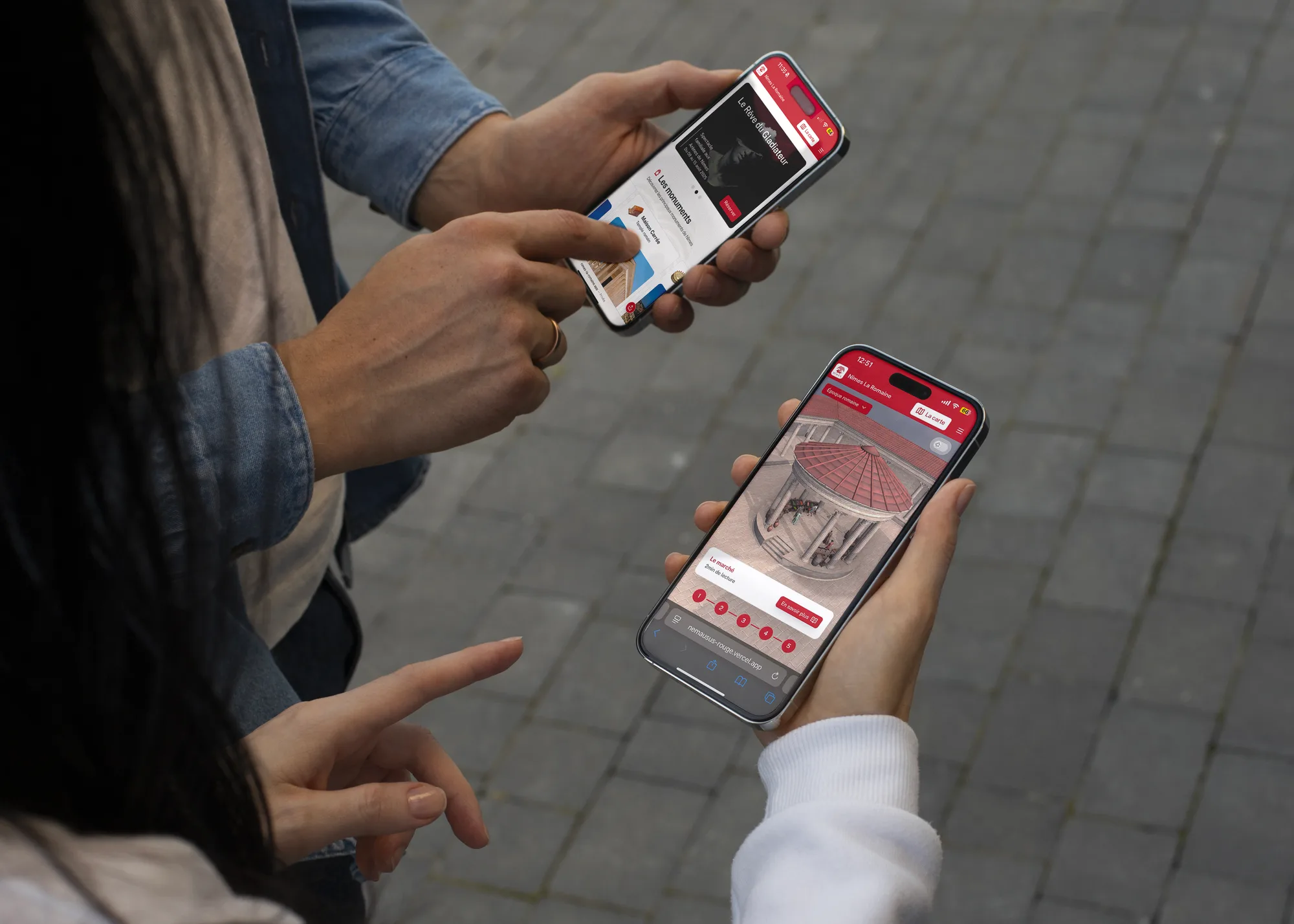
How do you design a 3D augmented visitor journey that runs in a mobile browser?
A 3D augmented visitor journey is an interpretation installation that overlays a real site with a three-dimensional digital reconstruction, explorable from a smartphone — here, without installing a single app. For Nemausus — Nîmes la Romaine, METASENSE designed a WebGL Web App (PWA) reachable from a simple QR code, bringing the ancient city back to life: the Arena, the Maison Carrée (a UNESCO World Heritage site), the Forum and the Tour Magne modelled in 3D, audio narration in 3 languages, a treasure hunt and an augmented reality encyclopaedia.
This case study tells the story of how we built it: the constraints, the technical trade-offs and the production choices that fitted 2,000 years of heritage into a browser tab, in 6 months, with a "commando" team of 6 experts.
Worth remembering. A successful 3D augmented visitor journey is not won on the beauty of a 3D model, but on four trade-offs: hardware accessibility (running on entry-level phones), navigation (guiding without confining), historical accuracy (every detail validated by experts) and client autonomy (CMS and data handed over). That is exactly the grid we applied in Nîmes.
This case study complements the Nîmes la Romaine project page (overview) and the article on 3D cultural mediation, AI and immersive experiences. For the technical foundations, see also 3D immersive web and WebGL in 2026.
Why a Web App rather than an app to download?
Because the first barrier to an augmented visit is the download itself. Asking a tourist standing in front of the Arena to open a store, create an account and wait for 150 MB means losing most visitors before the first 3D scene ever loads.
So we chose a Progressive Web App (PWA): zero installation, instant access through a QR code displayed on site. The visitor scans, the journey loads in the browser, the experience starts. That choice serves both audiences targeted by AURA (formerly EDEIS) and the City of Nîmes: tourists passing through, who will not download an app for a 30-minute visit, and school groups, whose classes do not always have individual devices or store accounts.
The trade-off we accepted: a Web App carries performance constraints a native app does not (no assets pre-loaded at rest, a tighter browser memory budget). That is precisely where most of our engineering work went — detailed below.
- No download → immediate conversion on site.
- Cross-platform by nature (iOS, Android, any recent browser).
- Instant updates: no store review, content evolves continuously.
- Simple physical distribution: a QR code on a label, a poster, a ticket.
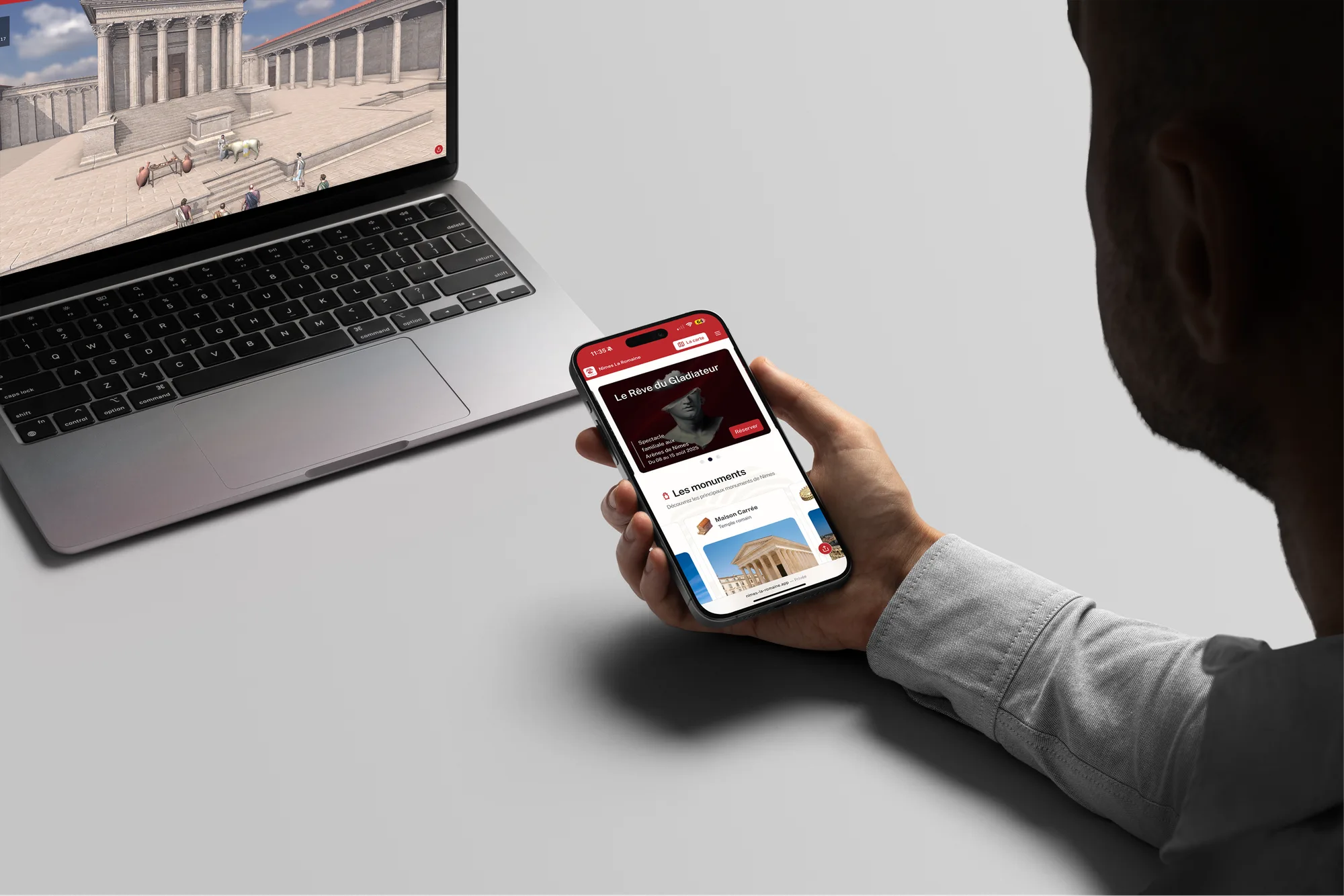
How do you run WebGL 3D on an entry-level smartphone?
By making the experience adaptive: the device dictates the level of rendering, not the other way round. On launch, the Web App detects the smartphone's capabilities and adjusts the 3D rendering automatically — texture quality, geometric density, effects — to preserve smoothness and avoid unnecessary loading.
The guiding principle: the experience adapts to the device, not the reverse. A 3D augmented visitor journey built for the general public cannot assume a recent flagship. It must deliver a worthy experience on a four-year-old phone as well as on a high-end model.
In practice, scene optimisation mattered as much as the modelling itself:
- Capability detection on load → selection of a suitable rendering profile.
- Geometric optimisation of the monuments (Forum, Arena, Tour Magne, Maison Carrée) to fit a mobile budget.
- Fine-grained asset management: we load only what the scene needs, when it needs it.
- Stack: Three.js + Nuxt, WebGL rendering, packaged as a PWA.
The result of that discipline: the Web App was built to absorb thousands of simultaneous connections — a real concern for a tourist site in high season.
Worth remembering. The performance of a mobile 3D experience is not won on the studio workstation, but on the most modest phone in the target audience. Adaptive rendering is not an option: it is the condition of access.
How do you guide visitors without taking away their freedom to explore?
With a cinematic camera driven by splines, which carries the narrative but hands control back for exploration. We built our own spline editor (trajectory curves) to orchestrate smooth camera moves between the points of interest along the journey.
This is the heart of the interpretation trade-off: a 3D augmented visitor journey has to tell a story — guiding the eye, sequencing the discovery — without turning the visitor into a passive spectator. Our spline editor resolves that tension on three fronts:
- A guided narrative route: the camera follows a trajectory designed like a film shot, from one monument to the next.
- Automation of complex 3D moves: transitions between points of interest are smooth, with no laborious handling by the user.
- Control handed back to the user: at every stop, they take over — observing, zooming, orbiting, exploring at their own pace.
Building that tool in-house rather than hand-crafting trajectories gave us two advantages: cinematic quality (smoothed moves, controlled pacing) and speed (re-sequencing a route becomes a setting, not a redevelopment).
How do you guarantee the historical accuracy of a 3D reconstruction?
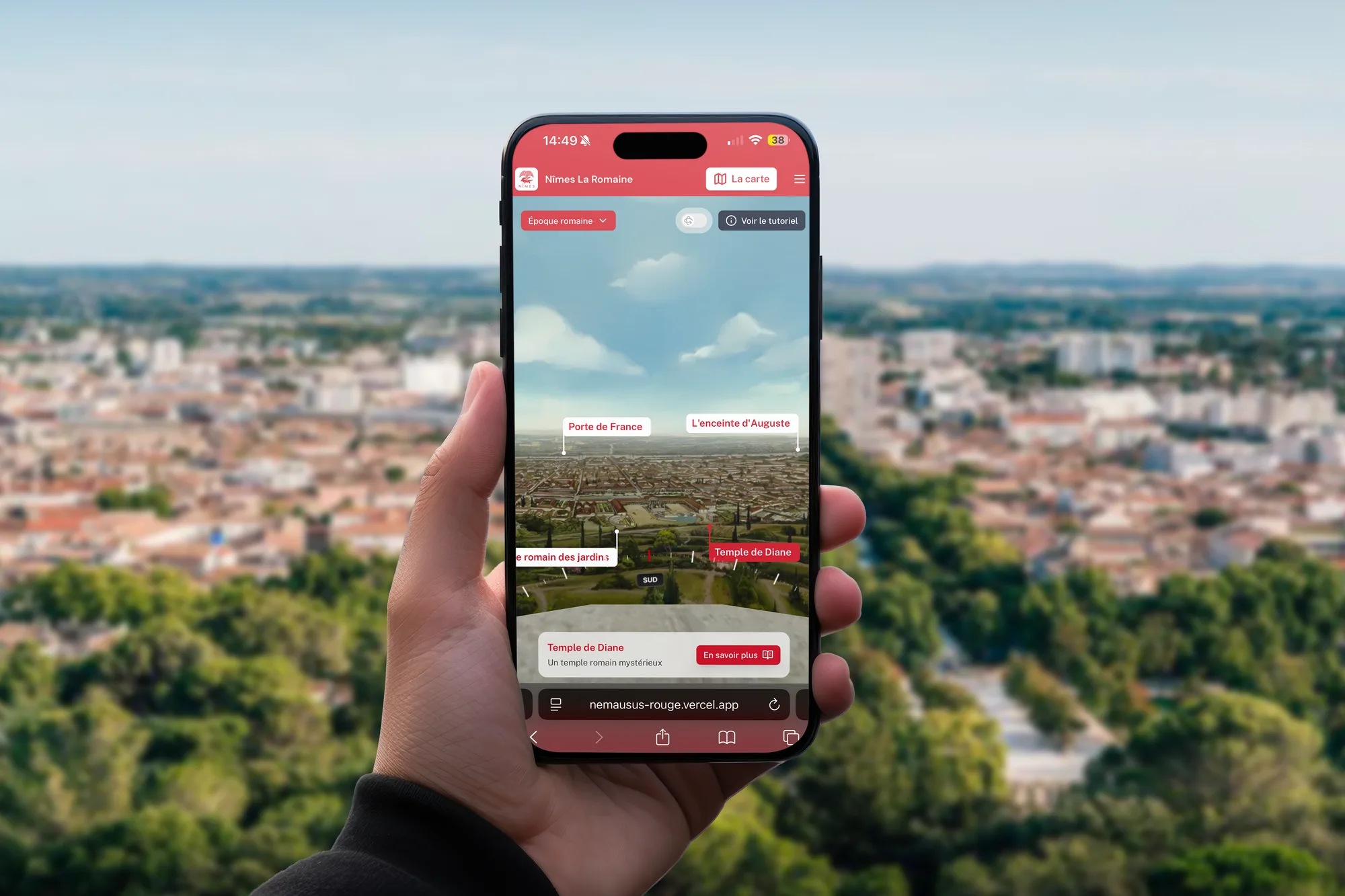
By making expert validation a production stage, not a final review. A 3D reconstruction of heritage only has interpretive value if it is accurate. We therefore worked in close collaboration with the Musée de la Romanité, AURA and the Tourist Office, who validated the architectural choices, the volumes and the details of Roman Nîmes.
That requirement shaped two parts of the journey:
- The HDRI panorama from the Tour Magne: a 360° reconstruction of the ancient city, designed as a dialogue between past and present — visitors compare the city of yesterday with the city of today from the same vantage point.
- The narration, where every audio entry had to match the validated scholarly account.
That last point drove a decisive production choice: AI-driven narration.
Why AI-generated narration for 100+ multilingual audio entries?
For the consistency of a single voice across the whole journey, and for the ability to keep up with historical validation. The journey holds more than 100 audio tracks, in 3 languages (French, English, Spanish). Carrying all of them with a single narrator voice generated through ElevenLabs guaranteed a consistent sound identity from end to end — an experience issue that dozens of scattered studio recordings would have weakened.
A deliberate creative choice: a slight French accent in the English and Spanish versions, anchoring the narrator's authenticity in the place.
The decisive advantage showed up in production: when historical validation called for a change of wording, regenerating an entry took a few minutes instead of booking an actor, a studio and an editing session. On a project of 100+ entries in 3 languages delivered in 6 months, that flexibility was a key factor in holding the schedule.
Here, AI is a production choice made for the client: consistent audio quality, native multilingual support and the ability to iterate quickly on evolving scholarly content. The skill is proven by what is delivered, not by the tool.
How do you turn a cultural visit into a game — and connect it to local business?
With a narrative treasure hunt that bridges digital and physical. The journey includes a gamification mechanic: helping Lucius, an apprentice from the year 70 AD, piece a mosaic back together through 5 challenges, each with its own creative direction:
- Latin Sutom (mystery word in Latin),
- matching gladiators to their equipment,
- an architectural memory game,
- spot the difference,
- a quiz on the Roman gods.
The digital → physical bridge is the real strategic move: once the mosaic is complete, the medallion earned becomes a QR discount code for local shops, validated in store through the METASENSE Dashboard. This is a drive-to-store mechanism: the augmented visit does not stay an isolated moment, it feeds local retail and partner shops.

An augmented reality encyclopaedia completes the picture, extending the interpretation beyond the guided 3D.

What do we hand over so the client stays autonomous after launch?
A custom-built CMS and a KPI dashboard: control over content and visibility on impact. A 3D augmented visitor journey is not a frozen deliverable. So we handed AURA:
- a custom-built CMS to evolve the content (copy, entries, settings) without depending on the studio;
- a KPI Dashboard to steer by data — measuring usage, validating QR discount codes in store, tracking impact over time.
Transparency. The app has only just launched. We therefore publish no usage figures (visits, scans, engagement) — there are none yet. This case study covers the method and the technical choices; audience results will be the subject of a later update, backed by real data.
What was the METASENSE approach, from idea to deployment?
End-to-end support, from strategic ideation to content creation — not mere execution. On Nemausus, METASENSE did not deliver an order: we co-built a cultural mediation experience with AURA and the partners in Nîmes.
- Strategic ideation — designing the journey, the immersive concepts and the game mechanic.
- Creative design — art direction, scriptwriting, design of the challenges.
- Development — WebGL Web App, spline editor, adaptive rendering, PWA (Three.js + Nuxt).
- Content creation — 3D modelling, HDRI panorama, 100+ multilingual audio entries.
- Client tooling — custom-built CMS and KPI Dashboard.
This illustrates our dual role: creativity and ideas on one side, in-house technical expertise to design, build and evolve them on the other. All of it delivered in 6 months by a "commando" team of 6 experts: 2 developers, 2 3D artists, 2 designers.
With thanks to Laure Berthelemy for her support on the project, and to the teams at the Musée de la Romanité, the City of Nîmes and the Nîmes Tourist Office.
Planning an immersive or cultural mediation project?
Whether you are a heritage institution, a tourist office or a local authority, a 3D augmented visitor journey is designed before it is developed: target audience, scholarly accuracy, on-site constraints, usage model. METASENSE, a Creative Tech agency based in Vélizy-Villacoublay, supports you from ideation to deployment — and can even embed within your teams.
Let us talk about your immersive project.
FAQ
What is a 3D augmented visitor journey?
It is an interpretation installation that overlays a real site or monument with a 3D digital reconstruction, explorable on a smartphone. Visitors discover the place as it once was, with narration, points of interest and sometimes games, alongside what they see in front of them.
Do you need to download an app for the Nîmes la Romaine journey?
No. Nemausus is a Web App (PWA) reached by QR code: the visitor scans, and the 3D experience loads straight into the browser, with no installation and no account. That choice was made for tourists passing through and for school groups.
How can a 3D experience run on a modest smartphone?
The Web App detects the device's capabilities on launch and automatically adjusts the level of 3D rendering (textures, geometry, effects). The principle: the experience adapts to the device, not the reverse — so it stays smooth from entry-level to recent models.
Which monuments of Nîmes are reconstructed in 3D?
The journey models the major monuments of Roman Nîmes: the Arena, the Maison Carrée (a UNESCO World Heritage site), the Forum and the Tour Magne. A 360° HDRI panorama from the Tour Magne sets the city of yesterday in dialogue with the city of today.
How is the historical accuracy of the reconstruction guaranteed?
Expert validation is built into production. The architectural choices, volumes and details were developed in collaboration with the Musée de la Romanité, AURA and the Nîmes Tourist Office, who validated the fidelity of the reconstruction.
Why was AI used for the audio narration?
For two reasons: a single, consistent narrator voice across 100+ entries in 3 languages (FR/EN/ES), and flexibility. When historical validation called for a change, regenerating an entry took a few minutes — a decisive advantage on a 6-month project.
What technology is used for the 3D rendering?
The journey relies on WebGL for 3D rendering, with Three.js and Nuxt, packaged as a Progressive Web App (PWA). An in-house spline editor orchestrates the cinematic camera moves between points of interest.
How is gamification connected to local business?
The treasure hunt has players piece a mosaic back together across 5 challenges. The medallion earned becomes a QR discount code valid in local shops, validated in store through a METASENSE Dashboard. It is a drive-to-store mechanism that extends the visit into local retail.
What usage results has the project achieved?
The app has only just launched: no usage figures (visits, scans, engagement) are available yet, and we publish none. A KPI Dashboard was delivered to AURA to steer impact; results will be the subject of a later update.
How long does it take to design a journey like this?
Nemausus was designed and delivered in 6 months by a "commando" team of 6 experts (2 developers, 2 3D artists, 2 designers). The timeline depends on the number of monuments, the volume of content, the languages and the depth of the gamification.
Who created the 3D augmented visitor journey for Nîmes?
METASENSE, a Creative Tech agency based in Vélizy-Villacoublay, for AURA (formerly EDEIS), in partnership with the City of Nîmes, the Musée de la Romanité and the Tourist Office. METASENSE handled the ideation, the creative design, the development and the content creation.
Sources
- Ministère de la Culture — La Coupole : un système de visite associant 3D et réalité augmentée
- OpenEdition (Culture & Musées / OCIM) — Les applications mobiles de musées et de sites patrimoniaux en France
- Three.js — 3D JavaScript library (WebGL) — official repository
- METASENSE — Project page: Nîmes la Romaine