From usage audit to business workflows: AI that finally produces
Your teams have access to AI, but usage stays shallow and the cost climbs with nobody steering it. We turn an under-used tool into productivity you can measure and control.
AI reaches organisations faster than the framework to steer it
More and more companies roll out Claude, Copilot or Mistral across their teams. The tool almost always arrives without a framework: nobody steers adoption, measures the value, or controls the cost.
With no adoption framework, everyone improvises alone: no business workflow gets built, and the value stays on the table.
Without measurement, leadership cannot say what AI returns. The licence becomes a cost line that is hard to defend.
With nobody steering, the more use cases spread, the higher token consumption climbs — with no visibility and no guardrails.
The issue is not the tool — it works. It is supporting the transformation it triggers: framing usage, equipping the business, and steering what it costs.
Free white paper
Claude Code at work
Understand agentic AI — Projects, Skills, agents, MCP, scripts — and put it to work concretely inside your organisation.
Download the white paper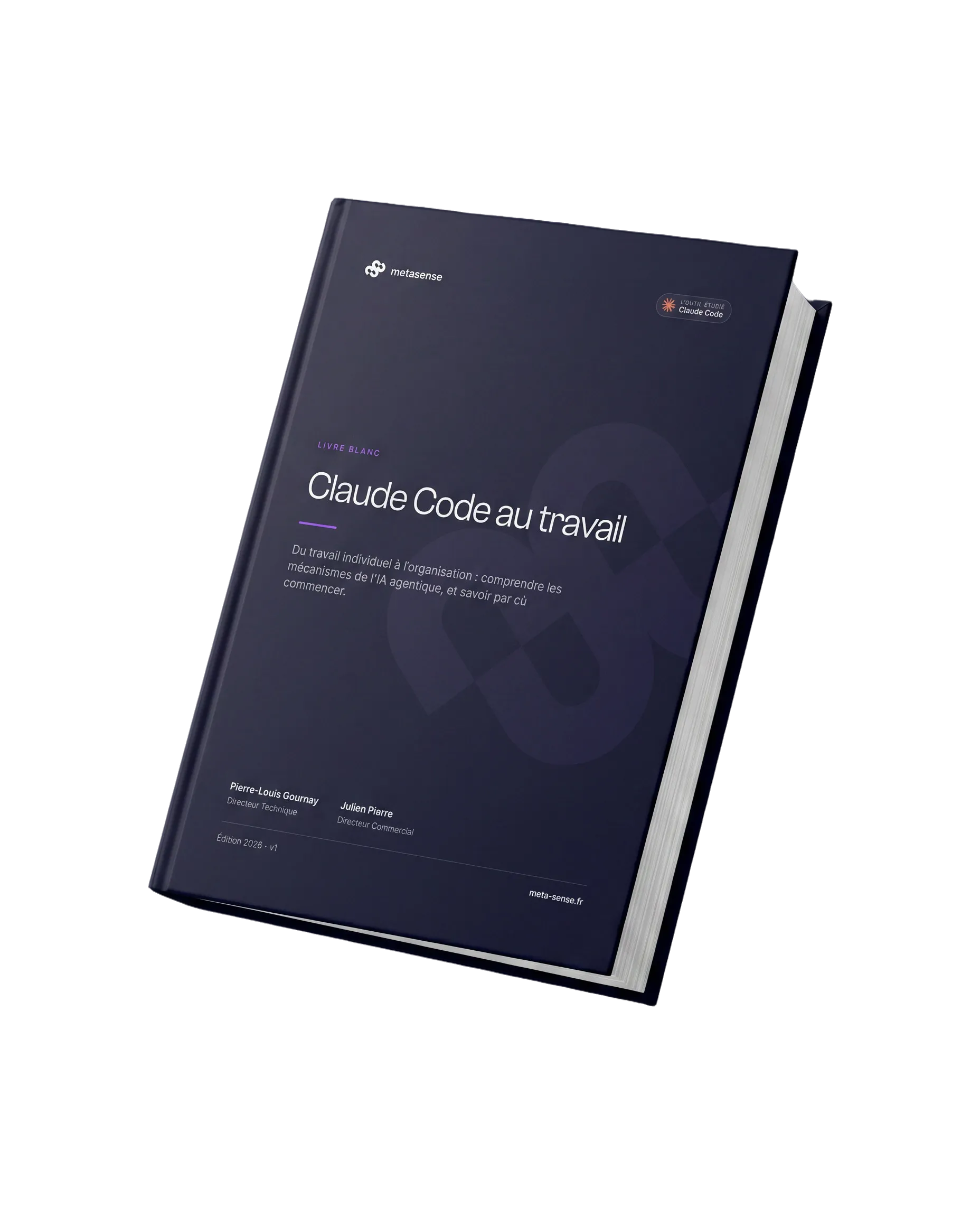
The method we sell, in four steps
Every step is run with your teams: we bring the method and command of the tool, your experts bring the business knowledge.
We map your processes with your teams, prioritise the high-leverage cases and rule out those that would burn tokens without creating anything. Deliverable: a prioritised map, readable by business teams and by leadership.
Not isolated prompts, but tooled sequences wired into your tools and your data — drawing on Projects, Skills, MCP and Cowork. Your teams come out able to maintain them.
Visibility and guardrails on token consumption — detailed below. Cost is controlled first by the way usage is designed, then by steering it.
A workshop creates enthusiasm; follow-up creates habit. We stay alongside — real friction, adjustments, skills transfer — until the practice becomes a working reflex.
Training is not a separate step: it is built into workflow design and into the run. (A real training and skills-transfer activity; we make no certification claim.)
Token cost governance: what do we actually put in place?
Cost control starts with design, not surveillance: we encode recurring know-how into reusable tools and cache what repeats, instead of sending everything back to the model on every request. Only then do we steer.
Recurring tasks are encoded as reusable Skills, instead of being re-explained every single time.
Repeated context (instructions, long documents) is cached instead of being billed again on every request.
The right model for the right task: a light model for simple work, a reasoning model for complex work.
The Claude Enterprise admin console shows who uses what, how much, and for which use cases.
Volumes, cost per team and per workflow, trend — readable without being technical.
Caps and alert thresholds per team, per department and per use case.
A precise method, backed by real technical expertise
Our credibility does not come from a pitch: we design and run AI systems every day — development, agents, automation, asset generation. That is the command we put to work for your teams.
Because we test it running our own AI systems — not because we read about it.
We translate how the models work into business and budget decisions.
The goal is your autonomy: what we deliver can be reproduced by your own teams.

For companies that have AI, but not (yet) the value
You have already rolled out Claude (or another AI assistant) for your teams, but usage is low, the ROI unclear or the cost running away. You do not need to be a technology company.
You pay for Claude Team or Enterprise, but usage has stalled.
You want concrete business cases, not generic prompting.
You watch AI costs rise without being able to steer them.
You want the practice to become a reflex, with no dependency.
Someone who talks to the business, to IT and to finance.
A first conversation to situate the value — and the cost — of AI in your organisation.
Describe your needsBook a slotWhat about the confidentiality of your data?
On Claude's enterprise plans (Team, Enterprise) as on the API, Anthropic states that your content is not used to train the models — with SSO, audit logs and retention controls.
Our role: help you set the rules (data scope, awareness, choice of plan) and, where sovereignty comes first, examine a European alternative such as Mistral. We work with your compliance and security teams, not in their place.
Content not used for training, SSO, audit logs, controlled retention.
Usage rules, data scope, European option (Mistral) where required.
Frequently asked questions
We have Claude licenses, but no one is really using them. What do you suggest?
We close the gap between “access granted” and “teams transformed”: usage audit, co-built business workflows, cost governance and adoption support. Training runs throughout the engagement.
How to manage token costs at an enterprise scale?
First by design (reusable tools and Skills, prompt caching, model routing), then by steering: usage analytics from the Claude Enterprise console, dashboard, quotas and alerts per team and per use case.
Do you need to be a tech company to receive support?
No. The engagement suits any company or mid-sized group that has rolled out Claude without getting the value it expected. We bring the method and command of the tool; your teams bring the business knowledge.
Do you really understand our business?
We do not claim to know it better than you, and that is deliberate. Our method rests on co-construction: your experts bring the field, we bring the method and the technical command of AI.
How does an AI workflow differ from a simple prompt?
A prompt is a one-off request; a workflow is a tooled, repeatable sequence wired into your tools and your data. With Claude, that draws on Projects, Skills, MCP and Cowork.
What is a token and why can its cost spiral out of control?
A token is the unit of text AI bills for: every request consumes some. Across an organisation, the total can grow far faster than expected, especially with no visibility and no framing.
Let's talk about your AI usage
The first step is simple: a conversation to see where AI really creates value in your organisation — and what it costs.
Defining the scope of your AI usage audit