

Most teams use AI as an improved search engine: one question, one answer, repeat. Orchestrating AI in the enterprise means taking the next step: chaining several stages, calling several internal tools (through MCP) and, where it is justified, having several agents work together — so that a complex business task runs under control instead of being driven by hand, request after request. This is the jump from “I ask, I review, I ask again” to “I describe the outcome I want, the sequence runs, and it stops wherever my judgement is needed”.
This article is written for CIOs, technical directors and transformation leads who already have basic AI usage in place and want to understand how to move to orchestrated sequences: what MCP and Cowork actually bring, the prompt → workflow → orchestration → multi-agent progression, how to frame a reliable orchestration (steps, controls, human sign-off), and — the central point — when to orchestrate and when definitely not to. It expands on Stage 4 of our method for integrating Claude into your processes.
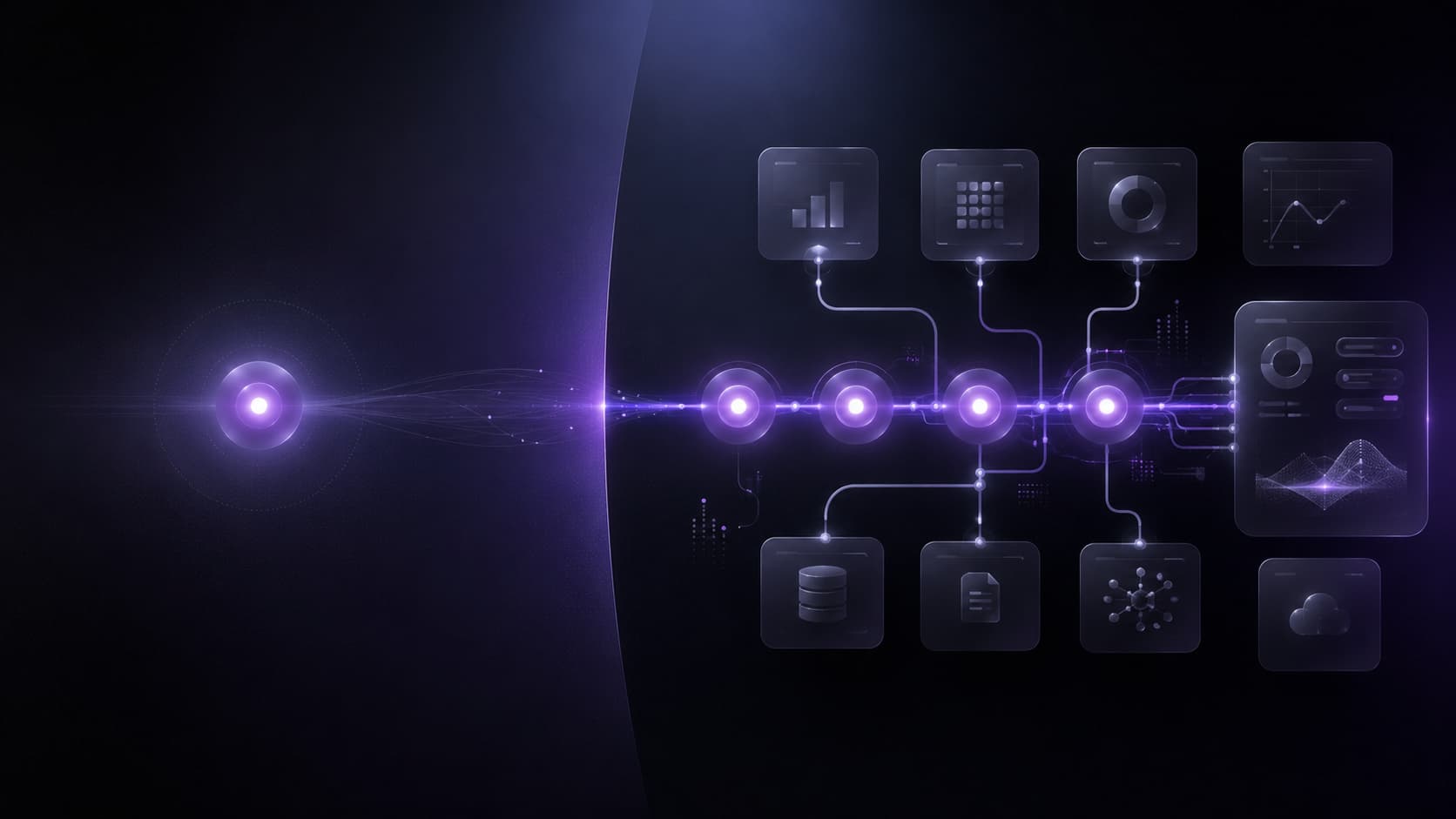
Worth remembering — Orchestration is not an end in itself: it is a tool for tasks that genuinely chain several steps and several sources. Put in the wrong place, it adds complexity, token cost and fragility. Put in the right place, it turns a manual multi-step chore into a reliable, repeatable process. The key skill is not technical: it is knowing where to draw the line.
Frame what is worth orchestrating in your organisation →
What does orchestrating AI in the enterprise mean?
Orchestrating AI means organising the chain of steps, tools and — where relevant — several agents to complete a whole business task, instead of sending isolated requests and stitching the pieces together by hand. Orchestration describes who does what, in what order, with which data, and where the human takes back control.
To set the vocabulary (the basic definitions are covered in the cornerstone article; we extend them here for orchestration):
- An AI agent is a system given an objective and a set of tools, which decides for itself which steps to take to reach that objective within a defined scope — as opposed to a workflow, where the steps are fixed in advance.
- Orchestration is the layer that coordinates those steps, tool calls and agents: execution order, context handover, error handling, stopping points for sign-off.
- A multi-agent system has several specialised agents work together (each with its role, tools and scope), delegating sub-tasks towards a shared objective.
- A human sign-off point (human-in-the-loop) is a step where the sequence stops and waits for a human decision before continuing, typically before an irreversible or high-stakes action.
The workflow vs agent distinction is structural. Anthropic states it plainly: a workflow follows predefined, predictable steps; an agent chooses its own path. Orchestration covers both — and the right instinct, recommended by Anthropic, is to keep the implementation as simple as possible and add autonomy only when the task genuinely requires it.
What is the difference between a prompt, a workflow and an orchestration?
The difference comes down to the number of steps, the number of tools involved and how much autonomy the AI is given. It reads as a four-level progression — and the rule is to stay at the lowest level that solves the problem.
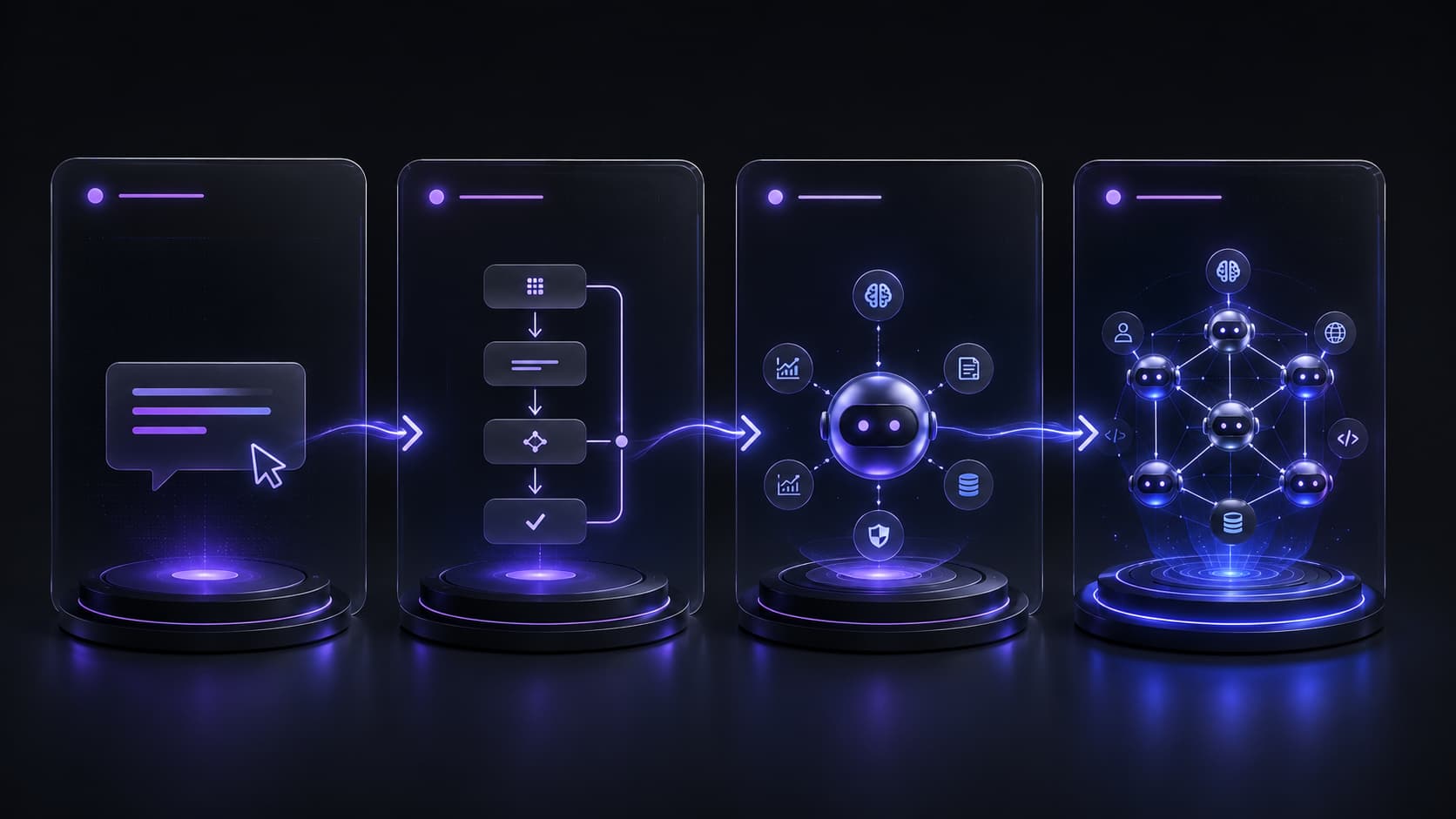
| Level | What it is | Steps | Tools | Autonomy | When it is the right level |
|---|---|---|---|---|---|
| 1. Prompt | A single isolated request | 1 | 0 | None | One-off answer, exploration, first draft |
| 2. Workflow | A repeatable, tool-connected sequence with fixed steps | Several, predefined | 1+ (via MCP) | Low | Recurring business task, predictable and verifiable |
| 3. Single-agent orchestration | One agent chains steps it selects itself, across several tools | Several, dynamic | Several (MCP) | Medium | Multi-step task with variable paths |
| 4. Multi-agent | Several specialised agents coordinate | Many | Many | High | Complex task that genuinely breaks into distinct roles |
Three principles follow from this progression:
- Each level adds value — and cost. The higher you go, the more you automate, but the more you pay in tokens, latency and coordination complexity. It is a trade-off, never a default.
- You move up a level only when the previous one no longer suffices. A reliable workflow covers the vast majority of business needs. Single-agent orchestration is justified only when the paths vary; multi-agent, only when the task genuinely breaks into distinct roles.
- You orchestrate once you have a reliable workflow, never before. Automating a shaky step means industrialising a mistake. The sequence must hold up manually before it is orchestrated.
An honest aside — The hype pushes towards level 4 (“armies of autonomous agents”). Enterprise reality mostly lives at levels 2 and 3. Most of the gains come from reliable workflows and well-framed single-agent orchestration. Multi-agent is powerful, but it is also the hardest to make dependable — you go there only when the problem demands it.
What does MCP bring to orchestration (connecting to internal tools)?
MCP (Model Context Protocol) is what lets an orchestration act on your internal tools instead of running in a vacuum: it is the open standard, created by Anthropic, that connects Claude securely to your document management system, your project tracker, your messaging or your CRM. Without that connection layer, an agent can only produce text; with it, it can read a document in the DMS, update a record in the project tracker, or post a message — which is what makes orchestration useful rather than demonstrative.
In practice, MCP plays three roles in an orchestration:
- Reading — the agent fetches information where it lives (a client folder in the DMS, a ticket history, a calendar) instead of waiting for a manual copy-paste.
- Acting — the agent writes into your tools (creating a task, updating a status, drafting a reply) within a scope you define.
- Security and scope — the connection is bounded: which tools, which data, which permitted actions. This is something to lock down with your security teams, not in their place.
MCP has established itself as an ecosystem standard: Anthropic has published many official connectors (Google Drive, Gmail, Google Calendar, WordPress and more) and donated the protocol to place it under open governance. For a CIO, the benefit is twofold: it is interoperable (not a proprietary format that locks you in) and it is auditable (actions run through traceable connections).
A point for CIOs — Connecting an AI to your internal tools opens a surface for action. MCP makes that opening governable (scope, permissions, logging), but the governing remains a decision: you explicitly list the tools connected, the data reachable and the actions allowed. The technical connection is the easy part; the access policy is the real question.
What does Cowork bring (multi-step execution)?
Cowork is the Anthropic capability that runs multi-step tasks autonomously — the execution engine that turns “here is what I want” into a chain of actions, rather than a series of hand-driven prompts. Generally available since 24 February 2026 (after a preview earlier in 2026), Cowork relies on MCP to read and write in your environment and to carry a task through end to end within a defined scope.
Where a prompt produces an answer to review, Cowork chains the work: fetch the right sources, analyse them, produce a structured deliverable, and file it in the right place — stopping wherever your sign-off is required. This is exactly the move from level 1 (prompt) to level 3 (single-agent orchestration) described above.
A few generic, client-side examples (never our own pipeline) of what this kind of multi-step execution makes it possible to orchestrate:
- Case file preparation — gather the documents from the DMS, produce a structured summary, flag what is missing, file a draft note.
- Second-line support — read a ticket history, cross-check it against the knowledge base, propose a reply, escalate if a threshold is met.
- Structured market watch — collect sources, sort them against your criteria, produce a weekly digest and post it in the team channel.
Guardrail — These examples are client-side illustrations, to be co-built with your business experts. How we ourselves produce at METASENSE stays internal: what we pass on is a repeatable method adapted to your business functions, not a copy of our own kitchen.
How do you frame a reliable orchestration?
A reliable orchestration is framed by making three things explicit: the steps (what chains together), the controls (what checks each action), and the human sign-off points (where a person decides). An autonomous sequence is not a black box: it is a process whose every link is defined, verifiable and interruptible.
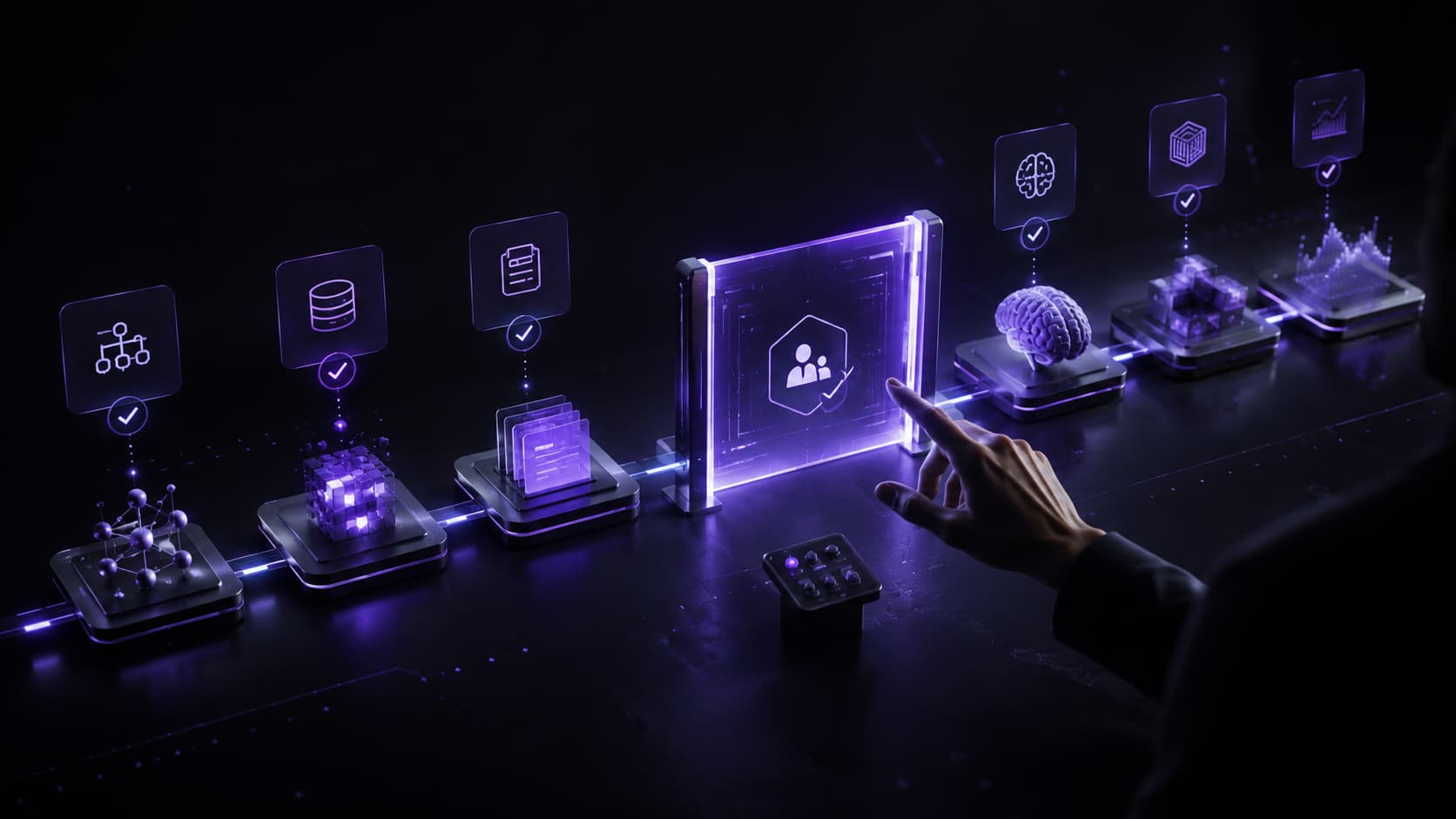
Here is a framing sequence, in order:
- Map the task into explicit steps. Break the real task (as a person performs it today) into named steps, with their inputs and outputs. If you cannot describe it by hand, you are not ready to orchestrate it.
- Identify the tools and data for each step. For every step: which internal tool (via MCP), which data is read, which actions are written, and under which permissions.
- Define the automatic controls. Rules that block forbidden actions, and checks that validate intermediate outputs before moving to the next step (a verifying agent, business rules, format guardrails).
- Place human sign-off points where they belong. Before any irreversible or high-stakes action (an external send, a change to sensitive data, a commitment), the sequence stops and waits for a decision. This is the human-in-the-loop principle recommended for tasks that call for judgement or accountability.
- Favour reversible actions. Where possible, have the sequence produce a draft rather than a final action: the human approves, then triggers. You cut the risk without losing the gain.
- Log and measure. Record actions (auditability) and track token consumption per sequence — to check that the value produced exceeds the cost.
This discipline is also what separates serious co-construction from a demo: the orchestration is designed with your business experts, because they are the ones who know where a mistake is expensive and where human sign-off is non-negotiable. We bring the method and the command of the tool; they bring the knowledge of the ground. (METASENSE runs a real training and skills-transfer activity around these methods; it is not certified.)
An honest aside — An orchestration without checkpoints is not “more advanced”, it is riskier. Maturity is not about removing the human; it is about placing them where their judgement counts, and automating where they were only re-typing.
When should you orchestrate — and when should you definitely not?
Orchestrate when a task genuinely chains several steps and several sources, recurs, and tolerates human control at the sensitive points. Do not orchestrate a task that is simple, rare, or where an error cannot be recovered without a full review anyway — orchestration there adds cost and fragility for no gain. This is the single most important criterion in this article: over-engineering is the number one trap of agentic AI in the enterprise.
| Orchestration makes sense if… | Do not orchestrate if… |
|---|---|
| The task has several real, recurring steps | The task fits in a single step (a good prompt is enough) |
| It draws on several tools or sources | Everything is already to hand, with no connection to fetch |
| It recurs often (the design cost pays back) | It is rare or one-off |
| The paths vary (which justifies an agent's autonomy) | The path is always identical (a fixed workflow is enough) |
| Human sign-off points are possible | Errors are not tolerable without a full review in any case |
| The value produced clearly exceeds the token cost | The gain is marginal against the cost of coordination |
Three signs of over-engineering to watch for:
- Agents are stacked up to impress. A sensible first rollout keeps to few agents; multiplying agents multiplies coordination, latency and cost. Look for the case with the fastest return, not the most spectacular one.
- A step that is not stable gets automated. If the manual workflow is not reliable, orchestrating it only industrialises the flaw.
- The token bill climbs faster than the value. Every autonomous step consumes tokens; a poorly calibrated sequence can cost far more than it returns. That is precisely the subject of our dedicated article on token cost governance for enterprise AI.
The cost / orchestration link — Orchestrating multiplies model calls: a task that cost one prompt can cost ten once orchestrated. The time saved has to comfortably exceed that overhead, otherwise orchestration is a net loss. Orchestrate what deserves it, measure, and cut what costs without returning.
Where do you start an orchestration without getting burnt?
Start with a single case, multi-step but bounded, already reliable as a workflow, and orchestrate it with human sign-off at the sensitive points — then measure before extending. Durable orchestration is built on proof, not on stated ambition.
A realistic path:
- Pick a recurring multi-step task whose pain is obvious (case file preparation, market watch, second-line support and so on).
- Make it reliable as a workflow first (level 2) before orchestrating it (level 3).
- Connect only what is strictly necessary via MCP — the tools and data useful to that task alone, with your security teams.
- Place human sign-off points before every irreversible action.
- Measure both the value AND the token cost of the sequence before generalising it.
- Iterate, then extend to the next task — not to ten at once.
Worth remembering — A good first orchestration project is small, bounded and measurable. One case that holds, proven internally, is worth more than ten agents in a demo. The line between “orchestrated enough” and “over-orchestrated” is found through experience, not theory — and that is exactly where support saves time.
The proof: making agentic AI understood, not imposed
Our standing on orchestration does not come from a slide: we use these models ourselves every day — to build platforms and produce assets (3D, images, video) — and we can tell orchestration that holds in production from a demo that impresses. This is the dual Creative Tech capability of METASENSE (Vélizy-Villacoublay) applied to AI: the advisory side (framing, prioritising, knowing where to draw the line) and the technical expertise (genuinely understanding what these systems can and cannot do reliably).

We carry that teaching into skills transfer as well. With Grand Angoulême, we ran a conference and a workshop on agentic AI, designed to help non-specialist participants understand and co-build agentic workflows — exactly the logic of this article: demystify orchestration, show where it creates value and where it does not, and leave teams able to judge for themselves.
Honesty — We do not claim to know your business better than you do, and that is deliberate. Knowledge of the steps, the edge cases and the points where human sign-off is non-negotiable stays yours. Our value lies in the orchestration method and in command of the tool; and how we ourselves produce stays internal — what we pass on is a repeatable method adapted to your business functions.
To go further on a neighbouring case: Do you need an AI agent on your website?
Let's talk about what is worth orchestrating in your organisation
You already have AI in use; the question is which uses deserve to be orchestrated — and which would cost more than they return. METASENSE (Vélizy-Villacoublay) works with you to frame the high-leverage multi-step tasks, designs reliable orchestrations (steps, controls, human sign-off) connected to your tools through MCP, and trains your teams to judge for themselves where the line sits — with Claude as the lead tool, and a method that adapts to other assistants.
Explore enterprise AI enablement & Claude workflows →
Frequently asked questions
What is enterprise AI orchestration?
AI orchestration means organising the chain of steps, tools and possibly several agents to complete a whole business task, instead of sending isolated requests and stitching the results together by hand. It defines who does what, in what order, with which data, and where the human takes back control.
What is the difference between a workflow and an AI agent?
A workflow follows predefined, predictable steps: it always does the same thing in the same order. An AI agent is given an objective and a set of tools, then decides for itself which steps to take within a defined scope. Anthropic recommends favouring the simplest solution: add agent autonomy only when the task genuinely requires it.
What is MCP (Model Context Protocol) for in an orchestration?
MCP is the open standard created by Anthropic that connects Claude securely to your internal tools (document management, project tracking, messaging, CRM). Within an orchestration, it lets the agent read information where it lives and act inside your tools, instead of being limited to text. That is what makes the sequence genuinely useful.
What is Cowork and what can it orchestrate?
Cowork is the Anthropic capability that runs multi-step tasks autonomously, relying on MCP to read and write in your environment. Generally available since 24 February 2026, it turns a request for an outcome into a chain of actions that stops wherever your sign-off is required.
When should you orchestrate AI and when should you not?
Orchestrate when a task genuinely chains several steps and several sources, recurs, and tolerates human control at the sensitive points. Do not orchestrate a task that is simple, rare, or whose errors cannot be recovered without a full review: orchestration there adds token cost and fragility for no gain. Over-engineering is the number one trap.
How many agents do you need for a first project?
Few. A sensible first rollout keeps to a small number of agents: multiplying agents multiplies coordination, latency and cost. Look for the use case with the fastest return, not the most spectacular one. Start with one bounded multi-step case, prove it, then extend — never ten agents at once.
How do you guarantee the reliability of an orchestrated sequence?
By making three things explicit: the steps (what chains together), the automatic controls (rules that block forbidden actions, checks on outputs), and the human sign-off points before any irreversible or high-stakes action. Favour reversible actions too (produce a draft that a person triggers), and log everything for auditability.
What is a human sign-off point (human-in-the-loop)?
It is a step where the orchestration stops and waits for a human decision before continuing, typically before an irreversible or high-stakes action (an external send, a change to sensitive data). It is the principle recommended for tasks that call for judgement or accountability: maturity is not about removing the human, it is about placing them where they count.
Does multi-agent orchestration cost more?
Yes. Every autonomous step and every additional agent consumes tokens and adds coordination: a task that cost one prompt can cost ten once orchestrated. The time saved has to comfortably exceed that overhead. This is why you measure value and cost per sequence, and cut what costs without returning.
Do you need to be a technical company to orchestrate AI?
No. Knowledge of the business steps, the edge cases and the points where human sign-off is non-negotiable stays yours — and it is what matters most. Outside support brings the orchestration method and command of the tool. It is precisely because your teams are not AI specialists that training them to judge what to orchestrate creates value.
Sources
- Anthropic — Building Effective Agents (workflows vs agents, the simplicity principle, human-in-the-loop).
- Anthropic — Introducing the Model Context Protocol (MCP).
- Anthropic — Donating the Model Context Protocol and establishing the Agentic AI Foundation.
- VentureBeat — Anthropic says Claude Code transformed programming. Now Claude Cowork is coming for the rest of the enterprise (Cowork, general availability 24/02/2026).
- Deloitte — Orchestration d’agents IA : un levier stratégique de performance et de valeur (2026 predictions).