

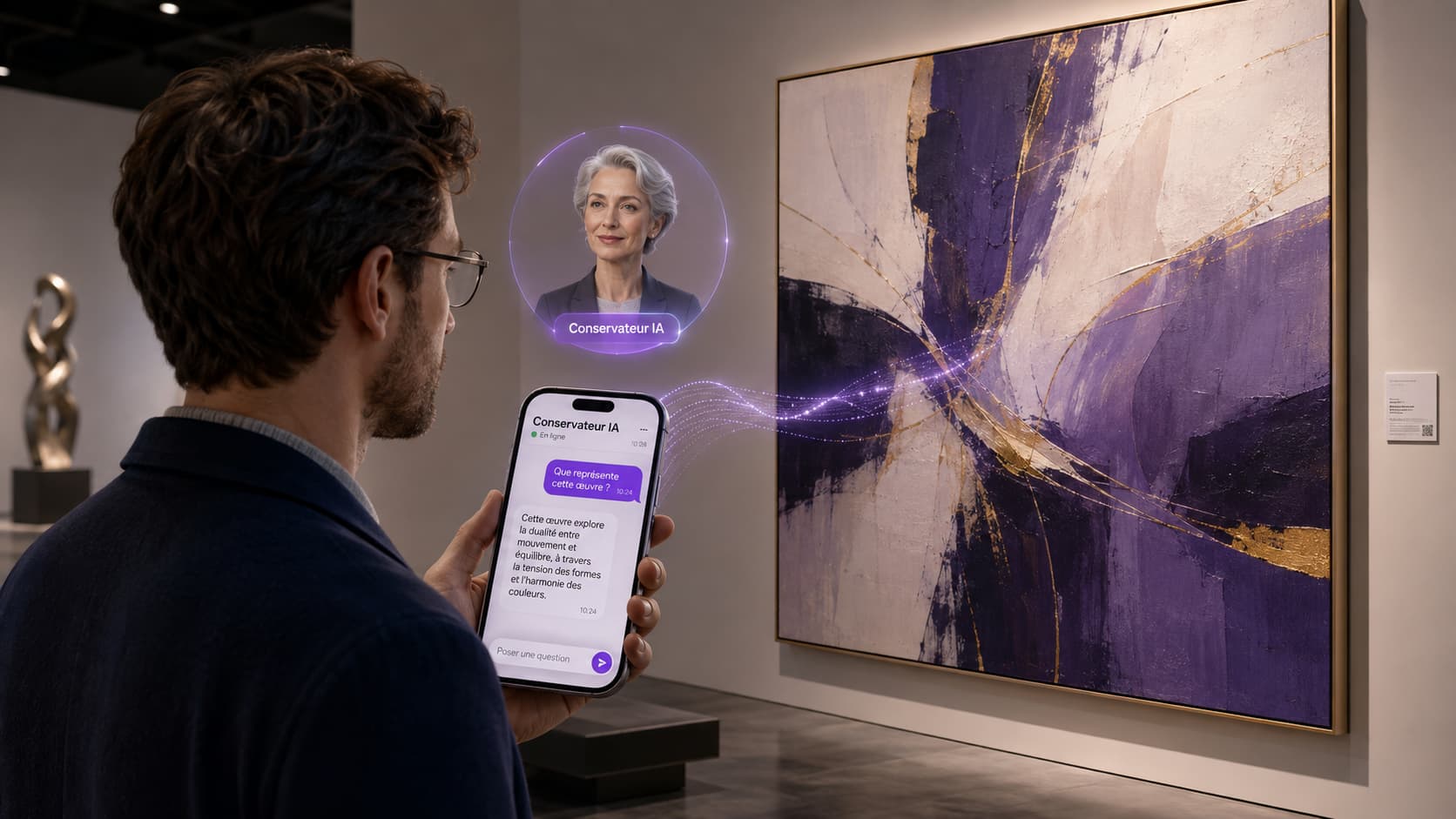
Should you install a generic chatbot, or design an AI agent for your own collection? An AI curator is a conversational agent built for one specific collection: it carries that collection's voice, it draws on the institution's own scholarship, and the institution defines what it may say. A generic chatbot knows the world — not your holdings. That is the difference between an FAQ engine parked beside the visit and a presence that is part of it.
The question is no longer theoretical. The Château de Versailles lets twenty of its sculptures talk to visitors through a simple QR code, in French, English and Spanish. The Musée d'Orsay runs a conversational agent in seven languages. Cambridge's Museum of Zoology lets thirteen specimens — the dodo included — answer in the first person. The Centre Pompidou has opened 113 works from its collection to dialogue. What sets these installations apart from interchangeable chatbots is not the AI model: it is what they know, how they speak, and what they are allowed to say.
In short
- An AI curator is an agent designed for one collection: a voice (personality, tone, stance), a body of knowledge (the institution's own corpus), and a defined scope (what it says, and what it does not).
- The real driver of engagement is not the technology but the personality: you do not consult a wall label, you meet someone.
- The institution's corpus is the asset nobody can copy: a competitor can buy the same model, not your archives or your research.
- Scholarly control is a guarantee, not a constraint: you decide what is said about your works.
- An installation that lasts mixes pre-produced, validated content with live generation reserved for what deserves it — which makes running costs predictable.
- The agent is one building block of the immersive journey, never a product parked beside it.
Design the AI curator for your collection →
What is an AI curator, and how does it differ from a museum chatbot?
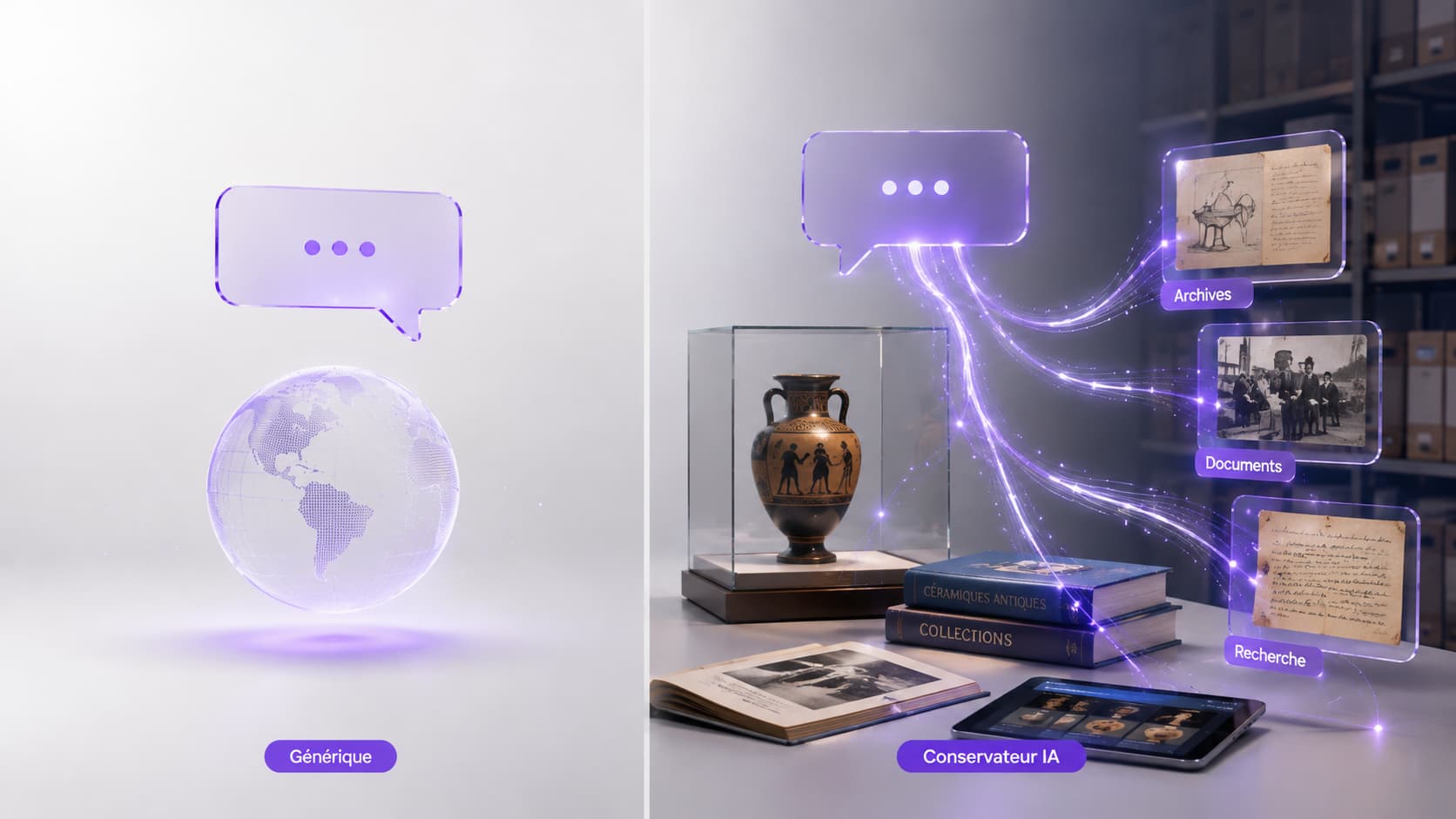
An AI curator is a conversational agent custom-built for a collection: it answers from the institution's scholarly corpus, speaks with a personality written for that venue, and operates within a scope of discourse the institution has set. A generic museum chatbot, by contrast, is a preconfigured assistant plugged into a few web pages: it handles opening hours and ticketing very well, and the question a visitor asks in front of a display case far less well.
The difference shows on the first substantive question. Ask a generic agent why this statue lost its arm, and it will tell you what the web knows about ancient statues. Ask an AI curator trained on the institution's catalogue records, conservation reports and research, and it will tell you what your institution knows about this statue — including what remains unknown.
| Generic chatbot | AI curator for your collection | |
|---|---|---|
| Source of knowledge | General knowledge plus website pages | Your own corpus: catalogue records, archives, research, interpretation |
| Voice | Neutral assistant tone | A written personality: scholarly guide, period character, house voice |
| Place in the visit | A widget beside the visit | A block built into the scenography and the visitor journey |
| Faced with an out-of-scope question | It improvises | It reframes, adds context, or hands over to a member of staff |
| What the institution controls | Little | The knowledge used, the tone, the limits of the discourse |
| Value produced | Takes pressure off the front desk | Takes pressure off the front desk plus interpretation, audience data, a documentary asset |
| Reproducible by another venue | Yes, identically | No: the corpus and the voice are yours |
The institutions that have taken the step are working on exactly this material. At the Muséum d'histoire naturelle in Autun, the agent "Ève" was built on 300 pages of curatorial notes, with answers grounded in content approved by the institution. At Versailles, the sculpture dialogue was designed with the château's chief curator of sculpture. That is not a production detail: it is what gives the installation its value.
Why is the agent's personality the real driver of engagement?
Because a visitor does not remember a knowledge base: they remember an encounter. Personality — voice, tone, stance, point of view — is what turns an answer engine into a presence. It is the factor that separates an installation used once from one people talk about on the way out.
Three registers work, and the choice depends on the venue and its audience:
- The scholarly guide. An expert, warm voice that explains without condescension and knows when to stop. It is the most versatile register, and the one that best carries a venue's scholarly voice.
- The embodied character. A period inhabitant, a craftsman, a patron, or a work that speaks in the first person. This is the most memorable register — Cambridge's Museum of Zoology has its specimens answer as if they were alive, from the dodo to the sperm whale. In Nîmes, the character Lucius leads the visitor from one monument to the next.
- The house voice. The institution speaking for itself, with its own editorial identity: the same tone as its labels, its posters, its social channels. This is the right register for a strong cultural brand.
A personality is not a setting you tick: it is written. Level of language, formality, answer length, the place of humour, how a naïve question is welcomed, how the agent says "I don't know", how it handles a visitor in a hurry or an eight-year-old. This is editorial work, done with the interpretation and curatorial teams — exactly as you write an audio guide, but for someone who answers back.
Worth remembering — Conversational technology has become a commodity. The voice has not. It is the one part of the installation no competitor can reproduce, and the one that decides how the visitor feels.
What should an AI curator know? The material in your collection
The quality of an AI curator rests first on the corpus you give it — and no institution needs to invent that corpus: it already has one. It is simply scattered across catalogue records, hard drives, publications and the memory of the team.
What makes up the material of a genuinely singular agent:
- The documented holdings: catalogue records, wall labels, inventories, catalogues, conservation reports, condition assessments.
- The archives: correspondence, plans, historic photographs, acquisition files, provenance histories.
- The scholarly work: curators' publications, conference proceedings, excavations, doctoral research, university partnerships.
- The interpretation already produced: audio guides, booklets, exhibition texts, education packs, guided-tour scripts.
- The tacit knowledge: what the guides know and have never written down — the anecdote that lands, the question everyone asks, the answer that triggers the "really?".
That last point is often the most profitable part of the project. Capturing it turns oral knowledge — fragile and impossible to pass on — into a structured documentary asset, reusable well beyond the agent: website, wall labels, audio-guide overhaul, press packs, training for new guides.
It is also what makes the installation impossible to copy. Another venue can subscribe to the same AI model, the same vendor, the same interface. It will not have your archives, your researchers or your history. The model is a commodity; your corpus is heritage. ICOM puts it plainly: AI feeds on the data it is given and does not work without documentary preparation — selecting, prioritising, making the material coherent.
What does it say, and what does it not? Keeping control of the discourse
This is the question every scholarly director asks, and the answer is good news: with a well-designed AI curator, the institution decides what is said about its works. That control does not slow the project down — it is one of its strongest arguments before a board or a supervising authority.
It rests on three provisions, set with the scholarly leadership at the framing stage:
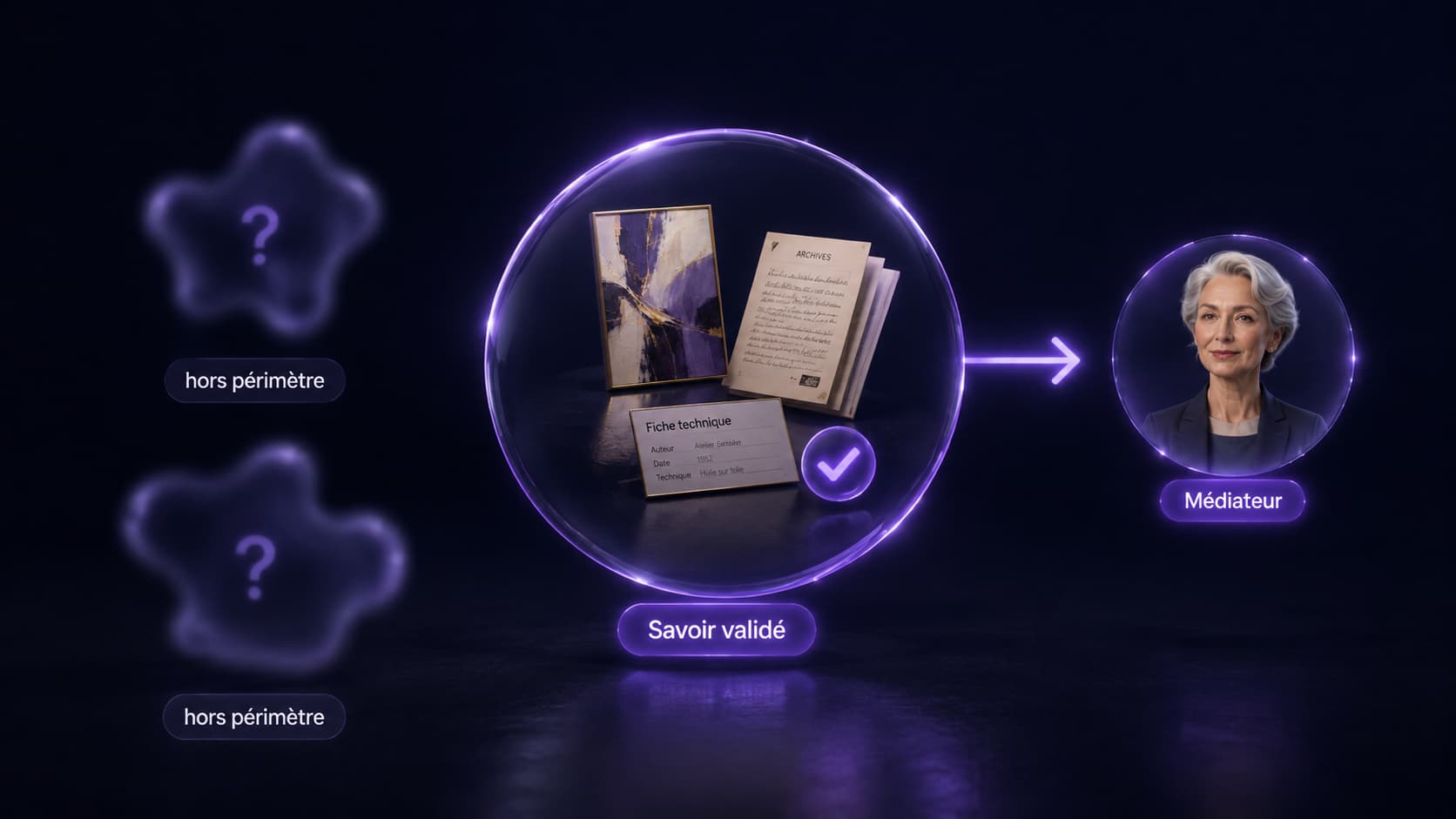
- Grounding in validated content. The agent answers from the corpus the institution has approved, not from what a model "believes it knows". That is the principle adopted in Autun, where every answer draws on a validated knowledge base to guarantee scholarly accuracy.
- An explicit scope of discourse. Some subjects call for an institutional position: provenance and restitution, uncertain attributions, disputed dating, political or memorial questions. You write in advance what the agent says about them — usually the state of the debate, with its sources — rather than letting it rule.
- A hand-over rule. A good AI curator knows how to say "I don't know" and refer on: to the guide in the gallery, to the documentation, to the visitor services team. It is a deliberate stance, and visitors read it as a mark of seriousness, not as a limitation.
The benefit goes beyond reassurance. Month after month, the questions the agent could not answer become an interpretation roadmap: they show what the public is really looking for and what the institution has not yet written. The Autun museum collects unanswered questions; the Musée d'Orsay uses its agent's data to read visitor nationalities, question frequency and question types. A well-designed conversational installation is not only an output channel: it is an audience sensor.
What architecture makes the installation sustainable over time?
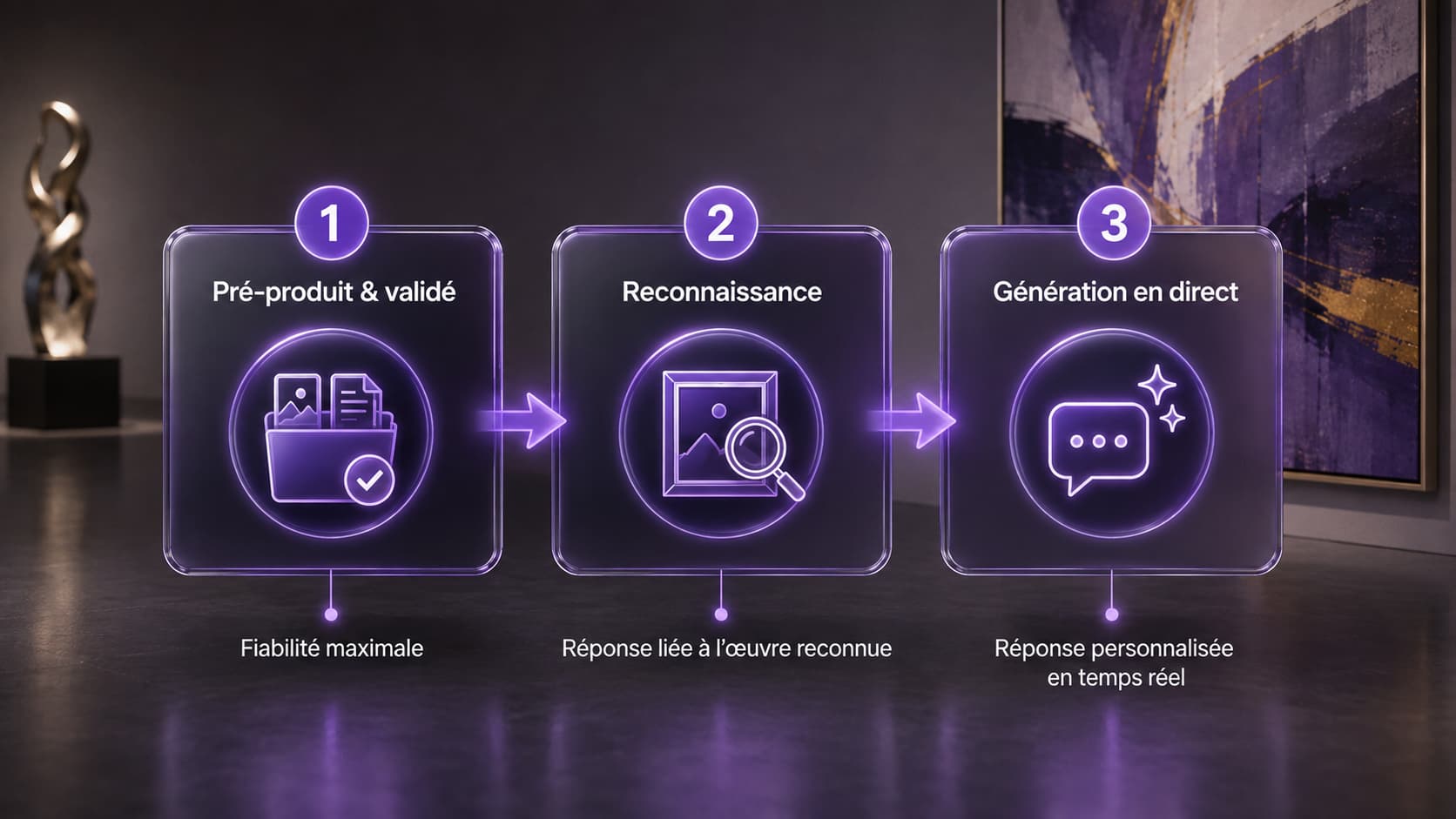
An AI curator stays sustainable when not everything is generated on demand: what is predictable is written, validated and served as is; live generation is reserved for what deserves it. This is the most decisive point for an institution, because it governs both the quality of the discourse and the predictability of the running budget.
Three content regimes coexist in a well-architected installation:
- Pre-produced content. Answers to the expected questions on the flagship pieces, gallery narratives, signposted routes, welcome and closing texts. They are written, edited and scientifically validated — then served identically, with no generation cost. This is the base layer: the part of the installation the public meets most often is also the part under tightest control.
- Live generation. It comes in where it genuinely adds something: an unexpected question, a follow-up on what the visitor has just said, a rephrasing for a child, a comparison between two works, an adjustment to the time available. This is the "magic" moment of the installation — it costs, so you reserve it for what is worth it.
- The recognition layer. Between the two, a mechanism able to spot that a question, asked differently, maps onto content already produced — and to serve it rather than regenerate it. Without it, an institution pays a thousand times for the same answer.
The order of magnitude is public and easy to check: at Anthropic, reading content already held in cache is billed at 0.1 × the price of a standard input token. In other words, "serving again" and "regenerating" belong to different economies. We set out this cost mechanism in our article Controlling enterprise AI token costs.
Translated into the language of a director, this comes down to three concrete commitments:
| The institution's concern | What the architecture delivers |
|---|---|
| Running budget | A capped, predictable cost per visitor, not an invoice discovered at the end of the quarter |
| Quality of the discourse | The content that matters is validated up front, not checked after the fact |
| Scaling | Double the attendance does not double the bill: the pre-produced share absorbs the peak |
| Seasonality | A temporary exhibition means a batch of content to write, not a rebuild of the installation |
This is a matter of architecture, not of tooling: it is decided at the framing stage, with the institution, according to what its collection and its audience actually require. A highly seasonal venue, an open-air site and a permanent-collection museum do not call for the same balance.
Multilingual and accessible: how does the agent fit into the visitor journey?
Multiple languages and accessibility are not optional extras for an AI curator: they are two of the most rational reasons to build one. A single corpus, written and validated once, can be delivered in several languages and at several reading levels — something no interpretation team can do at constant headcount.
On languages, the sector's figures speak for themselves. In 2025 the Louvre welcomed 9 million visitors, 73% of them from abroad. Deployments follow suit: seven languages for the Musée d'Orsay agent, three for the Versailles sculpture dialogue, automatic language detection in Autun. According to its vendor Ask Mona, the Orsay agent freed up in one month the equivalent of six months of human work on the questions handled — a figure to treat as vendor-supplied, but one that shows where the gain sits.
On accessibility, the agent is a genuine lever: read-aloud, voice input, simplified answers on request, a detailed description of a work for a visually impaired visitor, an alternative to a label unreadable from a wheelchair. Regulation points the same way: since 28 June 2025, the European Accessibility Act (EU Directive 2019/882) has extended digital accessibility obligations to new services, while French public digital services already fall under the RGAA. A conversational installation is only accessible, however, if its interface is too — that is a design decision, not a promise.
That leaves the agent's place in the wider setup. An AI curator is not a product parked beside the visit: it is a building block. Its full value comes from being connected to the others:
- Frictionless access, via QR code, with no app to download — the number one usage condition for a general audience (see our article on the augmented visit without installing an app).
- A 3D or augmented reality layer: the agent comments on what the visitor sees reappear at full scale.
- A game mechanic: the guide character becomes the narrative thread of a trail, rather than one more module.
- Voice narration, which frees the visitor's eyes and gives them back to the place.
This is exactly the logic of the augmented visitor journey at Nîmes la Romaine, designed with Aura (formerly EDEIS): a 3D web app opened by QR code, multilingual AI voice narration and a trail carried by a character, now in production. The design is described in our case study of the Nîmes augmented journey. We are also exploring, as an internal demo — a concept, not a delivered installation — what the same conversational principle gives in VR inside a motorcycle museum: there the agent becomes a presence in the space rather than an interface on a screen.
One point deserves to be stated plainly: the mechanism described here is not specific to Roman antiquity or to natural history. It transfers to any collection — fine art, industry, memorial sites, corporate heritage, private collections — because what makes it singular is the corpus and the voice, not the subject.
How do you build an AI curator with an institution?
You never start from the tool: you start from the voice and the corpus. Here is the path we follow, from framing to rollout, with the scholarly and interpretation teams.
- Frame the intent and the audience. What should the installation produce — understanding, emotion, extended engagement, relief for the front desk? For whom: school groups, families, international visitors, regulars? The objective decides everything else.
- Write the voice. Choose the register (scholarly guide, embodied character, house voice), then draft the charter: tone, length, vocabulary, humour, how to say "I don't know". It is an editorial deliverable, validated by the institution.
- Gather and qualify the corpus. Inventory what exists, capture the guides' tacit knowledge, identify the gaps. This work produces a documentary asset that will serve well beyond the agent.
- Define the scope of discourse. With the scholarly leadership: subjects requiring an institutional position, areas of acknowledged uncertainty, the rules for handing over to a human.
- Pre-produce what needs to be, then test with real visitors. Write and validate the expected content on the flagship pieces, trial the installation in the galleries, tune the voice against what the public actually asks.
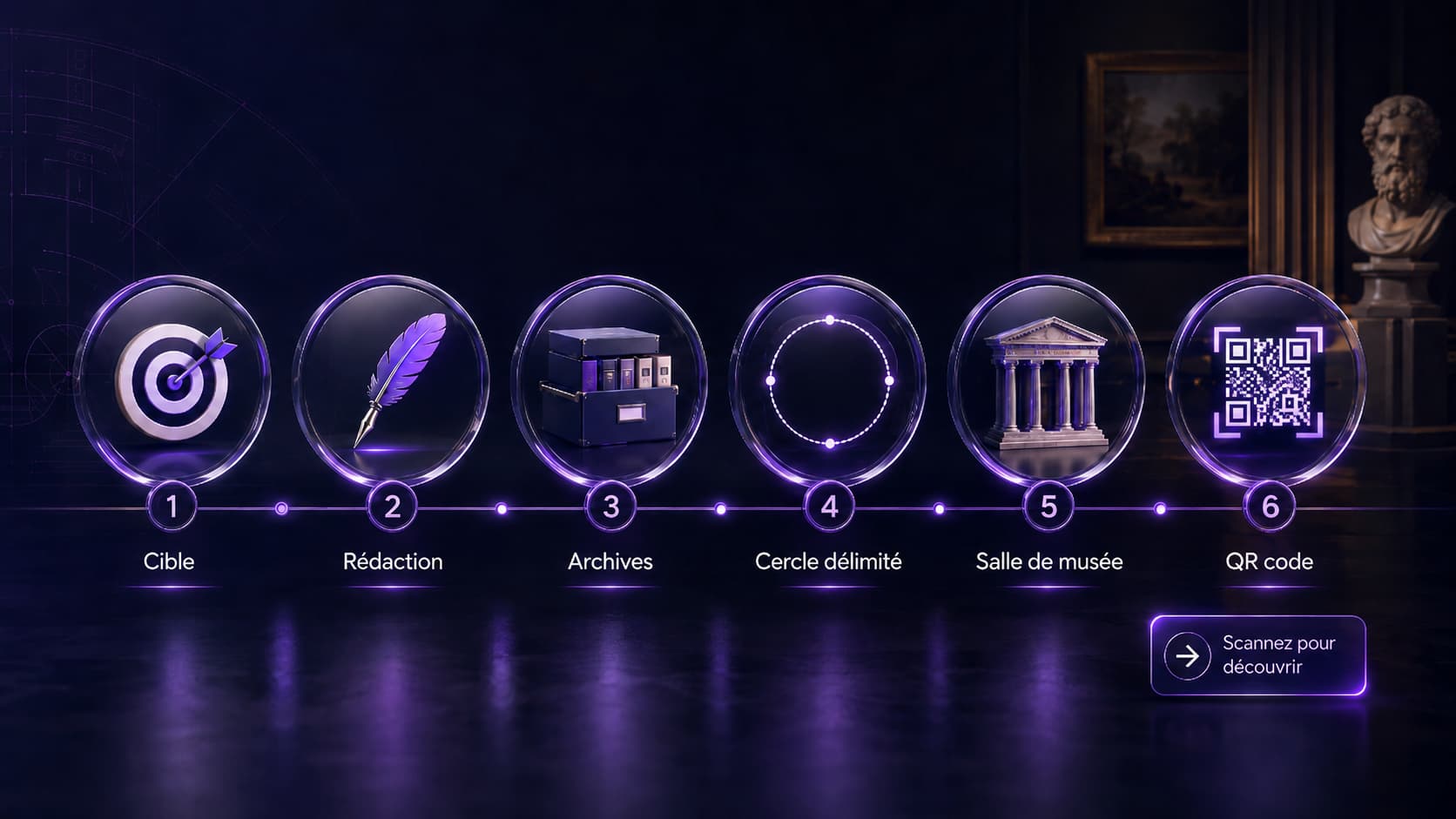
- Integrate into the journey and keep it alive. Connect the agent to the rest of the setup (QR code, 3D, game, voice), then feed it in step with exhibitions and with the questions the public raises.
At METASENSE, a Creative Tech agency based in Vélizy-Villacoublay, these six steps are run by a single team: consulting and creative on one side, technical expertise on the other — 3D on the web, WebGL, augmented reality with no download, AI agents, custom development. That dual capability is what keeps the editorial promise intact all the way to execution, rather than diluting it across three suppliers.
Your collection deserves better than a generic chatbot
Museum, heritage site, local authority, foundation, company with a collection: if you want your holdings to speak with their own voice — and to keep control of what is said about your works — let's talk. We design custom interpretation experiences, from scholarly framing to rollout.
Design the AI curator for your collection → · Contact us
FAQ — Museum chatbots and AI curators
What is an AI curator?
An AI curator is a conversational agent designed for one specific collection. It answers from the institution's scholarly corpus (catalogue records, archives, research, interpretation), speaks with a personality written for the venue, and operates within a scope of discourse the institution has itself defined.
What is the difference between a museum chatbot and an AI curator?
A generic chatbot relies on general knowledge and website pages: it handles opening hours well and the question asked in front of a display case badly. An AI curator draws on the institution's own holdings, carries its voice, and knows when to hand over.
Can an AI agent replace a guide or interpreter?
No, and that is not the aim. It absorbs repetitive questions, translation and round-the-clock availability, which gives teams time back for high-value interpretation. Designed properly, it refers explicitly to a member of staff on the subjects that warrant it.
How do you guarantee the scholarly accuracy of the answers?
Through three provisions: grounding answers in a corpus validated by the institution, writing the scope of discourse in advance on sensitive subjects (provenance, attribution, disputed dating), and defining a rule for handing over to a human when the question falls outside the frame.
What happens if a visitor asks an off-topic question?
The agent steers back to the collection or states that it cannot answer, then points to the right source. These unanswered questions are valuable: collected together, they map out an interpretation roadmap grounded in what the public is genuinely looking for.
Do you need to download an app to use an AI curator?
No, and it is strongly discouraged for a general audience. Current installations open from a simple QR code in the smartphone browser, with no install and no account. That is the case at Versailles, in Autun and on the Nîmes la Romaine journey.
Can an AI curator speak several languages?
Yes, and it is one of its most profitable contributions: a corpus validated once can be delivered in several languages. The Musée d'Orsay agent runs in seven languages; the Versailles one in three; the Autun agent detects the visitor's language automatically.
How much does an AI curator cost?
The cost has two parts: design (voice, corpus, validated content, integration into the journey) and running (the cost per conversation). An architecture combining pre-produced content with targeted generation makes that second item predictable. At METASENSE we price each engagement individually.
How do you stop the bill exploding if attendance rises?
By not generating everything on demand. The expected answers on the flagship pieces are written, validated and served as is; live generation is reserved for unexpected questions. A spike in attendance then hits mainly the least expensive part of the installation.
What data is needed to build an interpretation agent?
What the institution already owns: catalogue records and labels, archives, scholarly publications, existing interpretation content, plus the oral knowledge of the guides. Capturing it produces a documentary asset reusable well beyond the agent.
Does an AI curator improve the accessibility of a visit?
Yes: read-aloud, voice input, simplified answers on request, detailed description of a work. Provided the interface itself is designed to be accessible — a design point to address from the framing stage, not least in view of the RGAA and the European Accessibility Act.
Is this kind of installation only suitable for large museums?
No. The mechanism depends on the corpus and the voice, not on the size of the venue: a mid-sized city museum, a heritage site, a foundation or a private collection can draw just as much value from it. The Autun museum is a documented example.
Sources
- Château de Versailles — Le château de Versailles, Ask Mona et OpenAI (dialogue with 20 of the 824 sculptures in the gardens, QR code, FR/EN/ES): chateauversailles.fr
- University of Cambridge — Public invited to chat to museum animals in novel AI experiment (13 specimens, Museum of Zoology, Oct. 2024): cam.ac.uk
- Ask Mona — AI in museums: lessons from the Autun museum chatbot ("Ève", 300 pages of curatorial notes, validated content, FR/EN/NL): askmona.ai
- Ask Mona — Musée d'Orsay: a sustainable AI at the service of visitors (7 languages; audience data): askmona.ai
- Culture Matin — Un chatbot pour accompagner les visiteurs du Centre Pompidou (113 works, FR/EN): culturematin.com
- ICOM France — Et demain ? Intelligence artificielle et musées: icom-musees.fr
- franceinfo — Fréquentation du Louvre en 2025 : 9 millions de visiteurs, 73 % d'étrangers: franceinfo.fr
- Anthropic — Prompt caching (official documentation: cache read billed at 0.1 × the price of an input token): platform.claude.com
- Mon Parcours Handicap (French public service) — Accessibilité numérique : entrée en vigueur de l'European Accessibility Act le 28 juin 2025: monparcourshandicap.gouv.fr