


You signed the licences. Claude, Copilot, an in-house assistant — access has been handed out for six or twelve months now. And yet: a handful of enthusiastic users, a lot of dormant accounts, no business process genuinely transformed, and a budget line nobody knows how to defend. Enterprise AI adoption almost never stalls on the tool. It stalls on the absence of business workflows built with the people who do the work, and on the absence of governance — of access rights and of cost alike. Handing out access is not the same as installing a practice.
One figure sums up the situation, and it comes from France, from exactly the kind of organisation discussed here. According to the Bpifrance Le Lab ETI Barometer 2026 (over 530 executives surveyed, published on 23 June 2026), 77% of French mid-market companies use generative AI — up 19 points in a year — yet only 17% of those users report any time saved on their tasks. Equipment has soared. Effect has not.
In short
- The gap is not technological. Under BCG's 10-20-70 framework, roughly 10% of the value of AI comes from the models, 20% from technology and data, and 70% from people and processes. Spending 90% of the budget on 30% of the problem produces exactly what you are seeing.
- The most telling symptom is shadow AI. The MIT NANDA 2025 report finds that employees at more than 90% of companies regularly use personal AI tools for work, while only 40% of companies have bought an official subscription. Your teams know how to use AI. They do not know how to use it inside your framework.
- Shallow usage has a structural cause: nobody has translated the tool into work sequences specific to each business function.
- Unclear cost is the second blocker. With no visibility on consumption, AI becomes a cost you absorb rather than choose — and therefore one you cannot defend.
- The starting point is not a rollout. It is a usage audit, function by function: where AI creates value in your organisation, where it does not, and what that costs.
Review your AI usage with us →
Why does enterprise AI adoption fail when the tool itself works?
Because the organisation bought a capability, not a practice. The models of 2026 do what you ask of them on a well-framed task — that much is settled. What is missing in almost every disappointing rollout is the layer in between: translating that generic capability into precise work sequences, anchored in the real processes of each business function, and actively steered.
The research converges strongly on this point, and it is recent:
- MIT NANDA, The GenAI Divide: State of AI in Business (2025) — across more than 300 publicly documented initiatives, 52 organisations interviewed and 153 executives surveyed: around 95% of enterprise generative AI pilots deliver no measurable return on the P&L. The report is explicit about the cause: the obstacle is neither infrastructure, nor regulation, nor talent, but a "learning gap" — the systems deployed do not learn from the company's context and do not integrate into its workflows.
- McKinsey, The State of AI (2025) — usage is close to universal, yet only 39% of organisations attribute any EBIT effect at all to AI, and for most of them that effect is below 5%. More than 80% report no net effect at enterprise level.
- Gartner predicted as early as July 2024 that at least 30% of generative AI projects would be abandoned after proof of concept by the end of 2025 — because of poor data quality, inadequate risk controls, escalating costs or unclear business value. In June 2025 the firm added that more than 40% of agentic AI projects would be cancelled by the end of 2027, for reasons of the same nature.
None of this work points at model performance. All of it points at the organisation around the model.
The real problem — The question is not "does AI work?". It works. The question is: are our teams using it where it creates value, and do we know what that costs? Those two questions are answered together, or not at all.
What exactly is enterprise AI adoption?
Enterprise AI adoption is the move from distributed access to structured, measured and governed business use. It is neither rollout (handing out licences) nor transformation (redesigning an operating model): it is the step in between, the one most organisations skip — and precisely where the value is lost.
The distinction is not semantic. It determines what you measure and what you fund.
| Rollout | Adoption | Transformation | |
|---|---|---|---|
| Question asked | Who has access? | Who produces what, differently? | What does our operating model become? |
| Unit of work | The licence | The business workflow | The end-to-end process |
| Metric | Number of seats | Recurring tasks tooled, time returned, quality | P&L effect, headcount, offering |
| Who steers | IT / procurement | The business functions, with IT and finance | The executive committee |
| Horizon | A few weeks | 3 to 9 months | 2 to 3 years |
| Typical failure | None — it is easy | Dormant accounts, gimmick usage, unclear cost | Project halted at board level |
Three definitions worth fixing before we go further:
- An AI business workflow is a tooled, repeatable work sequence that handles a recurring task within a given function, with its real inputs, its edge cases and its compliance requirements — the opposite of an isolated prompt written on the fly.
- Shadow AI is the use, by employees, of AI tools the organisation has not approved — personal accounts, extensions, consumer apps — outside any security or data-handling framework.
- AI governance, in operational terms, is the set of rules that answer four questions: who holds a licence, who accesses which data, which uses are permitted, and how much all of it consumes.
What are the symptoms of adoption that never takes hold?
Failing adoption shows five signs, and each one traces back to an organisational cause — never to a limitation of the model. If you recognise three of them, your supplier is not the problem.

| Symptom observed | Actual cause | What needs fixing |
|---|---|---|
| Dormant accounts — a minority of active users, the rest inert | No use case tied to a task the person actually performs | Start from the recurring task, not from the tool |
| Shallow usage — AI serves as a better search engine | Nobody has built a reusable work sequence | Design workflows function by function |
| Results that do not reproduce — it works for one person, not the next | The know-how stays in the head of the advanced user | Capture and share the know-how |
| Unclear cost — the invoice arrives, nobody can explain it | No visibility per team or per use case | Put consumption tracking in place |
| Shadow AI — teams work from their personal accounts | The official tool is less practical than the workaround | Make the official framework more useful than the workaround |
What these five symptoms share: none of them is fixed by changing supplier. Organisations regularly move from one assistant to another hoping adoption will follow, then reproduce the identical outcome six months later, with a migration bill on top.
Worth remembering — A dormant account is not a usability problem, it is a relevance problem. Nobody spontaneously opens a tool that is not part of how they work. Usage arrives when the tool sits inside the task, not beside it.
Why is shadow AI the most revealing signal?
Because it proves the opposite of what people assume: your employees know perfectly well how to use AI — they simply do not know how to use it inside your framework. Shadow AI is not an appetite problem. It is the verdict on your internal offering.
The MIT NANDA report documents what it calls a "shadow AI economy": only 40% of companies report having bought an official subscription to a language model, while employees at more than 90% of the companies surveyed regularly use personal AI tools for their work. Sector studies confirm the scale of the phenomenon, with orders of magnitude that vary by methodology but never in direction.
What that signal tells you, in concrete terms:
- The skill already exists in-house. You do not have a basic upskilling problem. You have a channelling problem.
- The official tool is seen as less useful. Because it is plugged into nothing: not the team's documents, not its tools, not its standards.
- Your data is circulating outside the framework. That is the risk side — and the reason a legal director or a CISO suddenly becomes the most effective ally an adoption programme can have.
- You are paying twice. Official licences sit idle while the real work happens elsewhere, sometimes on personal subscriptions.
Banning it outright is never the answer on its own. Prohibition without a better offer simply displaces the usage. What ends shadow AI is an internal setup that is more useful than the workaround: connected to the team's real tools, fed with its context, and paired with clear access rules on what may be exposed and what may not.
What does an AI usage audit look at, function by function?
A usage audit by function is a stocktake that answers three questions: where AI genuinely creates value in your organisation, where it creates none, and what current usage costs. It is the first deliverable of any serious engagement, and it is what stops you funding twenty demonstrations for three uses that hold up.

Here are the six axes we examine, department by department:
| # | Audit axis | The question asked | What it produces |
|---|---|---|---|
| 1 | Task mapping | Which recurring, time-consuming, rule-bound tasks exist in this function? | A shortlist of candidates, ranked by volume and by pain |
| 2 | Real usage | Who uses what today, officially and unofficially? | The real usage rate of licences plus the extent of shadow AI |
| 3 | Data and tools | Which sources should AI be connected to, and which are off limits? | The technical perimeter and the compliance perimeter |
| 4 | Rights and access | Who should hold a licence, who accesses which data? | An explicit access policy — ending shadow AI from the top |
| 5 | Consumption and cost | How much does each use consume, and what value does it produce? | A value-versus-cost basis for decisions, use case by use case |
| 6 | Maturity and appetite | Who are the internal champions, where are the human sticking points? | The skills-transfer plan and the choice of pilot function |
Two principles make this exercise useful rather than decorative.
First: a good audit also says no. Some tasks have nothing to gain from being tooled — either they already run smoothly, or errors there are intolerable without systematic human review, or the volume does not justify the effort. Saying so is part of the job. Three workflows that hold up in production are worth more than twenty pilots that impress a steering committee.
Second: the audit is done with the business, not to it. An audit run from IT alone produces a list of plausible use cases; an audit run with the people doing the work produces a list of real ones, edge cases included. The difference shows up directly in the adoption rate six months later.
Being straight about it — We do not claim to know your business better than your teams do. Our value lies elsewhere: in the method, in command of the tooling, and in the ability to turn business know-how into a reliable work sequence. Field knowledge remains yours — which is exactly why everything is built with your experts.
Why do co-built vertical workflows change the outcome?
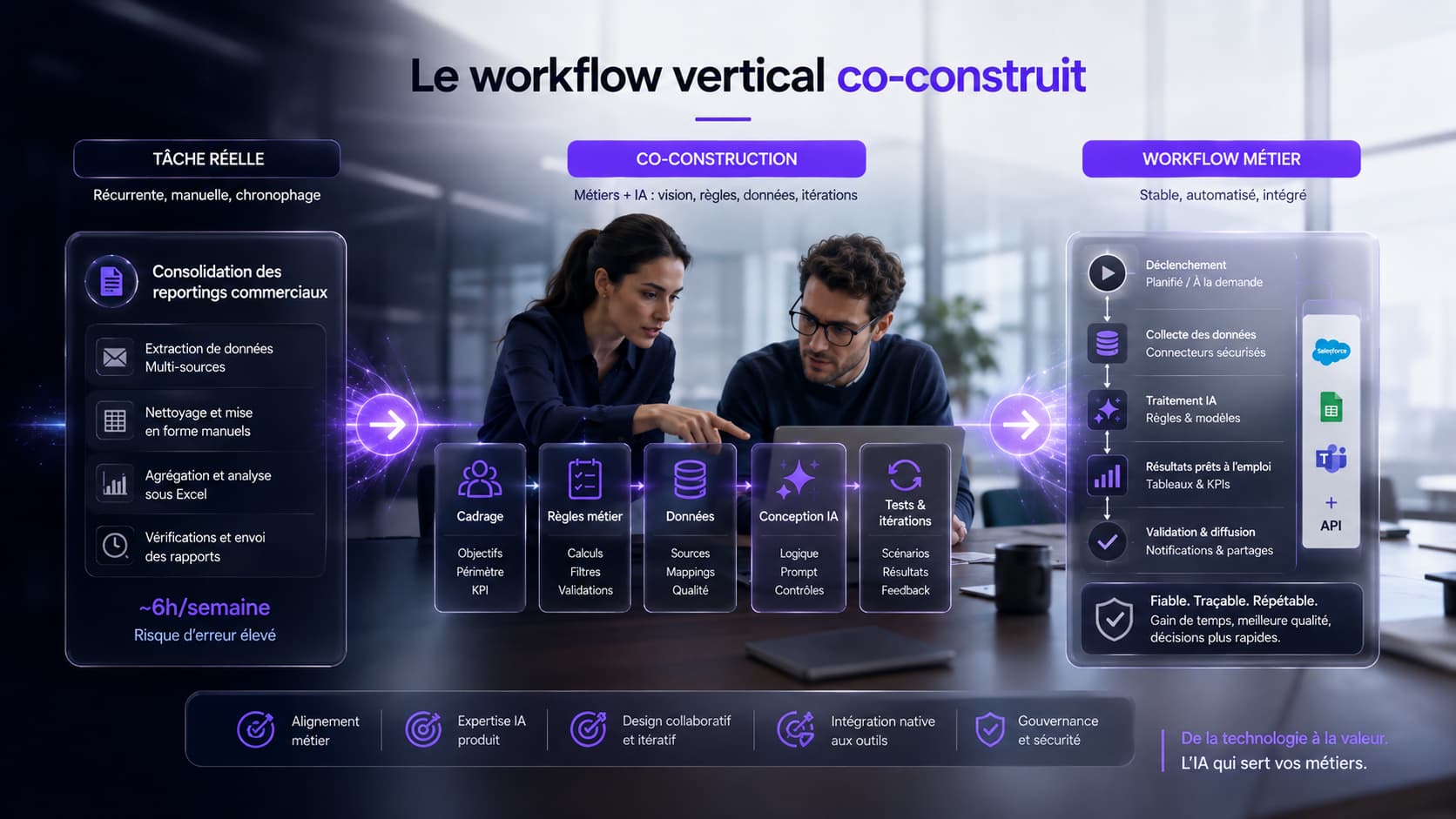
Because a vertical workflow starts from a real task in a real function, rather than from a generic capability looking for a use. That is the difference between "here is an assistant, figure it out" and "here is the sequence that handles your contract reviews, your lead qualification, your non-conformity analysis".
BCG's 10-20-70 framework gives the order of magnitude: across hundreds of engagements, the firm estimates that around 10% of the value produced by AI comes from the algorithms, 20% from technology and data, and 70% from people and process redesign. Most organisations invert that split in their budgets. That is the mechanical cause of the gap between equipment and effect.
A vertical workflow has four attributes:
- It is anchored in an identified recurring task — not a family of use cases, but one task somebody performs every week.
- It is co-built with the experts in that function, who supply the real inputs, the edge cases, the quality criteria and the regulatory requirements. Nobody else knows them.
- It is connected to the tools and documents where the work actually lives, rather than fed by copy-paste.
- It compounds: once it holds up, the know-how is encoded and shared, instead of staying in the head of whoever found the right prompt.
This is also what makes the setup impossible to copy. A competitor can subscribe to the same model, the same enterprise plan, the same vendor. They will not have your processes, your edge cases or your quality standards. The model is a commodity; your workflows are an asset.
Skills transfer is what keeps the setup alive. A workflow only a supplier can evolve dies at the first reorganisation. That is why training teams to design and maintain their own workflows is a component of the engagement, not a side product. (METASENSE runs a training and skills-transfer activity; it is not certified.)
On tool choice: Claude is our lead tool, because its enterprise ecosystem is currently among the best equipped for building genuine business workflows. But method comes before tool — for organisations concerned with sovereignty and data handling in Europe, the enterprise offering from Mistral (a French vendor) is a credible alternative, and the approach described here is unchanged. The method is set out in detail in our guide How to integrate Claude into your company's processes, and the anatomy of a business workflow in Building an AI workflow for each business function with Claude.
Why is cost governance inseparable from adoption?
Because spending you cannot explain is spending you cut. This is the second blocker of adoption — less visible than the first, but often more decisive: it is rarely the business that stops an AI programme, it is finance, at budget time.
The mechanism is simple. The more usage intensifies — users, integrations, multi-step sequences — the more token consumption rises. Without visibility per team and per use case, the invoice grows while nobody can tie a line of cost to a unit of value. Leadership ends up defending a budget it cannot justify — and Gartner explicitly lists escalating costs and unclear business value among the main causes of abandoned generative AI projects.
Four levers make this line item manageable:
- Visibility — knowing who consumes what, per team and per use case, with alerts when consumption drifts.
- Boundaries — quotas and rules per department, so that experimentation does not become budget leakage.
- Optimisation — the right model for the right task, standardised templates, batching of high-volume processing, caching of repeated context.
- Value-versus-cost decisions — tying every use to what it produces, so you can cut what costs without returning and invest where the leverage is real.
These mechanisms, their documented orders of magnitude and the tracking method are set out in our article Controlling enterprise AI token costs.
The argument for leadership — Cost control is not a brake on AI: it is what makes the rollout sustainable and defensible. A programme that can state "this use costs X and returns Y" gets through the committee. A programme that can only say "it consumes" does not.
Where should you start to restart AI adoption in your organisation?
Start with one function, not the whole company — and prove it through usage before extending. Lasting adoption is built on proof, never on mandate. Here is the path we recommend.
- Pick a pilot function where the pain is clear and the value measurable — not the most enthusiastic function, the one where the effect will read most clearly.
- Audit that function's usage: recurring tasks, real licence usage, shadow AI, available data, current cost.
- Prioritise two or three cases with strong leverage, and explicitly rule out those without it.
- Co-build the first workflow with the experts in that function, until it holds up on real cases, edge cases included.
- Capture the know-how so it is shared and reusable instead of staying in one person's head.
- Plug in cost tracking from day one, not at the moment of the budget surprise.
- Measure, adjust, then extend to the next function, with internal proof in hand.
Worth remembering — The classic trap is the simultaneous mass rollout. The right sequence is the reverse: one function, one workflow that holds up, one quantified internal proof, then extension. The organisations that succeed are not the ones that deployed fastest — they are the ones that structured before extending.
To go further on the two following steps: capturing and sharing know-how across the organisation and orchestrating multi-step sequences when it is warranted.

Let us review your AI usage
You have the licences. What remains is turning them into augmented processes. METASENSE, a Creative Tech agency based in Vélizy-Villacoublay, audits your usage function by function, co-builds your workflows with your experts, trains your teams to run them independently, and installs governance of access and cost. Our credibility is concrete: we design and operate AI systems in production ourselves, every day — so we can tell a use that holds up from a demonstration that impresses.
Every context differs, so we price each engagement individually, after a scoping phase.
Explore our enterprise AI enablement → · Get in touch
FAQ — Enterprise AI adoption
Why are our AI licences not being used?
Because no use case has been tied to a task employees actually perform. Distributed access does not create usage: the generic capability has to be translated into work sequences specific to each function. Dormant accounts are a relevance problem, not a usability or supplier problem.
What is enterprise AI adoption?
It is the move from distributed access to structured, measured and governed business use. It sits between rollout (handing out licences) and transformation (redesigning the operating model). Its unit of work is not the licence but the business workflow, and its metric is not the number of seats.
How many companies actually get value from generative AI?
Few, at this stage. The MIT NANDA 2025 report estimates that around 95% of generative AI pilots deliver no measurable return on the P&L. McKinsey finds that only 39% of organisations attribute any EBIT effect at all to AI, most often below 5%.
Is the problem the choice of model or of vendor?
Rarely. BCG's 10-20-70 framework estimates that around 10% of the value comes from the algorithms, 20% from technology and data, and 70% from people and processes. Changing vendor without changing the organisation reproduces the same outcome, plus a migration cost.
What is shadow AI, and why does it matter?
Shadow AI is the use of AI tools the organisation has not approved, on personal accounts. MIT finds that employees at more than 90% of companies do it, while only 40% have an official subscription. It proves the skill is there: it is the internal offering that is not useful enough.
How do you put an end to shadow AI?
Not by prohibition alone, which simply displaces the usage. By making the official setup more useful than the workaround: connected to the team's tools and documents, fed with its context, paired with a clear policy on which data may be exposed. A ban is a guardrail, not a strategy.
What is an AI usage audit by business function?
It is a stocktake answering three questions: where AI creates value in your organisation, where it does not, and what current usage costs. It examines six axes: task mapping, real usage, data and tools, rights and access, consumption and cost, and team maturity.
Should you start with one function or deploy at scale?
With one function. The right sequence is: a pilot function where the pain is clear, two or three prioritised cases, a co-built workflow that holds up on real cases, quantified internal proof, then extension. The simultaneous mass rollout is the most common trap.
What is a vertical workflow, and how does it differ from a prompt?
A vertical workflow is a tooled, repeatable sequence that handles a recurring task within a given function, with its real inputs, its edge cases and its compliance requirements. A prompt is a one-off request. It is that structure, and its co-construction with the experts, that makes the gain reproducible.
How do you justify the AI budget to the finance director?
By tying every use to what it produces. Four levers make the line item manageable: visibility per team and use case, boundaries through quotas, technical optimisation, and value-versus-cost decisions. Gartner lists escalating costs and unclear business value among the main causes of abandonment.
Should teams be trained, and in what exactly?
Yes, and not in "using a chatbot". Useful training covers designing and maintaining their own workflows, so the setup survives the departure of a person or a supplier. It is a component of the engagement, not a side product. METASENSE runs a training and skills-transfer activity, which is not certified.
Can this approach be run with a sovereign assistant such as Mistral?
Yes. The method is independent of the tool: usage audit, co-built workflows, know-how capture, governance of access and cost. Claude is our lead tool for the depth of its enterprise ecosystem, but for organisations concerned with European sovereignty, Mistral's enterprise offering is a credible alternative.
How much does an AI adoption engagement cost?
The cost has two parts: the engagement itself (audit, workflow design, skills transfer, run) and the running cost of the uses, meaning consumption. METASENSE prices each engagement individually, after a scoping phase: the scope depends on the number of functions involved, team maturity and compliance constraints.
Sources
- Bpifrance Le Lab — Baromètre ETI 2026 (16th edition, over 530 executives, published 23 June 2026: 77% of French mid-market companies use generative AI, up 19 pts in a year; 17% of users report time saved) : lelab.bpifrance.fr
- MIT NANDA — The GenAI Divide: State of AI in Business 2025 (300+ initiatives, 52 organisations, 153 executives: ~95% of pilots with no measurable return; "learning gap"; shadow AI economy 40% / 90%) : PDF report — press coverage: Fortune
- McKinsey & Company — The state of AI in 2025: Agents, innovation, and transformation (39% attribute an EBIT effect, most often < 5%) : mckinsey.com
- Boston Consulting Group — the 10-20-70 framework (10% algorithms / 20% technology and data / 70% people and processes) and From Potential to Profit: Closing the AI Impact Gap : bcg.com — summary: Forbes, Jan. 2026
- Boston Consulting Group — AI at Work 2025: Momentum Builds, but Gaps Remain (June 2025: regular usage rises from 67% to 79% beyond five hours of training; only 36% consider their training sufficient) : bcg.com
- Gartner — Gartner Predicts 30% of Generative AI Projects Will Be Abandoned After Proof of Concept By End of 2025 (29 July 2024) : gartner.com
- Gartner — Gartner Predicts Over 40% of Agentic AI Projects Will Be Canceled by End of 2027 (25 June 2025) : gartner.com