

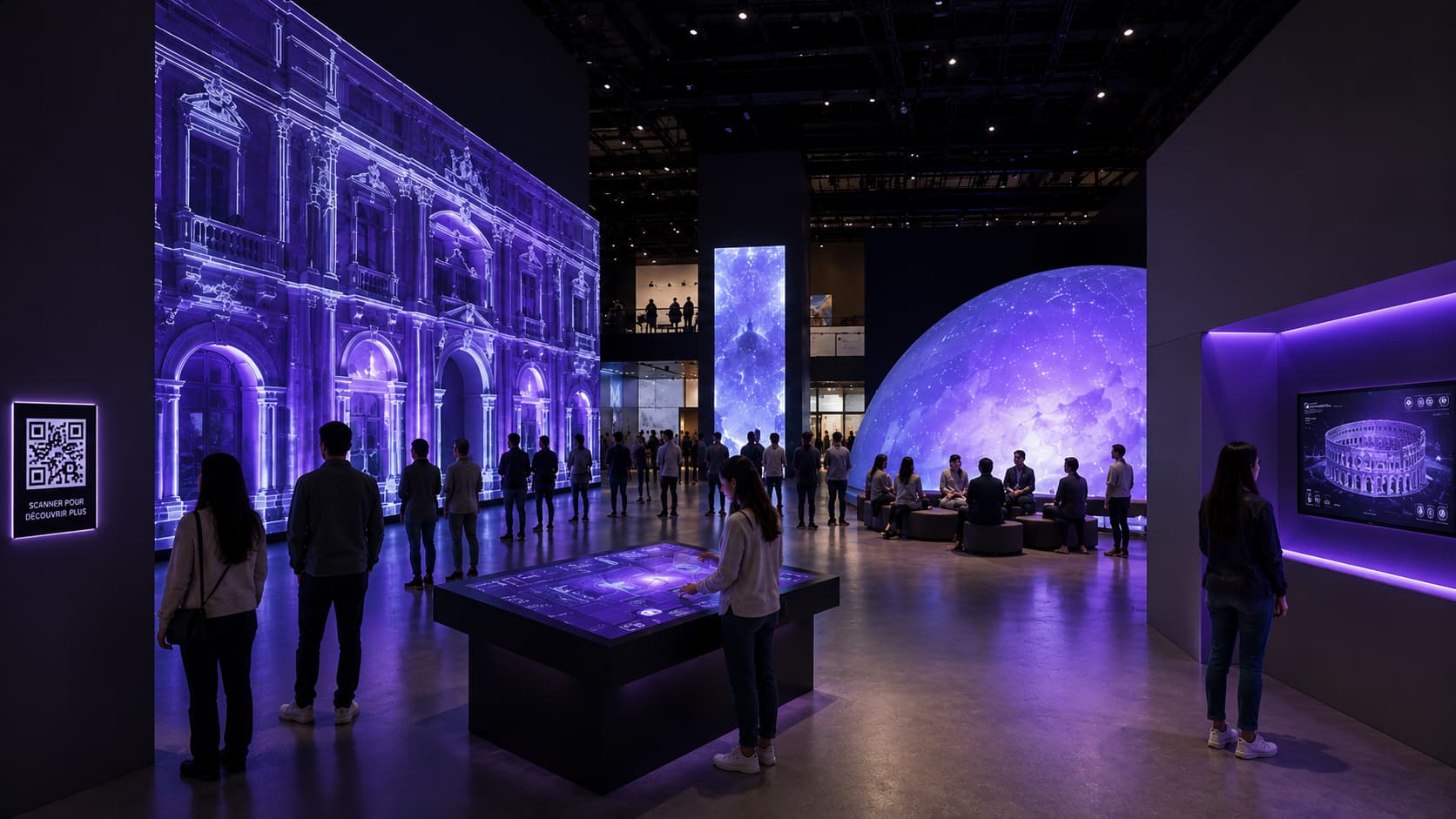
There is no "best" immersive technology: there is the one that fits your venue, your visitor flow, your running budget — not just your capital budget — and the team that will operate the installation five years from now. Video mapping wins on collective impact and on the façade. Headset VR wins on deep, supervised immersion for small groups. The dome wins on the seated group experience. The touchscreen kiosk wins on in-depth consultation at a single stopping point. Web AR and 3D web win on flow, running cost and lifespan, because there is no hardware fleet to maintain and no app to re-publish with every OS release.
This comparison of immersive technologies in museums is a decision grid built on real constraints, not a catalogue. We are a Creative Tech agency based in Vélizy-Villacoublay, and we design these setups: 3D Web Apps, AR, gamification, touring installations. So we have a bias, and we state it plainly: web without an app usually holds up better over time. You will see where that is false, and why.
In short
- Video mapping: unbeatable on collective impact, façades and one-off events. Real running cost (projectors, alignment, operation), and weather-dependent outdoors.
- Headset VR: the deepest immersion, but low capacity, mandatory staffing, and a fleet to renew. The Quest 1 lost its security updates five years after launch.
- Web AR — no app download: reaches the whole flow via a QR code, with zero hardware, but depends on the visitor's smartphone — 91% of people aged 12 and over own one in France (Baromètre du numérique, CREDOC, édition 2026), so not 100%.
- 3D web (WebGL): the foundation that outlives the exhibition — the content stays online, indexable and reusable.
- Immersive dome: the best seated group experience; controlled capacity, but floor area, ceiling height and staffing to plan for.
- Touchscreen kiosk or table: the safe choice for consulting and going deeper; it is also the setup that ages most visibly.
- The deciding criterion: cost per visitor reached across the lifespan of the installation. A fleet of four VR headsets reaches roughly 21% of a 800-visitor day; a QR code reaches all of them.
Which six immersive technologies should a museum compare?
Six families cover most immersive interpretation projects: video mapping, headset virtual reality, Web AR with no download, real-time 3D web (WebGL), the immersive dome, and the touchscreen kiosk or table. They often combine within a single journey, but they do not substitute for one another: each answers a different interpretation intent.
- Video mapping: video projection aligned to the volumes of a building, a set or an object. A non-invasive technique, which makes it valuable on a listed monument.
- Headset virtual reality (VR): the field of view is entirely replaced by a 3D environment. It carries the visitor into a vanished state of the site, into a body, into a scale otherwise out of reach.
- Web AR with no download: an augmented reality experience that opens in the browser via a QR code, with no App Store or Play Store. The augmented layer anchors onto an artwork, a label or the real space.
- Real-time 3D web (WebGL): interactive 3D models displayed directly in the browser. It is the technical foundation of Web AR, and an experience in its own right — exploring a reconstructed monument, handling an object, comparing a before and after.
- The immersive dome: a hemispherical room where the image is projected across the whole vault, usually at 180°, for a seated group. The direct heir of the planetarium.
- The touchscreen kiosk or table: a fixed consultation station along the journey. It deepens, contextualises and plays, but it does not immerse in the strict sense.
A useful definition — An immersive technology is defined by what it does to the visitor's gaze: it moves them (VR, dome), it augments what is in front of them (Web AR, video mapping), or it gives them something to handle (3D web, kiosk). Three interpretation intents, and one practical consequence: until the intent is settled, the specification is written backwards.
Immersive museum technologies: the comparison in one table
Here is the comparison on what actually decides a project: what each technology does best, the flow it absorbs, and the kind of venue where it belongs. This first table answers "for what use?"; the next one answers "for what budget, and for how long?".
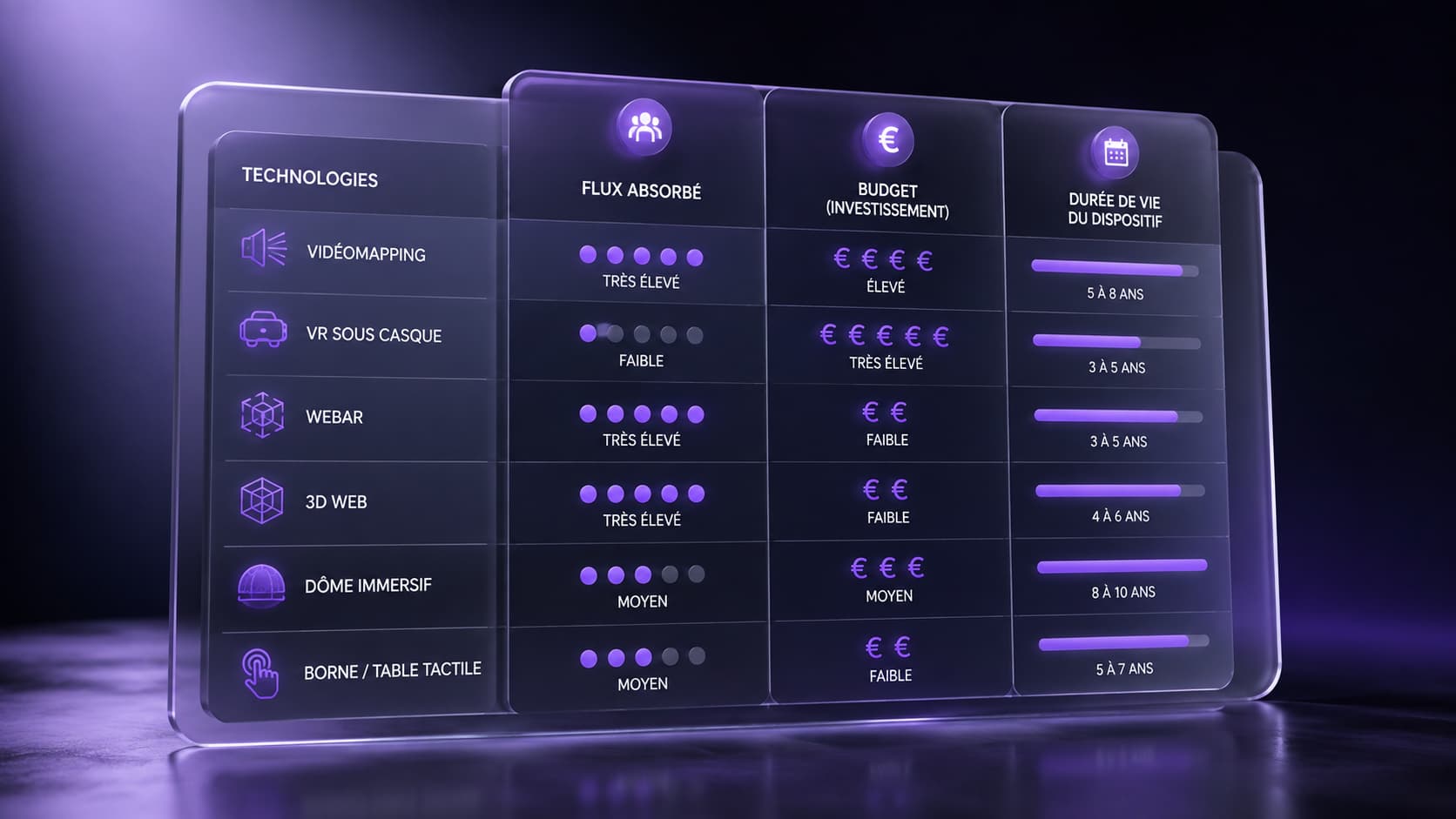
| Technology | What it does best | Flow absorbed | Staffing required | Natural home |
|---|---|---|---|---|
| Video mapping | Collective impact, spectacle, façades, key moments | Very high (a crowd sees the same thing) | Low during, high beforehand | Façade, courtyard, nave, set, large object |
| Headset VR | Deep immersion, travel to another place or another era | Low (1 visitor = 1 headset = 8 to 12 min) | Mandatory (fitting, hygiene, assistance) | Dedicated room, booked slots, workshop |
| Web AR — no download | Augmenting the artwork or the real space, at the scale of the whole audience | Very high (as many as there are smartphones) | Low (signage + QR code) | Permanent journey, outdoors, touring |
| 3D web (WebGL) | Exploring, handling, comparing, understanding a reconstruction | Very high (on site and remotely) | None to low | Journey, gallery, outdoor site, online |
| Immersive dome | The seated group experience, shared contemplation | Medium (sessions of 15-30 people, on rotation) | Medium (welcome, session scheduling) | Dedicated room with ceiling height, or inflatable structure |
| Touchscreen kiosk or table | Consulting, going deeper, playing together at one precise point | Medium (queues beyond 2-3 stations) | Low | Stopping point along the journey, interpretation centre |
And the second table, the one people look at too late:
| Technology | Capital cost benchmark (market, see Sources) | Running cost | Maintenance & spare parts | Lifespan of the installation | Reversibility |
|---|---|---|---|---|---|
| Video mapping | €10,000-15,000 indoors on an object; €20,000-60,000 on a standard façade; €80,000 to €300,000+ on monumental work (Immersive Element, 2026) | High if the event recurs (rental, crew, alignment); moderate for a fixed installation | Projectors, optics, filters, calibration; laser source rated up to ≈ 20,000 h in normal mode (Epson Pro L1100U/L1505U datasheet) | 5-10 years for the installation; the content ages faster than the hardware | Good: nothing is fixed to the projected surface |
| Headset VR | The headset is the lightest line in the budget: operation is what costs | The highest: dedicated staff, hygiene, charging, breakage, theft | Foam, straps, lenses, batteries; fleet renewal | Bound by manufacturer support: the Quest 1 (2019) lost its security updates on 31 August 2024 | Low: content tied to a hardware ecosystem |
| Web AR — no download | Cost = design + 3D content, no hardware to buy | Very low: hosting + editorial updates | No spare parts; maintenance = browsers and compatibility | Long: a URL is not dismantled when the exhibition closes | Excellent: the setup outlives both the venue and the exhibition |
| 3D web (WebGL) | Cost = modelling + development, shared with Web AR | Very low | Updating the technical foundation | Long; 3D assets are reused (publishing, website, next exhibition) | Excellent |
| Immersive dome | No supplier publishes prices: every offer reviewed points to a quote. Two segments to separate, the inflatable touring dome and the fixed custom-built one | High: a room tied up, front-of-house staff, session scheduling | Fisheye or multi-projection systems, calibration, sound, canvas | 7-15 years for the structure; the films age faster | Medium (inflatable) to low (fixed) |
| Touchscreen kiosk or table | Hardware cost under control, software cost often underestimated | Moderate | The weak point: touch panels, embedded PCs, obsolete operating systems, parts unobtainable at 7 years | 5-8 years, and it ages visibly to the public | Medium |
Worth remembering — The two columns specifications forget most often are "running cost" and "spare parts". A setup that costs €40,000 plus €12,000 a year to run for eight years actually costs €136,000. A setup at €60,000 that costs €1,500 a year costs €72,000. The purchase price is not the price of the installation.
Which constraints should really decide?
Six constraints are enough to settle the question, and none of them is technological: visitor flow, the double capital/running budget, maintenance and spare parts, accessibility, the skills available on the operator's side, and the target lifespan together with what is left at the end. Put them in that order, and the choice of technology almost makes itself.
1. Visitor flow: how many people, and in how much time?
This is the harshest constraint, and the one most often dodged. The maths fits on one line. A VR headset occupies one person for 8 to 12 minutes, or roughly six rotations an hour once fitting and cleaning are counted. With four headsets and one member of staff, across a seven-hour opening day: 4 × 6 × 7 = 168 visitors reached. On a day with 800 visitors, that is 21% of the audience — the remaining 79% see the queue, not the installation. A QR code on a label, by contrast, absorbs everyone at once.
The national scale gives the measure: 32.5 million visitors in 2024 across national museums and exhibition venues, up 1% (Patrimostat 2025, Ministère de la Culture). So the right question is not "how many visitors a year?" but "how many simultaneous visitors at peak?": a spring Sunday, the day after school holidays, an opening day. A setup sized on the average saturates at peak.
2. The double budget: capital and running cost
Capital spend is voted, visible, arbitrated. Running cost is what decides, three years later, whether the installation is still switched on. Add it up across the target lifespan: acquisition cost + (annual cost × number of years) + foreseeable hardware renewal. Divide by the number of visitors actually reached. You get the only indicator that compares like with like: cost per visitor reached.
The calculation, on a worked case — A museum with 800 visitors on a peak day, 120,000 visitors a year, an installation written off over eight years. The attendance assumptions below are ours and should be replaced by yours; the amounts come from the sourced market benchmarks further down.
- A VR fleet, four headsets and one member of staff. Contact rate: 168 visitors a day, or 21% of the flow. At equal total budget, a setup that reaches only a fifth of the audience has a cost per visitor reached roughly five times higher than one that reaches everyone. That is arithmetic, and it is independent of the price of the headset.
- Façade video mapping. On the published range of €20,000 to €60,000 (Immersive Element, 2026), a mapping at €40,000 played 60 evenings to 300 people works out at about €2.20 per spectator in the first season. Replayed over four seasons with unchanged content, it falls to around €0.55 — excluding the annual operating cost, which is precisely the line this calculation forces you to price.
- Web AR and 3D web. The denominator is the entire flow: 120,000 people a year, close to a million over eight years, with no fleet to renew. Hence the paradox: these setups argue badly on purchase price and very well on cost per visitor — provided the real scan rate is measured, which few projects do. A QR code nobody scans has an infinite cost per visitor reached.
3. Maintenance and spare parts
A physical installation is an industrial object with a life cycle. Touch panel, embedded PC, graphics card, headset: all of it gets replaced, and not always like for like five years later. Require from the supplier the list of wear parts, their estimated life and their availability, exactly as you would for a lift, and hold a buffer stock of the critical items.
The study « Musées et offres de médiation numérique : quelle(s) durabilité(s) ? », conducted in 2025 by OPUS (Alliance Sorbonne Université) and the agency Correspondances digitales on the basis of 30 professional interviews, makes exactly this point: managing obsolescence must be considered from the design stage, alongside frugality and replicability — not when the breakdown happens.
4. Accessibility: RGAA, physical access and audiences excluded by the technology
This is the most underestimated constraint, and the one that exposes a public body or a public service concession holder legally. Three levels to separate:
- Digital (RGAA). A website, a visit Web App, a mobile app or a kiosk connected to an online service all fall under article 47 of the French law of 11 February 2005 and under RGAA 4.1.2, in force since 18 April 2023. Public bodies and holders of a public service delegation are covered, which means the vast majority of museums and heritage sites. Since 6 September 2024, the public sector faces administrative penalties of up to €50,000, renewable every six months where the breach persists (Access42). Two points to build in if you are writing a long contract: version 5 of the RGAA is announced for late 2026 by the DINUM, and the European Accessibility Act (directive 2019/882) has applied since 28 June 2025.
- Physical access. A dome with steps, a kiosk mounted too high, a VR headset in a space you cannot move through: the accessibility of the installation is also the accessibility of its surroundings.
- Audiences excluded by the technology itself. Headset VR is not recommended by manufacturers for children under 12-13, a threshold which, as a review published by The Conversation (2021) points out, reflects industrial caution more than clinical evidence. Add motion sickness, a history of photosensitive epilepsy, wearing glasses, balance disorders. The practical lesson is simple: always plan the alternative.
A point of honesty that cuts against our own bias: the web is the technology whose compliance is the most directly auditable. Article 47 also covers mobile apps, software packages and digital street furniture — a touchscreen kiosk falls within it — but it is on a web setup that an RGAA audit is conducted without argument, criterion by criterion. Choosing Web AR or 3D web therefore means accepting a formal, enforceable requirement, and a real workstream in the project. It is also the only option where accessibility can be fixed afterwards, without changing a single screw.
5. Skills on the operator's side: who presses the button on Monday morning?
Ask who, by name, will switch the installation on and off, update it and troubleshoot it, and how much working time that represents. A dome and a headset fleet imply a daily presence. A Web App mainly implies a back office the interpretation team can use without a developer. That is why, on visitor journey projects, we deliver a custom-built CMS: without editorial autonomy, an installation freezes and dies of its own content.
6. The target lifespan, and what is left of it
Three months, three years, ten years: the answer changes the ranking. Under six months, spectacle dominates and durability weighs nothing. At ten years, what decides is updating content without calling the supplier back, and surviving two or three generations of hardware.
Ask the exit question in the same breath: when the exhibition closes, or when the contract ends, what does the institution keep? Reusable 3D models and a URL still online, or a box of headsets whose software ecosystem is no longer updated? Reversibility is a property of the technology you choose as much as a clause in the contract.
What does it cost? Market benchmarks, and what they are worth
No serious supplier prices an immersive setup without having seen the venue, the capacity and the available content: the benchmarks below are there to situate an order of magnitude, not to build a budget. We give them because navigating without any reference point leads to failed procurement.
| Line item | Public benchmark | Source |
|---|---|---|
| Indoor video mapping, object or compact set design | €10,000 to €15,000 | Immersive Element, 2026 |
| Architectural video mapping, standard-sized façade | €20,000 to €60,000 | Immersive Element, 2026 |
| Monumental video mapping (château, cathedral, large-scale show) | €80,000 to over €300,000 | Immersive Element, 2026 |
| Mapping show, medium façade with original content | €35,000 to €85,000 | Lime Art Group, updated July 2026 |
| Mapping show on a landmark monument / festival | €100,000 to €250,000 and above | Lime Art Group, updated July 2026 |
| 6 m inflatable dome (capacity ≈ 20 adults or 25 children per session, setup ≈ 30 min) | no public price — see below | Les Ateliers de l'Univers (capacity and setup), 2026 |
| Projector laser light source | ≈ 20,000 hours stated in normal mode (up to 30,000 h in extended mode), i.e. ~14 years at 4 h/day | Epson, light source datasheet Pro L1100U / L1505U |
Four cautions when reading this:
- These ranges come from suppliers, not from an independent observatory. To our knowledge there is no public price reference for cultural immersive installations in France. We would rather say so than fill the gap.
- The immersive dome has no public benchmark at all, and that is information in itself. We went through the catalogues of the main projection dome suppliers: none displays an amount. Polidomes points to a calculator and offers nothing below 8 m in diameter; FullDome.pro shows only a "request a quote" button. A dome is therefore budgeted by consultation, not by comparison. The variables that move the price by a factor of ten are known: diameter, inflatable or fixed structure, single fisheye projector or calibrated multi-projection, sound system, and above all film production. Require the structure, the projection system and the content to be priced separately: without that, two dome offers are not comparable.
- Hardware is never the dominant line. The price of a headset says nothing about the cost of a VR setup: content, staffing and operation are what weigh.
- For Web AR and 3D web there is no hardware benchmark at all: the budget is entirely design, 3D production and development. These setups therefore compare badly on "purchase price" and very well on eight-year cost. We set out the costing logic of an immersive event setup in a dedicated article; at METASENSE, we price each engagement individually, after visiting the venue.
Why does web without an app usually hold up better over time?
Because a web setup has no hardware fleet to maintain, no headsets to renew and no app to re-publish with every OS release — and because it carries on existing when the exhibition closes. That is our argument, and it rests on four verifiable mechanisms rather than on an aesthetic preference.
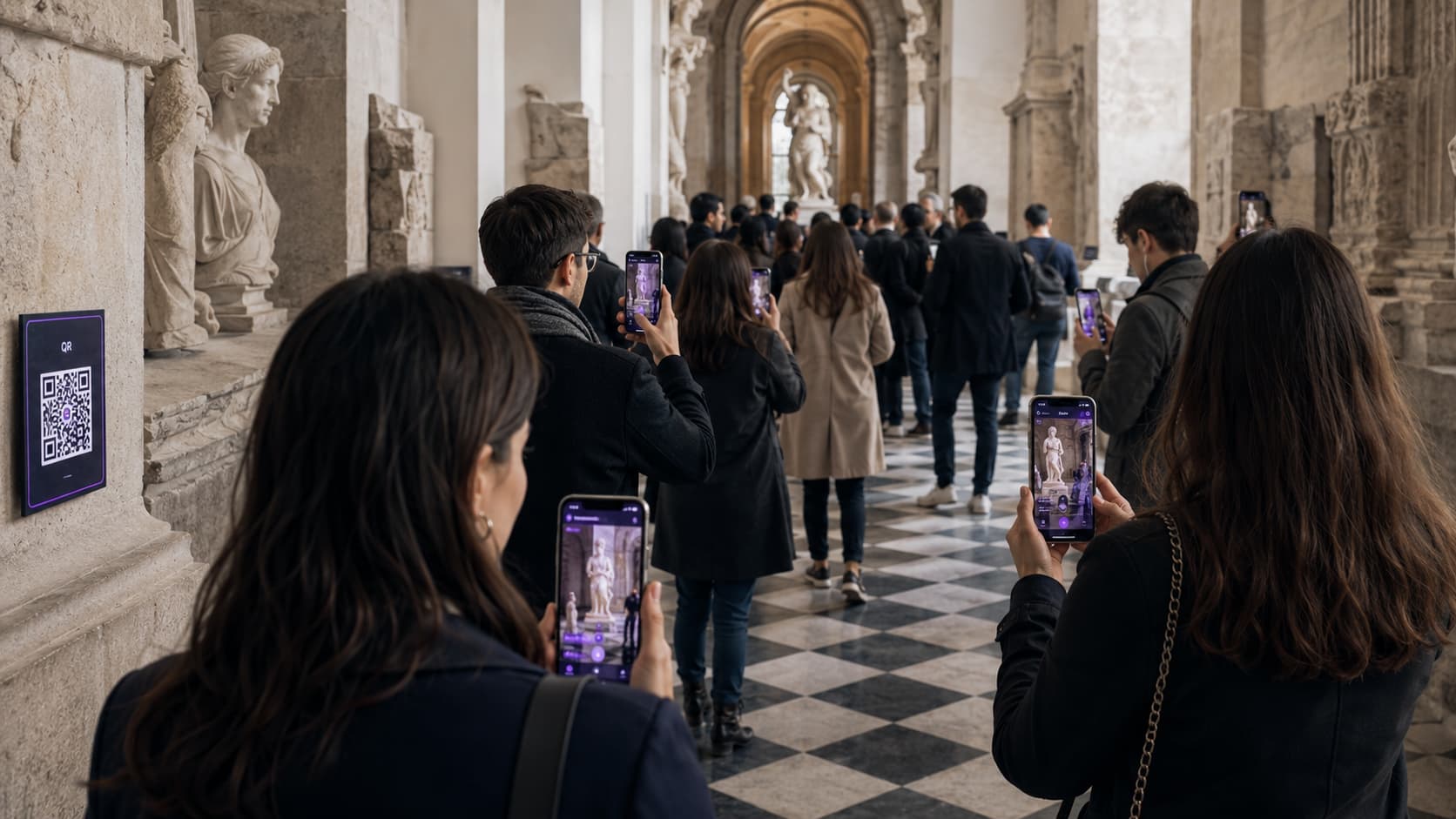
1. The visitor's hardware replaces yours. In France, 91% of people aged 12 and over own a smartphone (Baromètre du numérique, édition 2026, CREDOC for Arcep, Arcom, CGE and ANCT; 4,145 people surveyed, fieldwork June 2025). The fleet is already there, already charged, already up to date, and it is not yours: renewing it costs you nothing.
2. No app store, no friction. A native app imposes a download, an account, storage space and a good enough connection on the visitor. To our knowledge there is no consolidated public statistic on download rates per venue: the figures in circulation cannot be verified, and we will not repeat them. The structural point, however, is beyond dispute: an experience that opens from a QR code has no download rate, because there is nothing to download. We developed this point in our article on the museum visit app with no download.
3. The software life cycle is not yours. A native app is re-published with every major iOS or Android release, or it is pulled from the stores. A VR setup depends instead on its manufacturer's support: the Meta Quest 1, released in May 2019, stopped receiving security updates and bug fixes on 31 August 2024, five years on. That is the normal rhythm of consumer electronics. A permanent visitor journey, however, is written off over ten years.
4. The setup outlives the exhibition. A 3D model produced for an augmented journey gets reused: on the website, in a publication, in the next exhibition, in an education pack. A URL stays online, indexable, citable, measurable. It is the only case among the six where the question "what is left?" has a positive answer by default.
Our own evidence. For Nîmes-la-Romaine (Nemausus), with Aura (ex-EDEIS), the City of Nîmes and the Musée de la Romanité, we designed a multilingual WebGL 3D Web App opened by QR code: 3D exploration of the monuments (the Arena, the Tour Magne, the Maison Carrée), AI-driven storytelling, augmented reality, a treasure hunt and a custom-built CMS so the teams can evolve the content without us. The setup was sized to take thousands of simultaneous connections — a figure that would make no sense with a headset fleet. Details in our case study: augmented 3D visitor journey in Nîmes.
Where the web, honestly, is not enough. Four real limits, to build into the specification from the start:
- WebXR is not universal. Chromium browsers (Chrome, Edge, Samsung Internet) have offered partial support for the WebXR Device API since version 79; Safari on iOS and iPadOS does not support it, and it is disabled by default on Safari for macOS (caniuse, checked September 2026). In practice, a web augmented reality experience on iPhone does not run through WebXR but through adapted camera/WebGL approaches. That is real engineering work, not a box to tick.
- 9% of people aged 12 and over have no smartphone, and some of those who do will not take it out during a visit. That figure says nothing, moreover, about under-12s, who fall outside the survey and who are often the priority audience of a site museum or a heritage interpretation centre. A web setup must always have its non-digital counterpart: labels, staff-led interpretation, loan tablets.
- Poor networks are our problem too. We criticise the native app for requiring a good enough connection where the network is bad; a 3D Web App loads its WebGL assets over that same network, sometimes heavier than a download made at home the night before. The answer is technical and can be checked during procurement: a weight budget per scene, texture compression, progressive loading, caching, a dedicated Wi-Fi point where the site allows it. Require that performance budget in the offer, not after acceptance testing.
- The web does not create collective impact. Twenty people each looking at their own screen do not live the same thing as twenty people looking up at a façade. If the goal is shared emotion, the web is not the answer.
Where do video mapping, VR and the dome genuinely win?
Each of these three technologies does something the web cannot do, and saying so is the condition for being credible on everything else.
Video mapping: collective impact and respect for the monument
Video mapping is the only technology on this list that produces an aesthetic shock shared by a crowd, with nobody having to put anything on. No queue, no headset, no phone: you look up. It is also a non-invasive technique, which does not alter the projected surface — a decisive argument in front of a heritage architect or a curator.
It wins on the event: an opening, a museum night, the summer season, a reopening after works. It also wins indoors, on a set or a large object. Its limits are accepted: outdoors it depends on darkness and weather, it mobilises a technical crew, and the alignment has to be redone at every move.
Headset VR: deep, supervised immersion
Nothing matches a headset for bringing to life what no longer exists, what is out of reach, or what has no human scale. Descending into a collapsed gallery, standing inside a destroyed building, seeing from an impossible vantage point: the quality of presence is of a different order from anything a screen produces.
It wins in a supervised setting: booked slots, school groups, workshops, premium tours. In other words, when low capacity becomes a deliberate editorial choice and when the ticket or the subsidy covers the staff member. The projects that fail are almost always those that sold it as a mass setup — 21% of the flow, as we saw above, when everything goes well.
The immersive dome: the seated group experience
The dome is the only format that combines 180° immersion with a seated collective experience, controlled capacity and scheduled sessions. It brings the sharing that VR cannot give, and the envelopment that video mapping cannot give. It also structures the visit: a session has a start, an end and a duration, which regulates the flow across the whole journey.
Its constraints are architectural before they are technological: floor area, ceiling height, access, darkness, acoustics, evacuation. Two segments to separate. The inflatable dome — a 6 metre model goes up in around thirty minutes and seats roughly 20 adults or 25 children per session (Les Ateliers de l'Univers) — removes most building constraints and opens up touring, at the cost of a limited image and capacity. The fixed custom-built dome offers the opposite, against a lasting property commitment. Neither has a public price: see the previous section for how to obtain a comparable one.
What we do not prove. We have no delivered immersive dome project to cite. We say so rather than pad it out: the section above draws on the published characteristics of these installations and on analysis of the mechanics, not on field experience of our own. Our demonstrated expertise lies in immersive web, real-time 3D, augmented reality with no download and touring installations. If your project is first and foremost a dome, the eight questions below will help you frame the procurement. If the open question is rather "which setup for my venue, my flow and my budget", that is exactly where we come in.
How does the choice change with the type of venue?
The same interpretation intent does not call for the same technology outdoors, in a permanent journey, in a temporary exhibition or on tour: the venue dictates the flow, the maintenance and the lifespan.
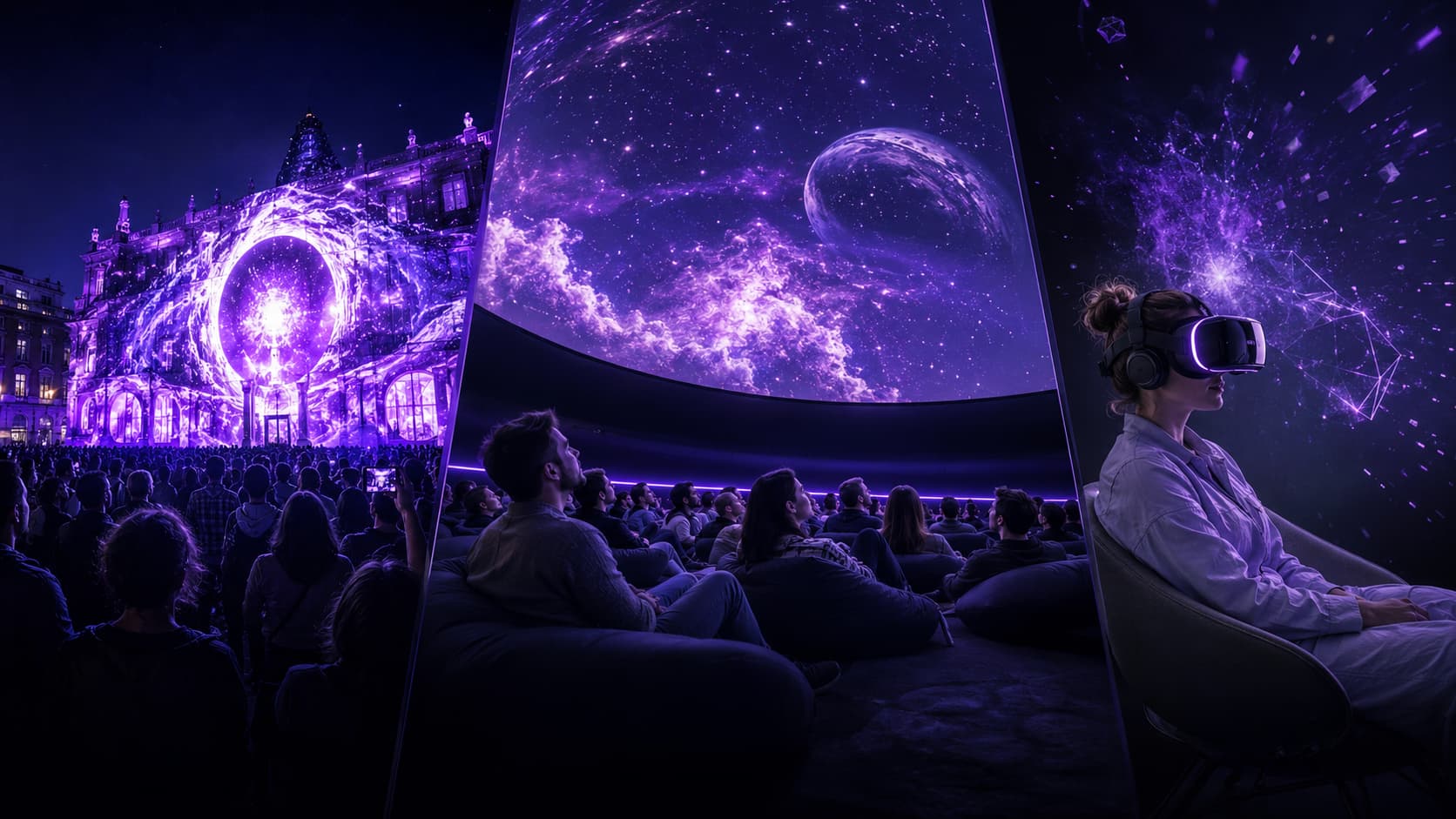
| Type of venue | Dominant constraint | Combination that works | To avoid |
|---|---|---|---|
| Outdoor heritage site, open air | No power everywhere, weather, vandalism, no continuous security | Web AR + 3D web via QR code on existing furniture; video mapping as a seasonal highlight | Unsupervised fixed hardware, headsets |
| Site museum / permanent journey (10 years) | Lifespan, editorial autonomy, running budget | 3D web + Web AR with a CMS, plus one "signature" installation (dome or indoor mapping) | Multiplying kiosks that will all age together |
| Temporary exhibition (3-6 months) | Immediate impact, install and strike, reuse | Indoor video mapping or supervised VR; 3D assets designed to be reused | Custom development that cannot be reused |
| Touring exhibition | Transport, reassembly, robustness, varying rooms | Web AR (nothing to transport) + inflatable dome if the collective experience is central | Installations aligned to the millimetre on a single venue |
| Heritage interpretation centre / CIAP | School audiences, groups, staff present on site | Collaborative touch table + VR in a supervised workshop | Unsupervised open-access VR |
| Events, off-site, trade shows | High flow, short time, engagement measurement | Web AR + gamification, lightweight physical structures | Setups that take a long time to explain |
Two mechanics we know how to deploy, transposable to any subject, heritage or otherwise:
- Orano — national roadshow. A touring setup combining physical structures, augmented reality and a serious game about radiation protection careers: 5 sites, around 870 visitors. The touring lesson is clear: what travels well is the content and the mechanics, not installations aligned to one venue.
- Gocad. Phygital kiosks paired with a web augmented reality game with no download: over 6,000 participants. Web AR absorbs a flow of audience that VR cannot, on a subject entirely unrelated to heritage.
On touring, see the touring exhibition of a private collection; on museum uses of AR, augmented reality in museums: the uses that work.
Which questions should you ask before writing the specification?
A specification that prescribes a technology before answering these eight questions produces an unsuitable installation, whichever supplier wins. These questions come before the six constraints in the previous section: they define the problem, and the constraints filter the possible answers. Here is the sequence, in order.
- What interpretation intent? Move, augment or give something to handle. One main answer, not three.
- Which priority audience? Families, school groups, individuals, groups, hard-to-reach audiences, audiences with disabilities. The priority audience rules technologies out before the budget does.
- What flow at peak? Not the annual average: the maximum number of simultaneous visitors on a busy day.
- What target lifespan? Three months, three years or ten years — the answer changes everything, and nobody asks it early enough.
- What annual running budget is genuinely secured? Not hoped for: voted, or written into a public service delegation.
- Who operates it, and with how much working time? Name the role, estimate the hours per week, check the person exists.
- What level of accessibility is required? RGAA compliance of the digital part, physical accessibility of the installation, an alternative for audiences excluded by the technology.
- What must be left at the end? 3D source files, exploitation rights, reusable content, technical documentation, back-office access. Write it into the contract: that is where reversibility is decided, not in the closing discussion.
The classic trap — Prescribing the technology in the specification ("delivery of a virtual reality experience") instead of prescribing the objective ("enable 800 visitors a day to understand the state of the site in the 2nd century"). The first formulation closes the door on the best answer; the second lets bidders propose the solution that fits your constraints. A good specification describes a problem, not a solution.
Let us frame your immersive setup
Comparing options before committing a budget calls for someone who will also say what will not work in the venue. That is our role: METASENSE is a Creative Tech agency based in Vélizy-Villacoublay that designs and builds immersive experiences — WebGL 3D Web Apps, augmented reality with no download, gamification, touring installations — from idea to rollout, with a CMS that leaves teams autonomous. We are glad to come in very early, at the programming stage, while the choice of technology is still open: that is where costly mistakes are avoided, and it is also where we will say, if need be, that the right answer is outside our scope.
Let us talk about your project →
To go further: the same comparison logic applied to technical stacks in Three.js, React Three Fiber, Spline: which stack for 3D on the web?, and the wider picture in cultural mediation: 3D, AI and immersive.
We design and produce these interactive installations for museums, content included.
FAQ
Which immersive technology should a museum choose?
The one that matches your visitor flow, your running budget and your target lifespan. Video mapping for collective impact and façades, VR for supervised immersion in small groups, the dome for the shared seated experience, Web AR and 3D web to absorb the whole flow with minimal running cost and a long lifespan.
How much does video mapping on a building cost?
Benchmarks published by suppliers in 2026 put indoor mapping on an object between €10,000 and €15,000, architectural mapping on a standard façade between €20,000 and €60,000, and monumental mapping from €80,000 to over €300,000. These are planning orders of magnitude, never quotes: the price depends on the venue, the surface and the content.
Is virtual reality suitable for a high-traffic museum?
Rarely on open access. One headset occupies a visitor for 8 to 12 minutes, or about six rotations an hour: four headsets across a seven-hour opening day reach 168 people, or 21% of a day with 800 visitors. VR earns its place on booked slots, in workshops or with school groups, where low capacity is a deliberate editorial choice rather than a bottleneck.
What is Web AR with no download?
It is an augmented reality experience that opens directly in the visitor's browser, via a QR code or a link, with no App Store or Play Store. The 3D content anchors onto an artwork, a label or the real space. The institution supplies no hardware: the visitor's smartphone is enough.
Do you need a mobile app for a visitor journey?
In most cases, no. An app imposes a download, storage and a good enough connection on the visitor, then a re-publication on the institution with every major iOS or Android release. A Web App opened by QR code removes all three frictions and stays online after the exhibition closes.
Does a VR headset become obsolete?
It loses manufacturer support before it breaks down. The Meta Quest 1, released in May 2019, stopped receiving security updates and bug fixes on 31 August 2024, about five years on. A permanent journey written off over ten years must therefore budget at least one fleet renewal in its running costs.
Must a digital museum installation comply with the RGAA?
Yes, for its digital part. Article 47 of the French law of 11 February 2005 imposes the RGAA — version 4.1.2, in force since 18 April 2023 — on public bodies and on holders of a public service delegation, which covers almost every museum and heritage site. Since 6 September 2024 the penalty can reach €50,000 for the public sector, renewable every six months. Version 5 of the RGAA is announced for late 2026.
Is virtual reality accessible to every audience?
No, and that is structural. Manufacturers advise against it for children under 12 to 13, and it remains problematic in cases of motion sickness, a history of photosensitive epilepsy, balance disorders or wearing glasses. A VR setup must therefore always come with an accessible alternative to the same content.
Can you do web augmented reality on an iPhone?
Yes, but not through WebXR: Safari on iOS and iPadOS does not support the WebXR Device API, whereas Chromium browsers have offered partial support since version 79 (caniuse). Web AR experiences on iPhone therefore rely on adapted camera and WebGL approaches. That is real engineering work, to be checked with the supplier before committing.
How much does an immersive dome cost?
No projection dome supplier publishes prices: every offer reviewed in 2026 points to a quote, and there is no public benchmark that would allow an honest range to be stated. The variables that move the price by a factor of ten are, however, known: diameter, inflatable or fixed structure, single fisheye projector or calibrated multi-projection, sound system, and above all film production. Ask for a breakdown across structure / projection / content, and build in operation: a room tied up, front-of-house staff, session scheduling.
How do you compare two immersive technologies honestly?
By calculating the cost per visitor reached across the target lifespan: acquisition cost, plus annual running cost multiplied by the number of years, plus foreseeable hardware renewal, all divided by the number of visitors actually exposed to the installation. It is the only indicator that makes a mapping, a headset fleet and a Web App comparable.
What should be left to the institution at the end of the project?
The 3D source files, the exploitation rights to the content, the technical documentation, back-office access and, ideally, assets reusable in another exhibition or online. This reversibility is written into the contract, not at the end of the project: it depends as much on the contract as on the technology chosen.
Sources
- Ministère de la Culture — Patrimostat 2025 (heritage attendance, 2024 data: 32.5 million visitors in national museums and exhibition venues, +1% vs 2023): https://www.culture.gouv.fr/espace-documentation/statistiques-ministerielles-de-la-culture2/publications/collections-de-synthese/patrimostat/patrimostat-2025
- OPUS (Alliance Sorbonne Université) & Correspondances digitales — « Musées et offres de médiation numérique : quelle(s) durabilité(s) ? », 2025 (scientific direction Olivier Aïm and Antoine Roland; 30 interviews; environmental, economic, organisational and technological durability; managing obsolescence from the design stage): https://institut-opus.sorbonne-universite.fr/letude-inaugurale-musees-et-offres-de-mediation-numerique-quelles-durabilites
- CREDOC for Arcep, Arcom, CGE and ANCT — Baromètre du numérique, édition 2026 (91% of people aged 12 and over own a smartphone; sample of 4,145 people aged 12 and over; fieldwork June 2025, published February 2026): https://www.arcep.fr/cartes-et-donnees/nos-publications-chiffrees/barometre-du-numerique/le-barometre-du-numerique-edition-2026.html
- Access42 — Obligations légales d'accessibilité numérique en France (article 47 of the law of 11 February 2005, scope covering public bodies and public service delegation holders, penalty up to €50,000 renewable every six months for the public sector since 6 September 2024): https://access42.net/ressources/accessibilite-rgaa-obligations-legales/
- DINUM — Référentiel général d'amélioration de l'accessibilité (RGAA) (version 4.1.2 in force, updated 18 April 2023; version 5 announced for late 2026): https://accessibilite.numerique.gouv.fr/
- Ministère chargé des Personnes handicapées — « 28 juin 2025 : une avancée décisive pour l'accessibilité des produits et des services en Europe » (entry into application of directive (EU) 2019/882, the European Accessibility Act): https://handicap.gouv.fr/28-juin-2025-une-avancee-decisive-pour-laccessibilite-des-produits-et-des-services-en-europe
- Programmez! — « Meta Quest 1 : fin de support » (security updates and bug fixes stopped on 31 August 2024): https://www.programmez.com/actualites/meta-quest-1-fin-de-support-36664
- Immersive Element — « Quel tarif pour un mapping vidéo ? », 2026 (€10,000-15,000 indoors; €20,000-60,000 for standard architectural work; €80,000 to over €300,000 for monumental work): https://www.immersivelement.fr/articles-de-blog/quel-tarif-pour-un-mapping-video-guide-pour-mieux-anticiper-votre-budget
- Lime Art Group — « How much does a Projection Mapping Show Cost », updated July 2026 (€35,000-85,000 for a medium façade with original content; €100,000-250,000+ for a landmark monument): https://limeartgroup.com/much-cost-video-mapping-show/
- Can I use — WebXR Device API (Safari iOS/iPadOS: not supported; Safari macOS: disabled by default; Chrome, Edge and Samsung Internet: partial support since version 79; checked September 2026): https://caniuse.com/webxr
- The Conversation — « Réalité virtuelle, réalité augmentée : quels risques pour la santé ? », 2021 (manufacturers' age recommendations, motion sickness, photosensitivity; absence of consolidated clinical evidence): https://theconversation.com/realite-virtuelle-realite-augmentee-quels-risques-pour-la-sante-164250
- Epson — Caractéristiques de la source lumineuse laser, projecteurs Pro L1100U / L1200U / L1300U / L1405U / L1500U / L1505U ("up to approximately 20,000 hours" in normal mode, up to 30,000 hours in extended mode, depending on projection mode and ambient conditions): https://files.support.epson.com/docid/cpd5/cpd51322/source/specifications/reference/pl1100u_1505u/spex_laser_pl1100u.html
- Les Ateliers de l'Univers — Planétarium itinérant (6 m inflatable dome: capacity of about 20 adults or 25 children per session, setup in around thirty minutes): https://lesateliersdelunivers.com/le-planetarium-itinerant/
- Polidomes — Fulldome projection and FullDome.pro — Planetariums and education domes — cited here as evidence of the absence of public pricing: the first points to a price calculator and offers no model below 8.0 m in diameter, the second shows only a "request a quote" button. Neither publishes an amount (pages consulted on 2 September 2026): https://polidomes.com/immersive/fulldome-projection/ · https://fulldome.pro/planetariums-and-education-domes/