


A website redesign becomes necessary the moment your site stops serving your business goals: it brings in no leads, it is slow, it was never built for mobile, its design has aged, or its CMS holds you back. The market rule: a site is rebuilt every three to five years; beyond that, the gap with current standards and with competitors turns into a silent cost. Below: the 7 concrete signs that a redesign is due, the difference between a full redesign and a simple refresh, the stages of a successful redesign, and sourced price benchmarks.
In short
- When to rebuild? When the site costs more than it returns: no leads, slow pages, a rushed mobile experience, a rigid CMS, stalled SEO.
- Redesign ≠ refresh. A refresh updates the surface; a redesign reworks structure, technology and conversion.
- The number one risk: losing your SEO. A poorly prepared redesign can cut traffic by 30 to 60%. Run properly, it retains ~92% of traffic.
- 2026 market benchmarks: from a visual refresh (~€3,000) to a full redesign with migration (€60,000+). METASENSE prices each engagement individually.
1. Your site generates no leads and no sales
The first sign, and the most expensive: a site that attracts visitors but converts none of them is a site to rebuild. A website is not a business card, it is an acquisition channel. If it produces no quote requests, no bookings and no sales, the conversion architecture is either missing or broken — an unclear journey, invisible calls to action, a faulty form, pages that fail to answer visitor intent.
The redesign then means rebuilding the site as a conversion funnel: a clear message in under five seconds, social proof, ranked CTAs, short and working forms. That is exactly the logic we set out in our guide on building a high-performing website that generates leads.

2. Your site is slow and fails its Core Web Vitals
A site that takes more than three seconds to load loses visitors before it can convince them. Speed is no longer a comfort: the Core Web Vitals (LCP, INP, CLS) are fully part of Google’s ranking algorithm, which penalises slow sites. A slow site therefore pays twice: less visibility and more drop-offs.
The usual causes: unoptimised images, legacy code stacked up over the years, a theme overloaded with plugins, undersized hosting. When case-by-case optimisation is no longer enough, rebuilding on sound technical foundations becomes the only lasting answer. Performance is not an end-of-project option: design must serve performance, not the other way round.
3. Your site is not (really) responsive on mobile
If your site does not deliver a flawless mobile experience, you are losing most of your audience. More than half of web traffic is mobile, and Google indexes mobile-first. A site that is responsive on paper but unusable on a smartphone — tiny text, buttons too small, broken menus, unworkable forms — signals amateurism and drives people away.
The test is simple: take out your phone and try to do, on your own site, what you expect a prospect to do (find a key piece of information, fill in a form, call you). If it is painful, that is a sign to rebuild.
4. Your design has aged and no longer reflects your positioning
A dated design undermines even an excellent company: visitors read the quality of your offer straight from your site. Web design codes move fast; a site built five years ago now looks frozen in time. More serious than fashion is the positioning gap. If your business has moved on, if you address new audiences or have moved upmarket, a site left behind misrepresents who you have become.
This is one of the cases where our dual advisory/creative and technical capability makes the difference: a redesign is not a new skin, it is the opportunity to realign identity, message and experience. At Gourand (textiles, a house founded in 1971), we handled the identity and the website together: a refreshed identity and the company's first website, built on Webflow and delivered in under two weeks.

5. Your CMS is rigid or technically outdated
When editing a page becomes a project, or when your technology is no longer maintained, the problem is no longer cosmetic: it is structural. A rigid CMS makes you dependent on an agency for every comma, slows your marketing down and eventually freezes your site. Obsolete or unmaintained technology (abandoned extensions, an end-of-life PHP version, dead dependencies) also opens security holes.
A redesign is the moment to pick the right foundation for how you actually work: a premium no-code/low-code tool for editorial autonomy, or a custom-built headless stack for a business platform. We set out that comparison in detail in Webflow or WordPress in 2026. On the business-platform side, our stack (Nuxt.js, Vercel, headless CMS) gave CPX Group a corporate site shipped in 72 hours, or 75% less time than a conventional cycle.
6. You are invisible on Google (and to AI engines)
If your customers cannot find you when they search for what you do, your site has a deep SEO problem that a redesign can solve. Messy HTML structure, missing markup, thin content, poor speed, an architecture search engines cannot read: these obstacles pile up on an ageing site. In 2026 a new stake is added — being understood, extracted and cited by generative answer engines (ChatGPT, Perplexity, Google AI Overviews), which requires structured content and marked-up data.
A word of caution: a redesign is also the moment where search rankings are most easily lost if it is badly run (see below). Run properly, it is on the contrary the best lever to start again on sound foundations — as with the WordPress rebuild for The Mortgage Professionals (Vancouver), designed around SEO and a custom-built calculator.
7. Your site is no longer maintained (and has become a risk)
An un-updated site is an open door: security, GDPR compliance, reliability — all of it degrades over time. No HTTPS certificate, no backups, security updates never applied, vulnerable dependencies: a site left unattended ends up exposing your data and your customers’ data, or simply goes down. For sensitive subjects (personal data, estates, payments), security has to be designed in by design, as on the MyLoot platform (estate transfer, “Privacy by Design”, GDPR).
If you tick three or more of these seven signs, the question is no longer “should we rebuild?” but “when and how?”.
Worth remembering — A single sign may only call for targeted fixes. But as soon as the symptoms stack up (slow pages + zero leads + a blocked CMS), patching costs more than a clean rebuild. That is the moment to start again from the foundations.
Redesign or simple refresh: how to decide?
A refresh updates the appearance; a redesign reworks the foundations. Which one you need depends on the nature of the problem, not on the budget.
| Refresh (partial redesign) | Full redesign | |
|---|---|---|
| What changes | Visual layer, colours, a few pages, content | Structure, technology/CMS, site architecture, conversion, SEO |
| When? | The site works but looks dated | The site is slow, rigid, does not convert, or is outdated |
| Duration | 1 to 3 months | 2 to 4 months (brochure site) · 4 to 8 months (e-commerce) |
| Relative cost | 30 to 50% cheaper than a full redesign | A structural investment |
A simple rule: if your problems are cosmetic, a refresh is enough. If they are technical, structural or commercial (signs 1, 2, 5, 6), only a full redesign addresses the cause.
What are the stages of a successful website redesign?
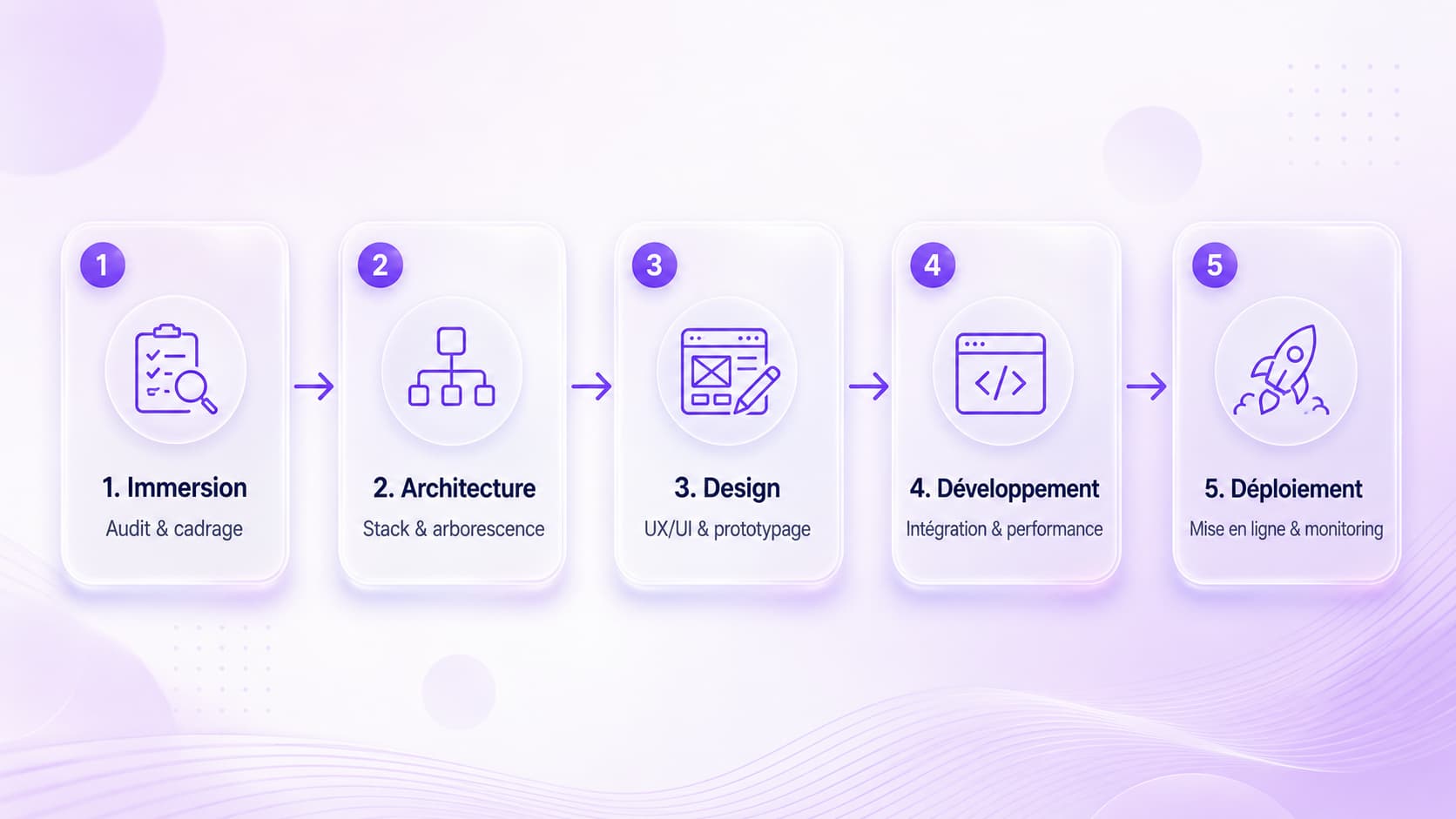
A successful redesign follows a five-stage process, from auditing what exists to a controlled go-live. This is the method we apply, “from vision to performance”:
- Immersion (audit & framing). We audit what exists — traffic, high-performing pages, user journeys, technical debt — and set the business objectives. This is where SEO is secured, by mapping the URLs and content to keep.
- Architecture. Choice of stack and CMS, functional specifications, site architecture, roadmap. We decide what to keep and what to rebuild.
- Design (UX/UI). Wireframes, interactive prototyping, user testing. Design is built for conversion and performance.
- Development. Pixel-perfect front-end integration, robust back end, Core Web Vitals optimisation, a 301 redirect plan prepared upfront.
- Deployment. QA acceptance, switch to a staging environment, go-live, intensive monitoring for the first 30 days, team training.
How do you rebuild a site without losing your search rankings?
SEO is the number one risk area in a redesign: a failed migration can cut traffic by 30 to 60%. Three pillars secure it:
- An exhaustive 301 redirect plan: every old URL points to its equivalent, prepared before go-live.
- A pre-migration audit: keep the content that drives traffic (delete nothing that has brought in at least one organic visit over 12 months without a replacement plan).
- Monitoring over the first 30 days: watch 404s, indexing and rankings, and submit the new sitemap.
Across 47 documented SME migrations, sites that respected these three pillars retained 92% of their traffic on average and recovered it in full within 60 to 90 days. Conversely, a missing redirect plan or a blocking robots.txt can cost up to 80% of rankings overnight.
How much does a website redesign cost in 2026?
The price of a redesign depends on scope: from a few thousand euros for a visual refresh to more than €60,000 for a full redesign with a technical migration. Here are 2026 market benchmarks (publicly observed ranges, indicative only):
| Type of redesign | 2026 market benchmark (excl. VAT) |
|---|---|
| Simple visual refresh | from ~€3,000 |
| Small-business brochure site redesign (WordPress) | ~€1,500 to €5,000 |
| More advanced professional redesign | up to ~€25,000 |
| Full redesign + technical & functional migration | €60,000 and above |
These figures are market benchmarks meant to help you situate your project, not a METASENSE rate card. Every redesign is unique: the price depends on the number of pages, the complexity of the design, the features (e-commerce, calculators, client area), the data migration and the SEO work. METASENSE prices each engagement individually. To understand what moves a budget, read our detailed analysis of the price of a custom-built website.
Let’s talk about your redesign
Do you tick several of these seven signs? Then this is the right moment to rebuild — before the opportunity cost keeps adding up. A Creative Tech agency based in Vélizy-Villacoublay, France, METASENSE brings together advisory, creative and in-house technical expertise to design, build and deploy your new site: from audit to a controlled go-live, with no SEO loss. An accelerated Webflow rebuild, a signature corporate site or a custom-built business platform — we price against your objectives.
Let’s talk about your redesign project →
FAQ — Website redesign
How often should a website be redesigned?
On average every three to five years. Beyond five years, a site usually carries a technical and visual lag that penalises it against competitors and search engines. The real trigger, however, is commercial: as soon as the site stops serving your objectives, it is time to act.
What is the difference between a redesign and a refresh?
A refresh (partial redesign) updates the surface: colours, visuals, a few pages. A full redesign reworks the foundations: structure, technology, site architecture, conversion and SEO. A refresh suits a cosmetic problem; a redesign addresses a technical, structural or commercial one.
How long does a website redesign take?
Allow roughly two to four months for a brochure site and four to eight months for e-commerce. The longest phases are design (one to two months) and development (one to three months), plus about two weeks of testing and migration. An accelerated Webflow rebuild can be far quicker.
How much does a website redesign cost in 2026?
Market benchmarks run from around €3,000 for a visual refresh to €1,500–5,000 for an SME brochure site redesign, and above €60,000 for a full redesign with a technical migration. The real price depends on scope; METASENSE prices each engagement individually.
Does a redesign cost you your Google rankings?
Not if it is properly prepared. A failed migration can cut traffic by 30 to 60%. With an exhaustive 301 redirect plan, a pre-migration audit and monitoring over the first 30 days, sites retain 92% of their traffic on average, recovered within 60 to 90 days.
How do you rebuild a site without losing SEO traffic?
By securing three pillars: 301-redirect every old URL to its equivalent, keep the content that performs (any page that has generated organic traffic over 12 months), and watch 404s, indexing and rankings over the first 30 days, submitting the new sitemap.
Can you keep the content of the old site during a redesign?
Yes. Existing content usually transfers, but a redesign is also the opportunity to review and improve it: update, restructure and enrich the pages that bring in traffic. Content that performs is never deleted blind, without a replacement plan.
What are the signs that a site needs redesigning?
The main signals: no leads or sales, slow pages and poor Core Web Vitals, a failing mobile experience, a design that is dated or out of step with your positioning, a rigid CMS or obsolete technology, poor search visibility, and an unmaintained site (security, GDPR). Three or more signs together justify a redesign.
What are the stages of a website redesign?
Five stages: immersion (audit and framing), architecture (stack, specifications, site architecture), design (UX/UI, prototyping, testing), development (integration, performance, redirects) and deployment (acceptance, go-live, monitoring, training). Securing SEO starts at the audit.
Should you choose Webflow or WordPress for a redesign?
It depends on how you work. Webflow gives editorial autonomy and performance for a premium brochure or corporate site; WordPress and headless stacks suit more specific or fast-evolving needs. The right choice is made during framing — we compare the two in detail in a dedicated article.
Redesign or new site: what is the difference?
A redesign starts from what exists (content, traffic, SEO, data) to modernise and reorganise it; a new site starts from a blank page, often for a new brand or activity. A redesign demands closer SEO vigilance, because it inherits a history that must be preserved.
When is the right moment to launch a redesign?
Ideally before the problems become expensive: falling traffic or conversions, the launch of a new offer, a change of positioning, or technology reaching end of life. Planning ahead lets you run the redesign without pressure and secure the migration calmly.
Sources
- A3 Web — Refonte de site internet : les 7 signaux qui montrent qu’il est temps de tout repenser
- AppMobileNormandie — Migration de site web 2026 : HTTPS, refonte et changement CMS sans perdre votre SEO
- AppMobileNormandie — Refonte site internet 2026 : combien ça coûte vraiment
- Anthedesign — Projet de refonte de site internet : quelle durée prévoir ?
- Google — Understanding Core Web Vitals (web.dev)