

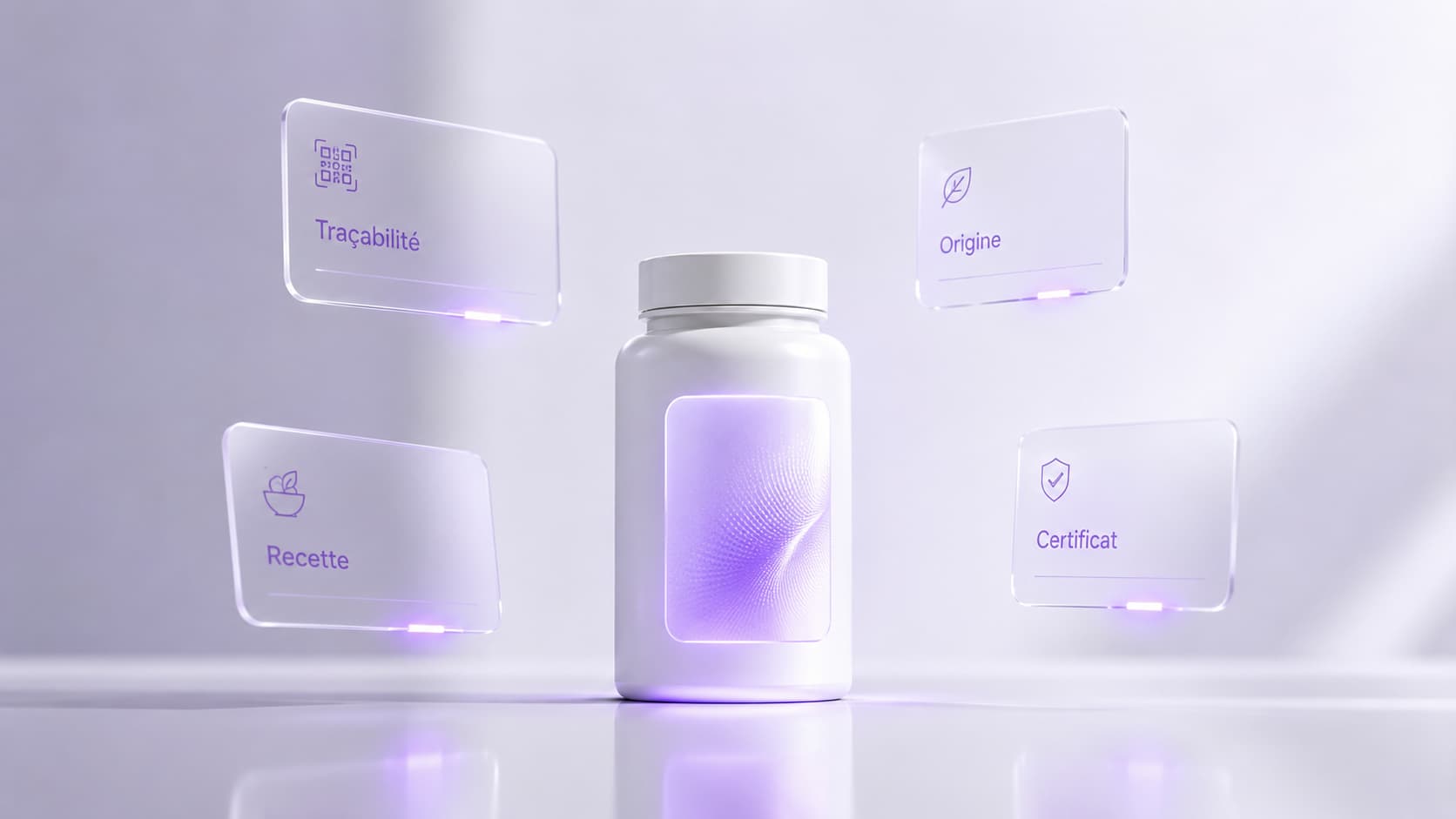
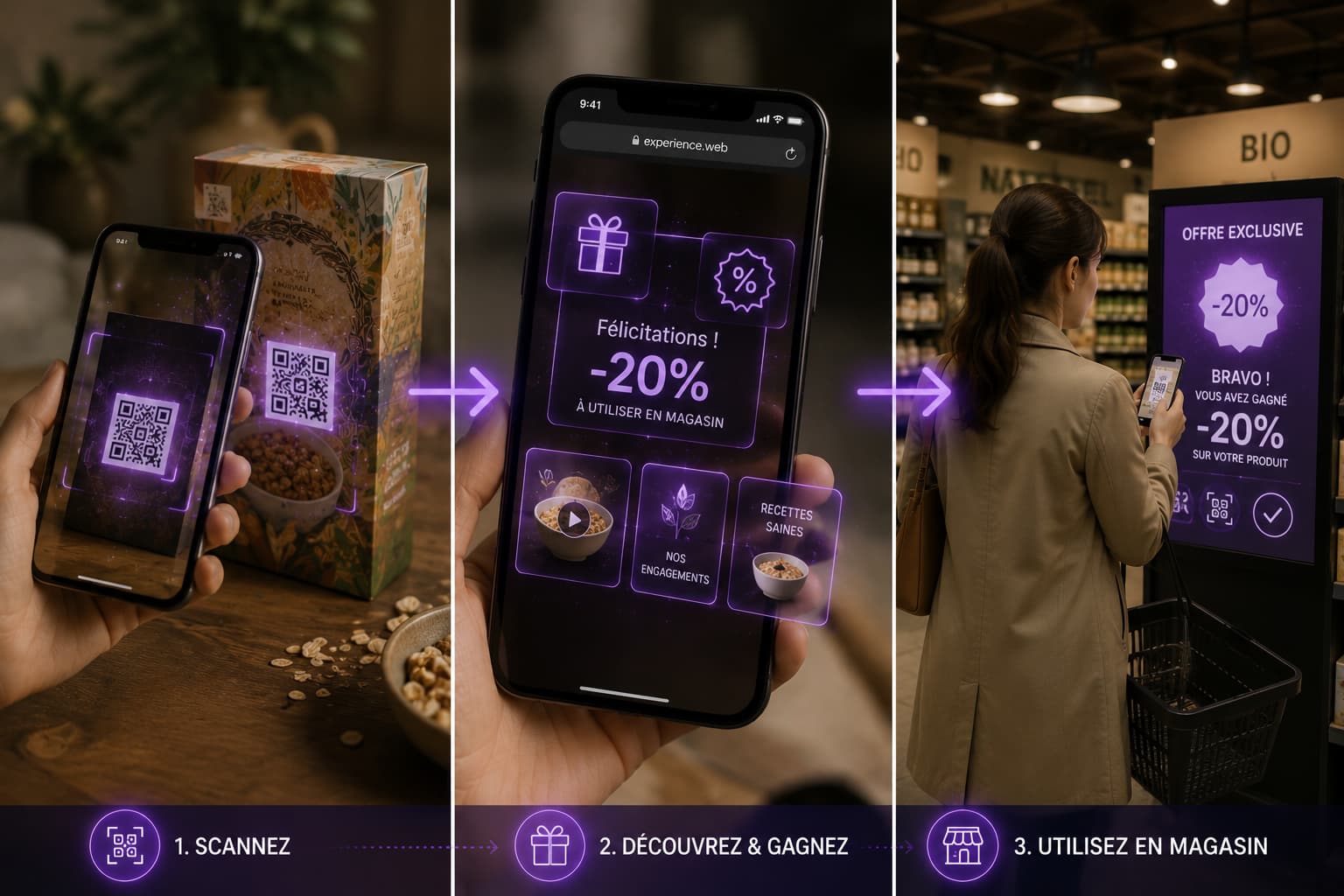
Augmented reality packaging means running an interactive experience — 3D animation, video, recipe, prize game, certificate of authenticity — by scanning a pack, a label or a catalogue page directly, with no app to download. The shopper points a phone camera at the product, the camera recognises the pack, and the digital content anchors onto it within seconds, in the browser.
It is the same principle as the WebAR we deploy in cultural mediation: no App Store, no Google Play, no account to create. That absence of friction changes everything, because the app download is the first place you lose people. This article explains, without needless jargon, how it works technically, what it enables sector by sector (food, cosmetics and luxury, wine, publishing), what to expect on ROI, and how to stay GDPR-compliant.
In short
- Augmented reality packaging = an interactive experience triggered by scanning the pack, opening in the browser, with no app.
- Technically: image-target tracking (the camera recognises the pack and anchors 3D onto it) + WebGL rendering in the browser, working on iOS and Android.
- Uses: traceability and prize games in food, storytelling and authentication in cosmetics and luxury, brand content in wine and spirits, catalogues and posters that come alive in print.
- ROI: markedly higher engagement and dwell time, a bridge to the store, opt-in data collection — provided GDPR is respected.
- Why we can speak to this: the app-free Web App for Nîmes la Romaine held thousands of simultaneous connections — proof that download-free WebAR works at scale.
What is augmented reality on packaging?
Augmented reality packaging is a technology that turns a physical pack into an interactive medium: by scanning the product with a smartphone, the shopper triggers digital content (3D, video, animation, game) overlaid in real time on the real pack. It is also called augmented packaging or interactive packaging.
The reference marketing definition is simple: augmented packaging means that “un packaging donne accès à un complément d'informations sur le produit par le biais du smartphone”, via a scan code or an app, “avec une utilisation particulièrement pertinente de la technologie de réalité augmentée” (Définitions Marketing). The decisive nuance today is that the app is no longer necessary: everything happens in the browser.
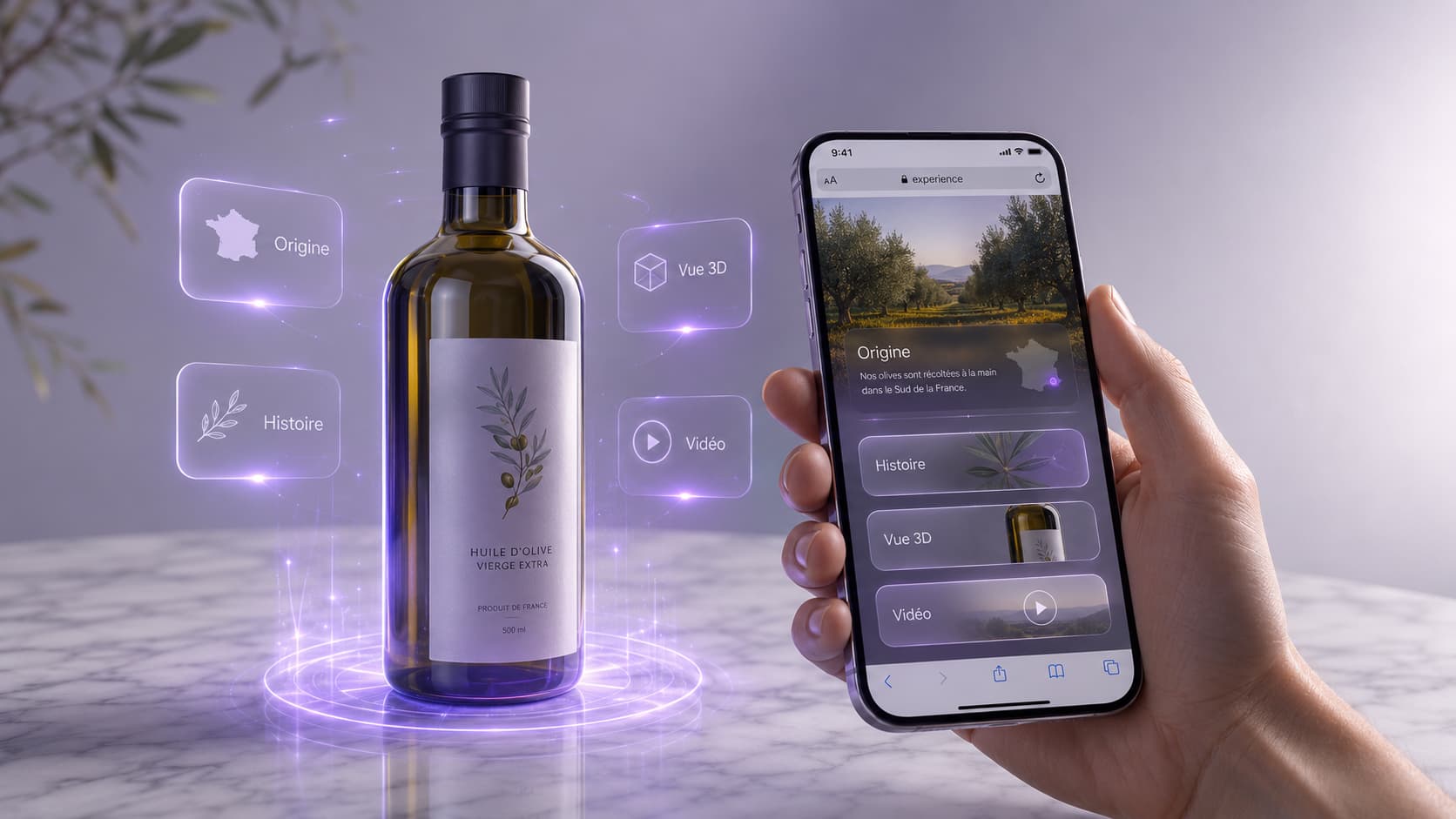
In practice, the shopper installs nothing. They scan a QR code printed on the pack — or, with image-target tracking, the label itself — and a Web App opens. The browser asks for camera access, recognises the pack, and anchors the augmented content onto it. This is exactly the “scanning is enough” logic we set out in our article WebAR: touring without downloading an app, applied here to the product on the shelf rather than the artefact in the museum.
How do you add augmented reality to a pack?
You add augmented reality to a pack by pairing a scannable target (a QR code, or the pack itself as an image target) with an online augmented reality Web App that recognises the product and displays the 3D content in the browser. No change to the production line is required: the work happens on the printed artwork and the web experience, not on the container.
Here is how it works, block by block:
- The trigger target. Either a discreet QR code printed on the pack (the most universal option), or the image target: the pack or label artwork itself becomes the marker the camera recognises. The image target delivers the most striking experience — content springs from the product, with no visible QR — but it needs artwork contrasted and stable enough to be recognised reliably.
- Image-target tracking. Once the pack is recognised, a computer vision engine tracks its position frame by frame and anchors the 3D model onto it, so the model stays fixed to the product as you move it or walk around it.
- Real-time 3D rendering (WebGL). Models, textures and animations are drawn by the browser's graphics engine (WebGL), the same technical foundation as immersive web and real-time 3D.
- Distribution. The experience is simply a URL. You distribute it by QR code on the pack, by link in an email, on social media, or by NFC. No marketplace, no store review, instant updates server-side.
Worth remembering. App-free augmented packaging is not a “degraded version” of augmented reality. It is an architectural choice: you favour immediate access for the many (zero friction) over access to the deepest operating system features. For a consumer product scanned once at the shelf, that is almost always the right trade-off.
An honest technical point: why it works on iPhone
WebXR, the standard web augmented reality API, is supported by Chrome on Android but not by Safari on iOS or iPadOS to date, according to public compatibility status. Relying on WebXR alone would mean the experience simply would not run on iPhone — a deal-breaker for a consumer product.
That is why genuinely deployable WebAR builds on JavaScript computer vision libraries (proprietary or open source tracking engines) that run in any recent browser, iPhone included. This is precisely where technical expertise separates a demo that works on one phone from a setup that holds up at the shelf, across your customers' entire device base.
Do you need an app to scan a pack in augmented reality?
No. With WebAR no app is required: the experience opens directly in the phone's browser, from a QR code or from the label itself. It is in fact the condition for the setup to work at all: augmented reality on packaging performs better the more it is clear, useful and quick to load without requiring an app download.
The reason is behavioural. Every step between the impulse and the experience — opening a store, finding the app, accepting permissions, waiting for the install — cuts the number of people who make it through. On mobile, app retention the day after install is very low: the sector commonly sees 74% uninstall rates within 24 hours. Asking someone to install an app to scan a bag of coffee or a bottle of wine means losing almost the entire audience before they have seen anything.
Going app-free removes that leak. It also makes the setup universal by design: a single Web App covers iOS and Android, with no dual development and no dual store review, and it updates instantly.
What are the sector uses for augmented packaging?
The most powerful uses connect the right augmented content to the right product at the right moment in the purchase journey: inform, tell a story, authenticate, entertain, or drive back to the store. Here are the families of use by sector, each with its own logic.
| Sector | Typical use | What AR adds |
|---|---|---|
| Food / FMCG | Traceability, origin, recipe, prize game | Transparency plus brand animation, without crowding the pack |
| Cosmetics / luxury | Product storytelling, tutorial, authentication | Premium experience plus counterfeit protection |
| Wine & spirits | Estate story, food pairings, collector content | Perceived value plus emotional connection to the brand |
| Publishing / print | Catalogue, poster or page that comes alive | Paper becomes an entry point to living content |
- Food and fast-moving consumer goods. The pack becomes a direct information channel: showing origin and traceability, playing a recipe video triggered by the packet, or launching a prize game or instant win on scan. It is natural ground for engagement — a subject we cover in our article on gamification in e-commerce and retail.
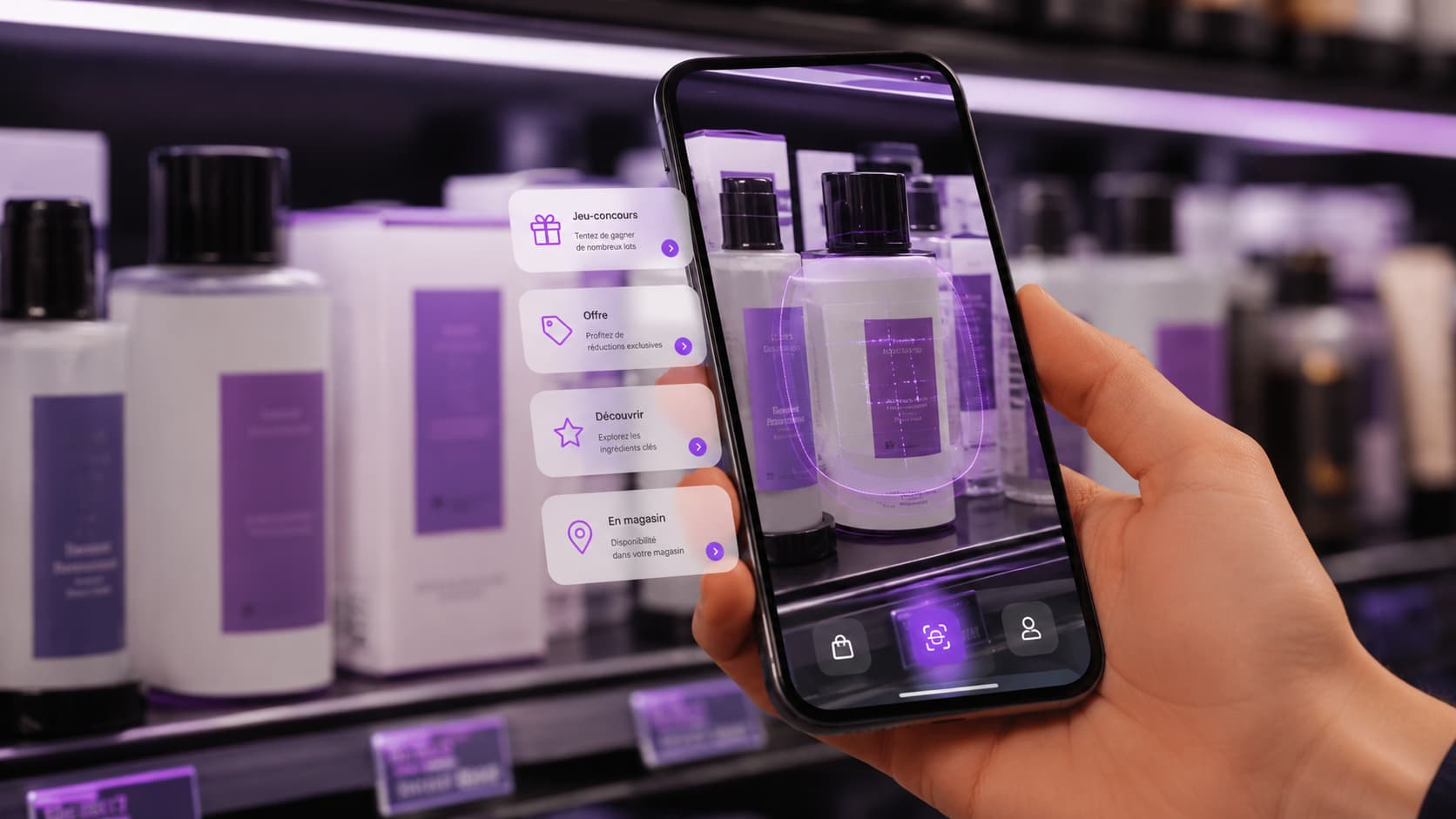
- Cosmetics and luxury. Here augmented reality serves storytelling (the story of a fragrance, how to apply a skincare product) and authentication: augmented content that is hard to reproduce becomes a signal of authenticity against counterfeiting. The finish must be flawless — the 3D rendering has to match the brand.
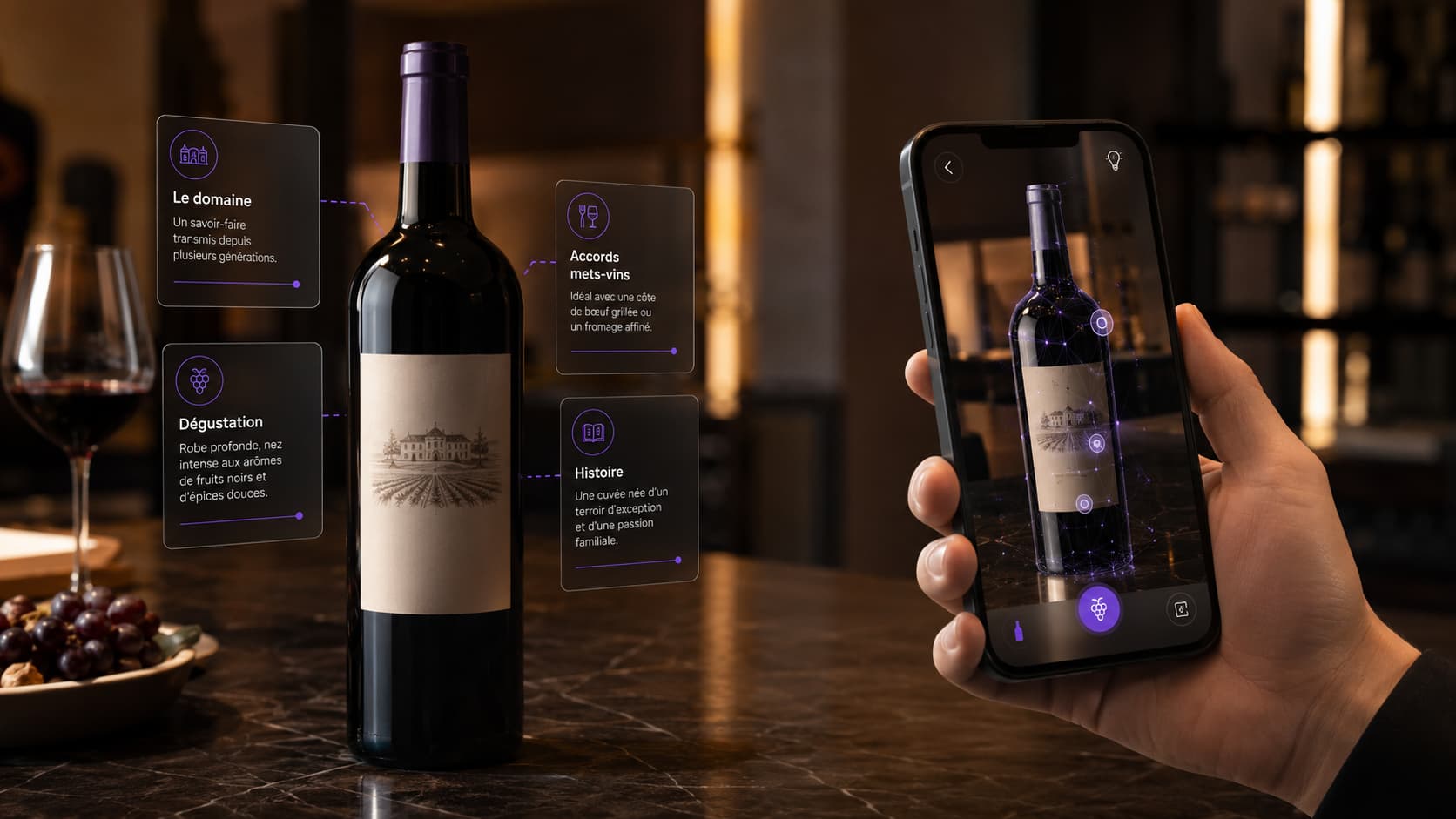
- Wine and spirits. An augmented reality label makes the bottle talk: the estate's story, the vintage, the pairings, even a collector animation. It is a lever on perceived value, at a time when, according to Deloitte, one shopper in five is willing to pay around 20% more for a personalised or exclusive product.
- Publishing and print. A catalogue page, a cover or a poster comes alive on scan: product demonstration, video, 3D model. The augmented reality catalogue extends paper into digital without changing the distribution medium.
A real example: connected AR and AI packaging at METASENSE
For Diffusion Plus, METASENSE designed a connected packaging setup in augmented reality coupled with AI: on scan, the pack triggers an experience that generates personalised cocktail recipes, as part of an interactive stand (a “Jackpot” AR terminal with instant wins). It is a concrete case where the pack stops being a container and becomes an entry point to a brand experience.
Beyond that case, our credibility on app-free WebAR comes above all from running it at scale. For the city of Nîmes (with our partner Aura, formerly EDEIS), we deployed a multilingual visitor Web App reachable from a single QR code, with no download at all, which sustained thousands of simultaneous connections. That is the demonstration that augmented reality in the browser is not a trade-show demo: it holds up in real conditions, across thousands of different devices at once. The full story of that journey is told in our case study on the augmented 3D visitor journey in Nîmes.
The know-how that transfers to products — image target, real-time tracking, WebGL rendering, multi-device — is exactly the same technical chain. What changes is the object being scanned (a pack instead of a monument) and the goal (selling and engaging instead of guiding a visit).
What ROI can you expect from an augmented pack or catalogue?
The ROI of augmented packaging is measured on three fronts: engagement (time and attention captured on the product), conversion (purchase, online and in store), and first-party data collected on an opt-in basis. The market's orders of magnitude are telling — provided you read them for what they are: sector benchmarks, not a contractual promise.
On engagement and conversion, published data on commercial augmented reality converge:
- shoppers rate an AR experience around 200% more engaging than an equivalent experience without AR;
- according to Google, 66% of shoppers want to use augmented reality to help them buy;
- according to Shopify, products with 3D/AR content convert 94% better on average than those without;
- according to Deloitte, 40% of shoppers would be willing to pay more for a product they can try in augmented reality.
On top of those figures come benefits specific to packaging: a bridge to the store (a scan at the shelf extends the act of buying, drive-to-store style), and first-party data collection — emails, preferences, game entries — when the shopper agrees to share them.
Worth remembering. These figures describe market potential, not a guaranteed result. Real ROI depends on how relevant the experience is (useful, fast, beautiful), on product traffic and on execution quality. We do not promise a percentage: we design the setup to maximise those levers, then we measure.
AR packaging and GDPR: data is collected on an opt-in basis
As soon as an augmented pack collects data — account creation, prize game entry, email for a coupon — the GDPR applies. The rule is clear: collection rests on the shopper's freely given, informed, opt-in consent, with a specific purpose and transparent information. In practice, no box is pre-ticked, you explain what the data is for, and you allow consent to be withdrawn. Done properly, WebAR is an excellent channel for clean first-party data, precisely because scanning is a deliberate act.
How much does augmented reality packaging cost?
The cost of augmented reality packaging depends on scope: the volume of 3D to produce, the complexity of the experience (animation, game, authentication), multilingual management, CRM/CMS integration and expected volumes. There is no meaningful off-the-shelf price, because no two brands have the same content to produce or the same objectives.
To situate the reader, the market generally distinguishes two families: self-service and template solutions (cheap, fast, but generic and barely differentiating) and custom-built setups (brand experience, dedicated 3D, integrations) — the latter usually running from thousands to tens of thousands of euros depending on ambition. Good news for the budget: augmented reality is generally added with no impact on the packaging production line, since the work happens on the printed artwork and the web experience.
At METASENSE we do not publish a rate card: we price each project from its real scope. The most structuring cost item is almost always 3D content production and the quality of the experience, ahead of the “AR block” itself. To situate your own project, the simplest route is to talk it through with our team.
How to launch an augmented packaging project, step by step
An augmented packaging project runs in five steps, from framing the experience to distribution by QR code on the pack. Here is the approach we apply, from idea to rollout.
- Frame the objective and the experience. Define what the pack should trigger (inform, tell a story, entertain, authenticate, drive back to store) and the matching KPI — in service of your brand, not technology for its own sake.
- Choose the trigger target. Printed QR code (universal) or image target (the pack itself), depending on the available artwork and the effect you want.
- Produce the 3D content and media. Modelling, animations, videos, optimised to load fast on a mobile network at the shelf.
- Build the multi-device Web App. Engineer the experience to run on iPhone and Android (beyond WebXR alone), with CRM/CMS integration and GDPR consent where needed.
- Distribute and measure. Print the QR codes or prepare the image targets, launch, then track usage (scans, dwell time, conversions) to keep improving the experience.
Let's talk about your augmented packaging project
Are you a food or cosmetics brand, a wine estate or a publisher, and you want to make your packs speak without forcing a download? That is exactly METASENSE's ground: we design and build augmented reality packaging experiences, from framing the idea to rollout by QR code, on the same technical foundation as the Nîmes la Romaine Web App.
Our dual capability — creative consulting and in-house technical expertise, based in Vélizy-Villacoublay — lets us imagine the experience and make it genuinely deployable, on every one of your customers' phones, in line with the GDPR.
Let's talk about your augmented packaging project →
FAQ — Augmented reality packaging
How do you add augmented reality to a pack?
You pair a scannable target (a printed QR code, or the pack itself as an image target) with an online augmented reality Web App. On scan, the camera recognises the product and anchors the 3D content onto it in the browser. No change to the production line is needed: the work happens on the printed artwork and the web experience.
Do you need an app to scan a pack in augmented reality?
No. With WebAR the experience opens directly in the phone's browser, from a QR code or from the label. No app to install, no mandatory account. It is in fact the condition for success: AR on packaging performs better the more it is useful, fast and download-free.
Does augmented reality on packaging work on iPhone?
Yes. The WebXR API is not yet supported by Safari on iOS, but consumer WebAR builds on JavaScript computer vision libraries that run on iPhone as well as Android. A well-built WebAR experience is usable on almost every recent smartphone.
How much does augmented reality packaging cost?
It depends on scope: volume of 3D, complexity of the experience, multilingual support, CRM/CMS integrations and volumes. The market ranges from self-service solutions (cheap but generic) to custom-built setups, often from thousands to tens of thousands of euros. METASENSE prices each project from its real scope, with no public rate card.
What ROI can you expect from an augmented pack or catalogue?
ROI is measured on engagement, conversion and first-party data. Market benchmarks are telling: AR experiences rated around 200% more engaging, conversion rates up to 94% higher with 3D/AR according to Shopify (self-reported average), 66% of shoppers favourable to AR according to Google. These are potentials, not guarantees: the result depends on execution and product traffic.
What is image-target tracking?
It is an augmented reality technique in which a reference image — the label, the pack artwork, a catalogue page — acts as the trigger. As soon as the camera recognises that image, the 3D content anchors onto it and follows it in real time. That is what lets an animation spring from the product, with no visible QR code.
What is the difference between a QR code and an image target on a pack?
A QR code is a dedicated marker: universal, highly reliable, but visible on the pack. An image target uses the pack artwork itself as the trigger: more immersive (content emerges from the product), but it requires artwork contrasted and stable enough to be recognised reliably across all devices.
Does augmented reality change how the pack is manufactured?
No, in the vast majority of cases. Augmented reality is added with no impact on the production line: the work happens on the printed artwork (adding a QR code or preparing the image target) and on the web experience. The physical pack stays the same; only the digital experience on scan is created.
Is augmented packaging GDPR-compliant?
Yes, when it is properly designed. As soon as data is collected (email, prize game, account), the GDPR requires freely given, informed, opt-in consent, a specific purpose and transparent information, with no pre-ticked boxes. Since scanning is a deliberate act, WebAR is a good channel for clean first-party data.
Can you build a prize game into an augmented reality pack?
Yes. Instant wins, treasure hunts, quizzes or points collection fit naturally into a packaging WebAR and lift engagement. METASENSE regularly combines augmented reality with game mechanics, for example through connected packaging setups and instant-win terminals.
How long does it take to set up augmented packaging?
It depends on scope: number of products, volume of 3D to produce and features (game, multilingual, integrations). A simple experience on one product is faster than a multi-reference setup with CRM. The schedule is defined once the objective and the experience have been framed.
Does augmented reality on packaging drive people back to the store?
Yes, that is one of its strengths. A scan at the shelf extends the act of buying and can point to an offer, a store or a purchase journey — drive-to-store logic. The pack becomes a digital entry point linking the product experience, the brand and the point of sale.
Sources
- Définitions Marketing — Packaging augmenté (définition)
- Sortlist — Packaging et réalité augmentée : avantages et ROI
- Shopify — The ROI on AR: How Augmented Reality is Boosting Ecommerce Sales
- BrandXR — 2025 Augmented Reality in Retail & E-Commerce Research Report
- Ecopack Concept — Smart Packaging : quand l'emballage devient interactif
- CNIL — Le RGPD et le consentement
- BrowserStack — WebXR: compatible browsers & implementation