

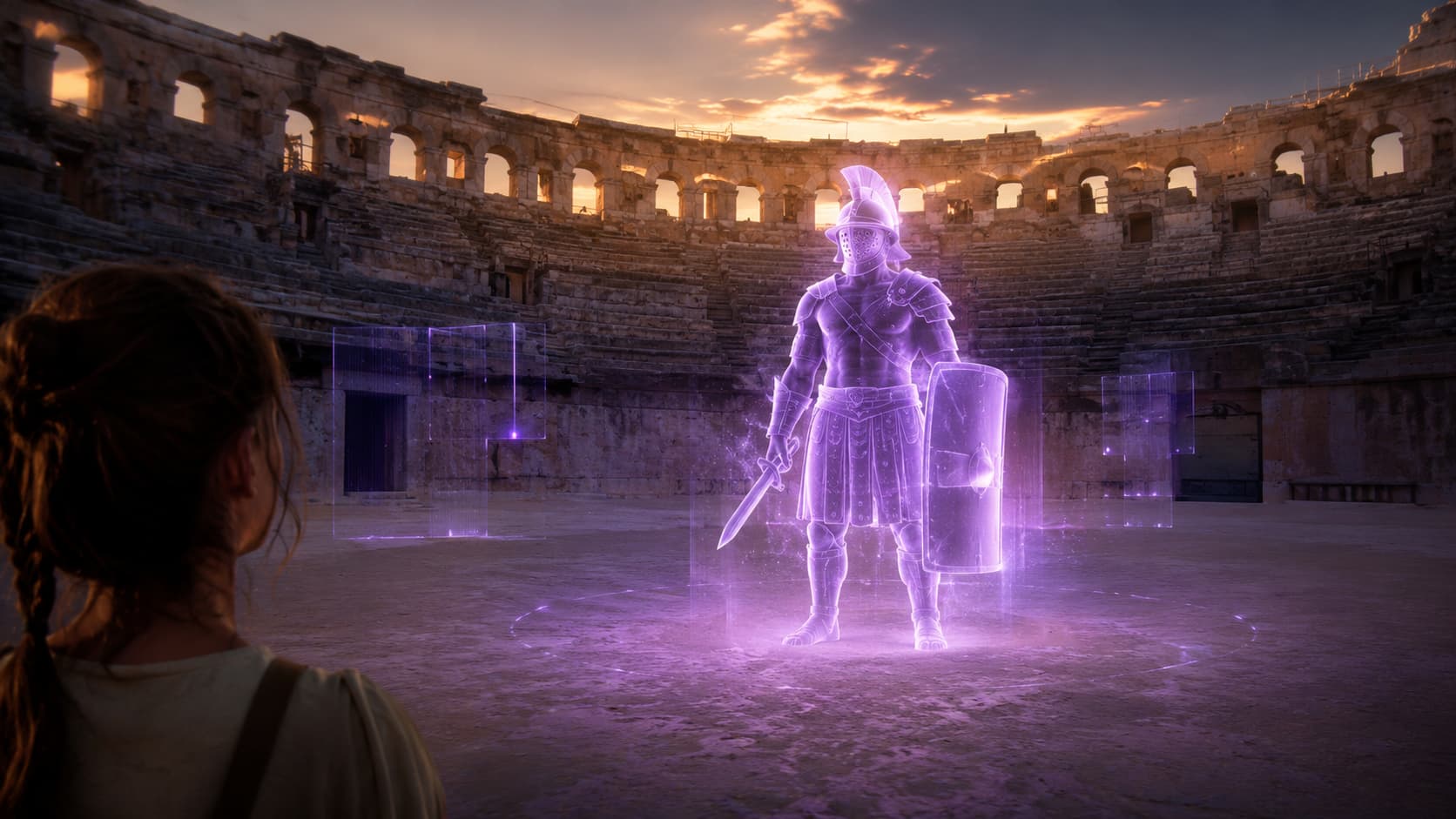
Augmented reality in a museum overlays digital content (3D, animation, contextual information) onto what the visitor is actually looking at, in real time and on their own screen. In practice: a vanished monument rebuilds itself above its remains, a statue tells its own story, a treasure hunt unfolds from room to room. Done well, AR does more than modernise the visit: it makes it more engaging, more memorable and more shareable — three direct drivers of attendance and repeat visits. In an impact study run by Cuseum among visitors given an AR experience, 85% said they would recommend the experience to a friend and 87% wanted every museum to offer one.
This article breaks down 5 concrete uses of AR in museums, read through the lens of visitor value and attendance: for each one, what it is, why it matters for interpretation, and a real example. It does not cover the technical how (launching an experience with no app to install) — for that, see our dedicated article on the museum visit app with no download. Here, the subject is uses and audiences.
In short
— AR acts on 3 drivers of attendance: engagement (people stay longer), recall (people understand more), sharing (people talk about it, and come back).
— The 5 uses that bring visitors back: on-site reconstruction, enriched contextual content, treasure hunts and gamification, journeys tailored by audience, social, shareable experiences.
— The deciding factor is not the technology but the interpretation: a successful installation serves the story first, never the wow effect.
Why does augmented reality bring museum audiences back?
Because it turns a passive visit into an active experience — and a lived experience makes people want to live it again, and to pass it on. AR works on three measured drivers of visitor behaviour.
- Engagement. By giving people something to do (look closer, scan, search, manipulate), AR extends attention span. At the Art Gallery of Ontario, 84% of visitors to an AR exhibition said they felt engaged with the works, and 39% went back to look at an image again after seeing it through the app.
- Recall. Situated information — shown in the right place, at the right moment, above the object it describes — sticks better than a label read from a distance. AR contextualises knowledge instead of stacking it up.
- Sharing and return visits. A striking experience gets retold. It feeds word of mouth and social media, and it gives people a reason to come back: a new journey, a new game level, a new season.
The three effects compound: an engaged audience stays longer, retains more, shares more, and returns. That is exactly what an institution needs when the challenge is no longer to attract people once, but to build loyalty and widen its audiences — especially younger visitors, who often keep their distance from the traditional museum.
Use 1 — On-site reconstruction: bringing back what has disappeared
On-site reconstruction rebuilds a monument, a room or an object in AR exactly as it was, precisely where the visitor is standing. It is the most spectacular and the most self-evident use of AR in heritage.
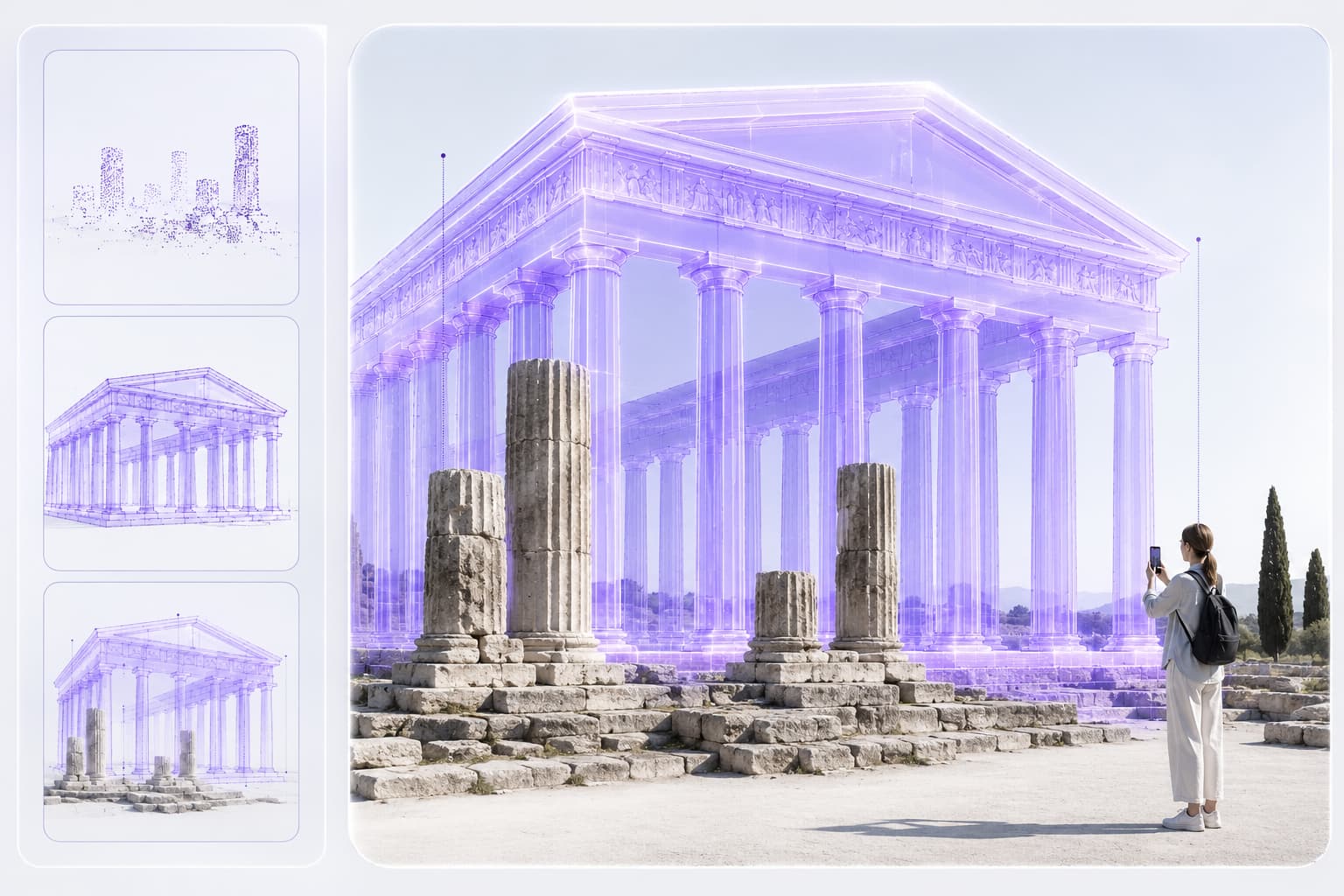
The interpretive value is immediate: faced with ruins, most visitors struggle to picture the original building. AR closes that gap of imagination. The visitor raises a smartphone towards the remains and watches the structure rise again — populated, coloured, alive. The past is no longer explained to them: it is shown, at full scale, where they stand.
A real example. On the Nîmes la Romaine journey designed with Aura (formerly EDEIS), METASENSE deployed a multilingual 3D web app reached by QR code, which lets visitors explore the city's Roman monuments (the Arena, the Tour Magne, the Maison Carrée) and overlay augmented content onto what is there. The setup recorded thousands of simultaneous connections — proof that a well-scripted use finds its audience at scale. The full story of the project is told in our case study of the augmented visitor journey in Nîmes.
Use 2 — Contextual content: an encyclopaedia that opens in the right place
This second use turns every work, display case or monument into an access point to a rich layer of information, triggered by the visitor's position or by a scan. It is often called AR encyclopaedia, or contextual content.
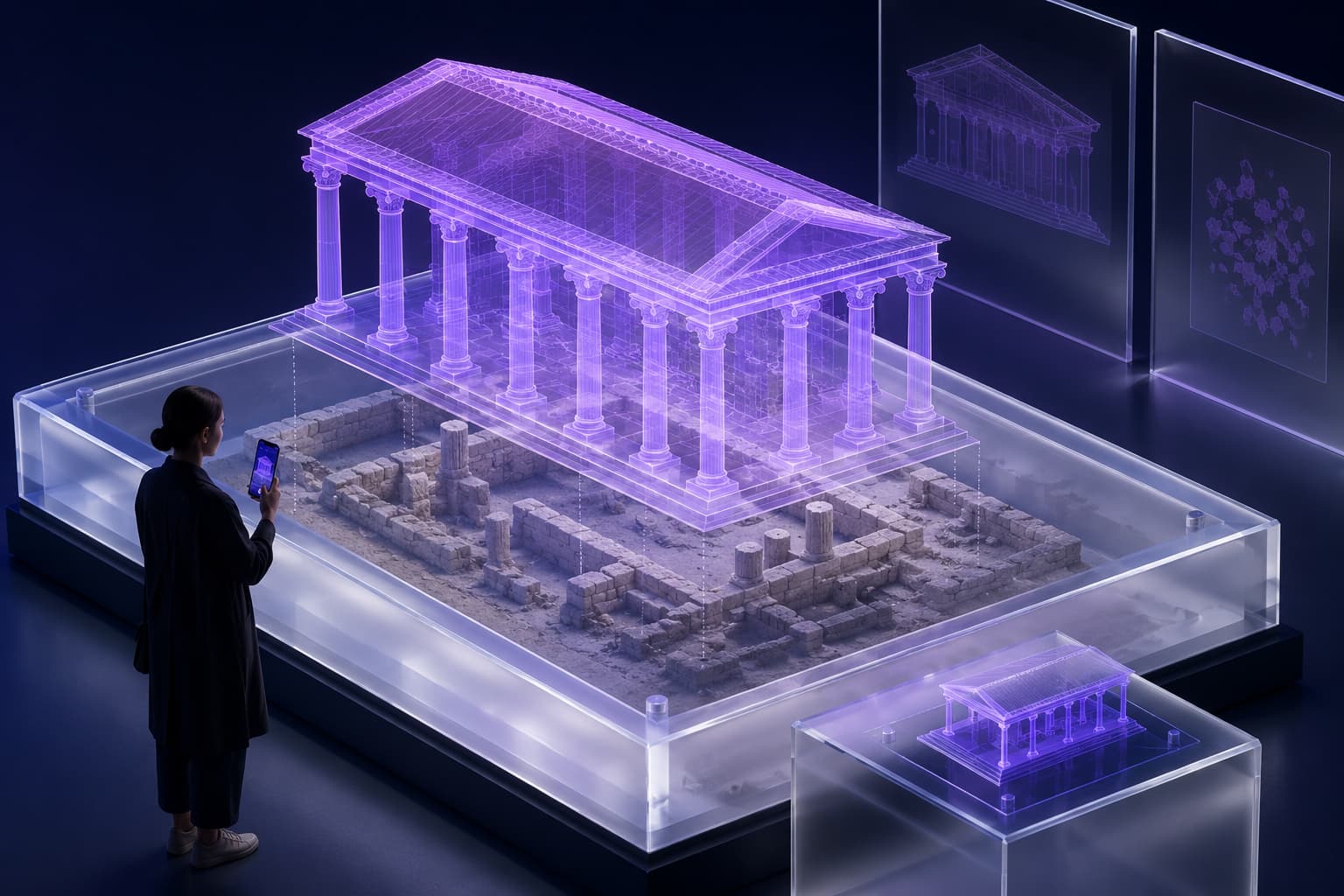
Where a wall label imposes one text on everyone, AR offers knowledge that is adjustable and deep: an explanatory animation, an exploded view of an object, original colours restored, an audio account, a before-and-after comparison. The visitor chooses the depth — a quick pass or a detailed dive. It is also a powerful accessibility lever: content can be translated, audio-described or simplified instantly, which opens the museum to overseas audiences and to people with disabilities.
In the Cuseum study, 91% of visitors saw mobile technology as an exciting way to access information and 9 in 10 found information easier to reach. On the Nîmes journey, this augmented-encyclopaedia logic combines with play (see the next use) to enrich the visit without weighing it down.
Use 3 — Treasure hunts and gamification: turning the visit into a quest
Gamification adds a game mechanic to the visit — puzzles, clues to scan, rewards, progression — which gives the journey a goal and makes it compelling. It is the most effective use for reaching young audiences and families.
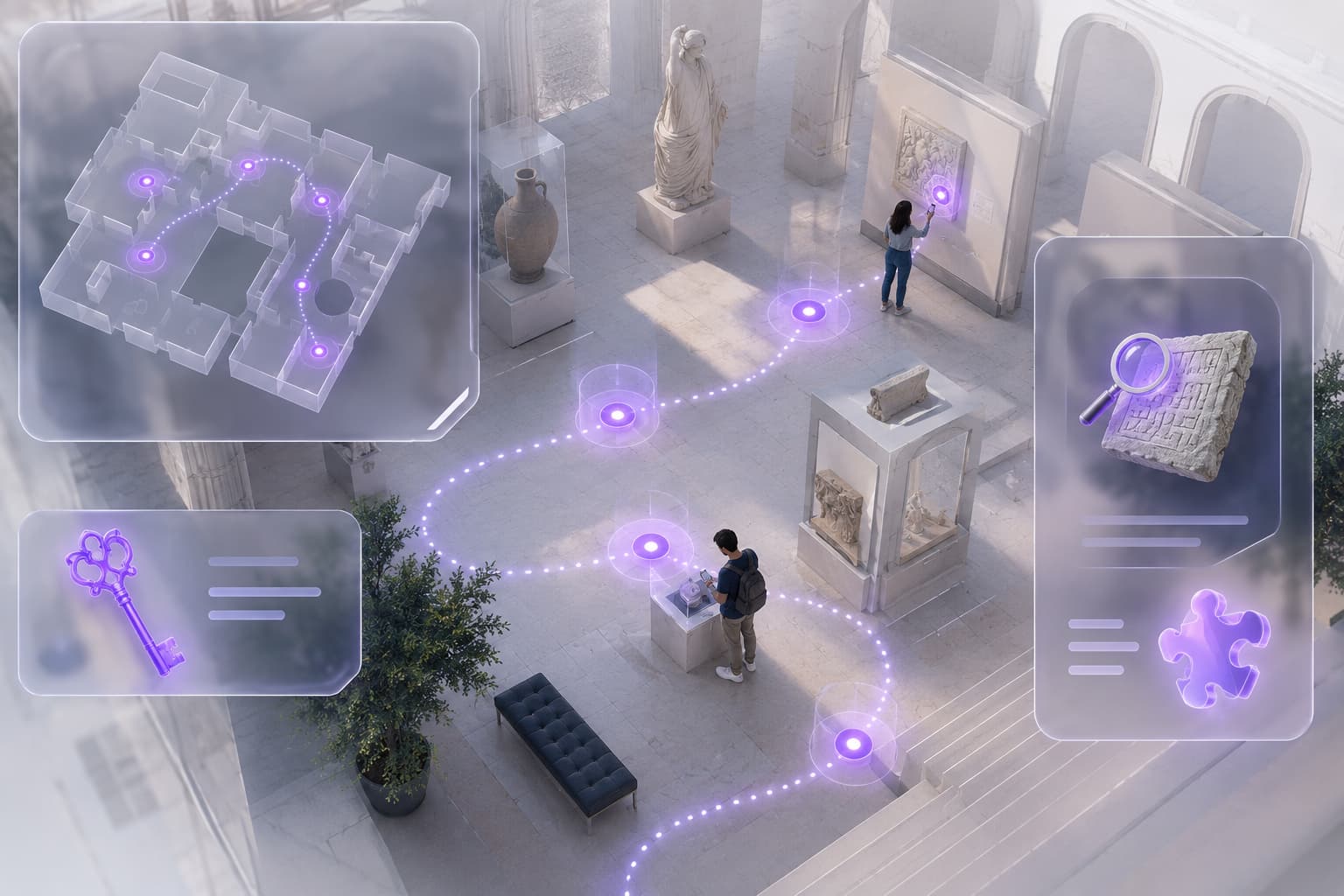
The principle: instead of wandering freely and passively, the visitor follows a quest. They hunt for clues scattered across the rooms, scan elements to unlock 3D content, and solve puzzles tied to the works. Game motivation does what a label cannot: it pushes people to explore every corner, to read in order to progress, and to return to finish or replay. The British Museum has tested experiences in which children with a phone set off to find clues, then scanned them to view archaeological objects in 3D.
A real example. In Nîmes, METASENSE built in a treasure hunt led by the character of Lucius, a narrative thread that guides the visitor from monument to monument. Gamification here is not a gimmick: it structures the journey and gives a reason to follow it to the end. More broadly, the effect is documented — the Musée de la Mer reports that an interpretation approach combining storytelling, gamification and AR lifted its attendance by 10 to 30%, with strong take-up among younger visitors. To understand why gamification is more than an instant-win mechanic, read our approach to cultural mediation in 3D, AI and immersive.
Use 4 — Tailored journeys: a different museum depending on who visits
AR makes it possible to adapt the content, the tone and the length of the journey to the visitor's profile: child, school group, family, time-pressed tourist or enthusiast. A single collection can therefore offer several distinct experiences.
The interpretive stake is central: the narrative that captivates an eight-year-old sends an academic to sleep, and the reverse is just as true. Rather than aim at an average visitor who does not exist, a tailored journey offers several ways in to the same content:
- School groups: an educational, playful route, adapted vocabulary, collaborative challenges aligned with the curriculum.
- Tourists and first-time visitors: a selection of highlights, a controlled duration, condensed historical context.
- Regulars and enthusiasts: in-depth content, thematic focuses, something new each season.
This tailoring is also a driver of return visits: by varying the journeys — seasonal, thematic, by game level — the institution gives a concrete reason to come back, where a fixed collection offers only one visit. Multilingual support, already live in Nîmes, is the first building block.
Use 5 — Social, shareable experiences: turning the visitor into an ambassador
This last use treats AR not as a solitary experience but as a moment to live together and share beyond the museum walls. An augmented selfie, a filter, a souvenir photo with a work brought back to life, a group challenge: AR creates content the visitor wants to circulate.
The benefit works twice. During the visit, sharing turns an individual experience into a collective moment (families, school groups, friends). After the visit, every photo or video posted becomes an organic recommendation — the visitor promotes the museum to their own network, free of charge. It is the natural extension of the 85% of visitors ready to recommend measured by Cuseum: a shareable experience accelerates that word of mouth.
Major institutions have grasped this: the Louvre has partnered with Snapchat to roll out, from February 2026, an AR interpretation tool across six of its departments — a way of reaching young audiences through their own habits. The principle holds for everyone: an experience designed to be shown is an experience that travels.
Summary table: 5 uses, 5 effects on audiences
| Use | What it gives the visitor | Effect on attendance |
|---|---|---|
| 1. On-site reconstruction | Seeing the past at full scale, where it stood | A memorable wow effect → word of mouth |
| 2. Contextual content | Deep, adjustable, accessible knowledge (languages) | A richer visit → satisfaction and recommendation |
| 3. Treasure hunt / gamification | A quest, a goal, enjoyment | Young audiences + replay value → return visits |
| 4. Tailored journeys | A museum matched to your profile and your time | Several visits possible → loyalty |
| 5. Shareable experiences | A moment to live and to show | Organic recommendation → new audiences |
How do you start an AR project in a museum?
You start from the story and the target audience, not from the technology. A successful AR installation owes less to technical prowess than to the quality of the interpretation. Here is a proven path.
- Set the attendance objective. Attract a new audience (young people, families)? Retain regulars? Increase dwell time? The objective points to which of the 5 uses to prioritise.
- Start from the scholarly content. Work hand in hand with curators and interpretation teams: digital serves knowledge, never the other way round.
- Choose the right use and script it. One story, one guide character, one clear mechanic. One use done well beats five poorly integrated.
- Favour frictionless access. For a general audience, the ideal is an experience reachable without installing an app — a simple QR code is enough (see our article on the augmented visit with no download).
- Prototype, test, deploy. Validate with real visitors before scaling up, then plan for evolution (new seasons, new journeys) to sustain return visits.
At METASENSE, this method — from idea to rollout — is what made Nîmes la Romaine an augmented journey at scale. We design and build everything in-house: consulting and creative on one side, technical expertise (3D web, WebGL, AR with no download) on the other.
Do you have an augmented interpretation project?
Museum, heritage site, local authority or tourist office: if you want to turn your venue into an experience people want to relive and share, let's talk. We design bespoke augmented journeys, from scholarly framing to rollout.
FAQ — Augmented reality in museums
What is augmented reality in a museum?
Augmented reality in a museum overlays digital content (3D objects, animation, information) onto what the visitor actually sees, through a smartphone, a tablet or glasses. It enriches the visit by contextualising knowledge directly above the works or monuments concerned.
What is the difference between augmented reality and virtual reality in a museum?
Augmented reality (AR) adds digital elements to the real world: the visitor sees the room and the overlaid content. Virtual reality (VR) replaces the real world entirely with a simulated environment, usually through a headset. In a museum, AR fits into the real visit, while VR creates a separate experience.
Does augmented reality really bring audiences back?
Yes, through a compound effect. An AR experience increases engagement, recall and sharing. The Musée de la Mer reports an attendance rise of 10 to 30% after introducing an interpretation approach combining gamification and AR, with strong take-up among younger visitors.
Do you need to download an app for an AR experience in a museum?
Not necessarily. Modern WebAR experiences run directly in the smartphone browser, through a simple QR code, with nothing to install. That is the recommended option for a general audience, because it removes the main friction at the entry point.
Which audiences does augmented reality attract to museums?
Above all the audiences traditionally distant from museums: children, teenagers and families, who find a more connected and playful experience. AR is also an accessibility lever for overseas visitors (instant translation) and for people with disabilities.
Can AR replace human interpretation in a museum?
No, it complements it. AR multiplies interpretive capacity (situated information, languages, depth on demand) but does not replace the interpreter, the curator or the scholarly narrative. Digital works when it serves interpretation, not when it substitutes for it.
How long does it take to design an augmented reality journey?
It depends on the scope: an installation at a single point of interest takes a few weeks, while a multi-site, multilingual journey with gamification runs over several months (framing, 3D modelling, development, testing). METASENSE prices each engagement individually, according to scope and objectives.
How do you measure the success of an AR installation in a museum?
Through cross-referenced indicators: number of connections and completed journeys, dwell time, return rate, social shares, and satisfaction surveys. The reference studies (Cuseum, Art Gallery of Ontario) measure perceived engagement, recommendation and re-engagement with the works.
Is augmented reality also suited to outdoor heritage sites?
Yes, and it is one of its most powerful uses. Outdoors, AR reconstructs vanished monuments at full scale above their remains, as on the Roman journey in Nîmes. It turns an archaeological site that is hard to read into an experience that is immediately understandable.
Where should I start an AR project for my museum?
Start with the objective (which audience, which attendance result) and the scholarly content, not with the technology. Choose one priority use among the five, script it with your interpretation team, prototype it with real visitors, then deploy with frictionless access (WebAR by QR code).
Sources
- Cuseum — Results from Augmented Reality Museum Visitor Impact Survey (2018): cuseum.com
- Art Gallery of Ontario / MuseumNext — How Museums are using Augmented Reality: museumnext.com
- L'Observatoire critique — La réalité augmentée au musée, une médiation en expérimentation (Musée de la Mer, British Museum): observatoire-critique.hypotheses.org
- L'Usine Digitale — Le Musée du Louvre inaugure une expérience de réalité virtuelle sur la Joconde: usine-digitale.fr
- Où & Quand — Réalité augmentée : comment elle transforme les visites de musées et monuments: ou-et-quand.net
- PLOS One — Factors influencing visitors' use of augmented reality technology in museum guided tours (2025): journals.plos.org