


A custom website built by an agency costs between €3,000 and over €120,000 in France in 2026, depending on the type of project. Expect around €3,000 to €8,000 for a professional brochure site, €10,000 to €50,000 for a corporate or fully bespoke brand site, €8,000 to €25,000 for e-commerce (and above €50,000 for complex catalogues), and €20,000 to €120,000+ for a custom platform or web application. These are the ranges charged by agencies and studios, excluding freelance rates and build-it-yourself solutions. Price depends far less on page count than on three things: functional complexity, the level of design and strategy, and total cost of ownership (maintenance, further development). Here are the real market ranges, what moves them, and how to avoid buying badly.
In short — agency/studio ranges (excluding freelance and DIY solutions)
- Professional brochure site: €3,000 – €8,000
- Corporate / bespoke site: €10,000 – €50,000
- E-commerce: €8,000 – €25,000 (€50,000+ if complex)
- Business platform / app / custom SaaS: €20,000 – €120,000+
- Annual maintenance: around 15% of the build cost per year, i.e. €800 to €2,500 a year for a brochure site, or €200 to €500 a month for e-commerce or a platform
A website is not a cosmetic expense: it is a business asset that has to produce leads and credibility.
How much does a custom website cost in 2026, by project type?
In 2026, an agency-built custom website costs between €3,000 and €120,000+, depending on the ambition of the project. “Custom” means design and development specific to your brand and your uses, as opposed to a ready-made template you simply dress up. The table below gives the ranges observed on the French market for agency or studio delivery (excluding freelance and DIY solutions). METASENSE does not publish a rate card: we price each engagement individually — these market benchmarks are there to help you position your project, not to replace a quote.
These orders of magnitude match public market data. France Num, the French government service supporting business digitalisation, puts a professional e-commerce site between €5,000 and €20,000 on average. On the agency side, a professional brochure site starts at around €3,000, and a custom site passes €10,000 as soon as you leave the template behind (Seedweb). For reference, a freelancer often charges less (roughly €1,500 to €5,000) but rarely covers an agency's full scope of consulting, design, development and deployment — which is why these ranges exclude them.
Why does a custom website cost more than a template?
A custom website costs two to four times more than a template because you pay for strategic thinking, design and development time, where a template only bills integration (Nanogramme). The difference is not cosmetic: it lies in what the site produces.
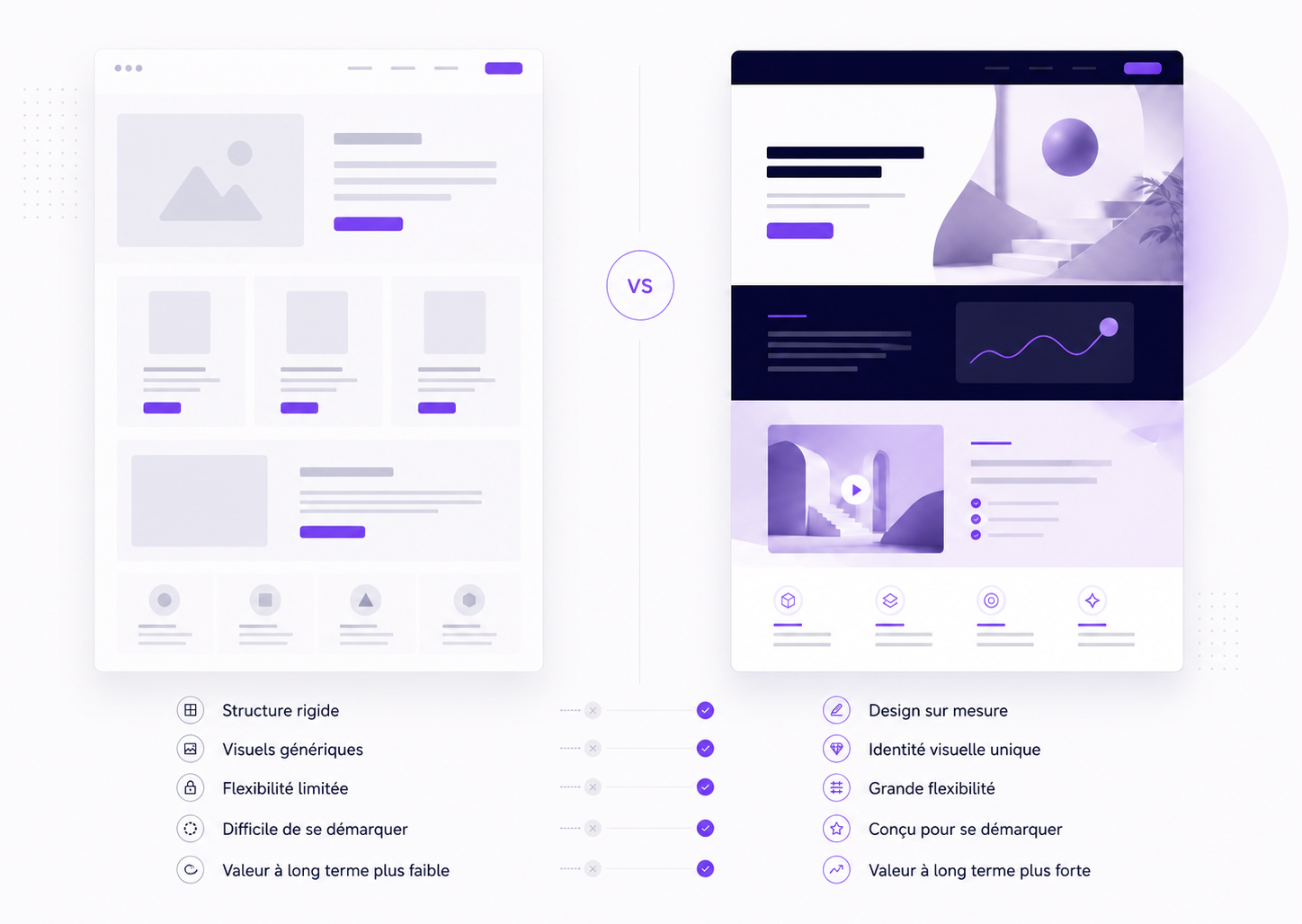
- Upfront strategy: business objectives, information architecture, conversion journeys — not a generic layout.
- Proprietary design: an identity that sets you apart, not a theme seen at 10,000 other companies.
- Specific development: features, integrations (CRM, payment, data) and performance built for your uses.
- Room to grow: a technical foundation that absorbs traffic and change, instead of a theme you end up throwing away.
False economy has a hidden cost: a poorly mastered template often means a full rebuild 18 months later. The right benchmark is not the mock-up delivered, but the trajectory of the project over time — a site whose traffic and conversions keep rising after launch.
What really moves the price of a website?
The price of a website depends on five main factors, far more than on the number of pages. Here they are, from the most structural to the most secondary.
- Functional complexity. A contact form has nothing in common with a customer portal, a configurator, a payment flow or a data integration. Every intelligent building block adds development and testing.
- The level of design and strategy. A bespoke art direction, animation, 3D or an interactive experience take design time — and create the differentiation.
- Content. Copywriting, photography, video, multilingual translation: a turnkey site with content included does not carry the same budget as one where you supply everything.
- Technical integrations. CRM, ERP, marketing tools, third-party APIs, SSO: the richer the ecosystem to connect, the higher the ticket.
- Total cost of ownership. Hosting, maintenance, security, further development: a low purchase price can hide high running costs (see below).
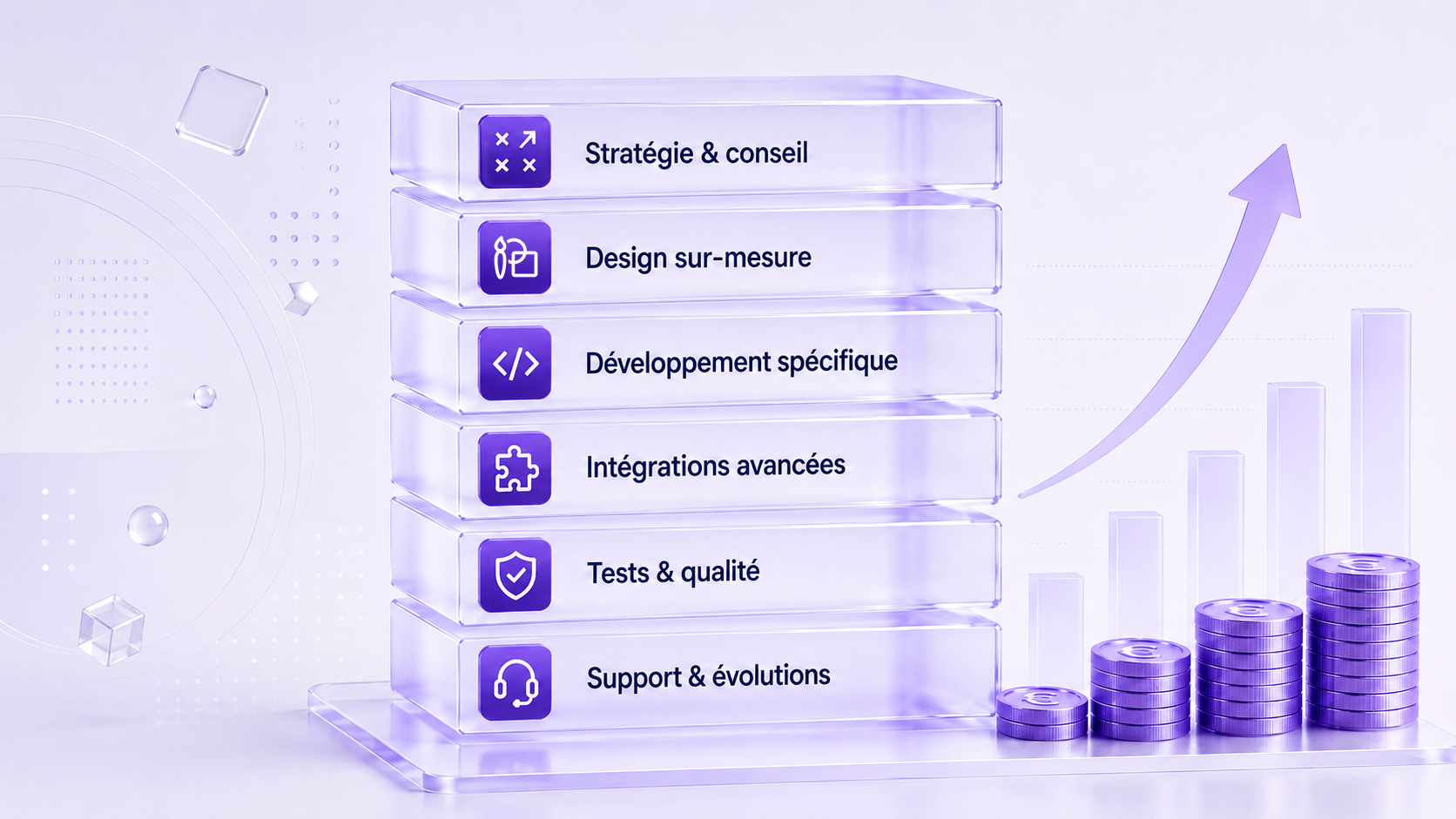
Put differently: two “brochure site” quotes at €4,000 and €18,000 do not describe the same object. The first sells pages; the second sells an asset that has to generate business.
How much does a brochure site, an e-commerce site or a SaaS platform cost?
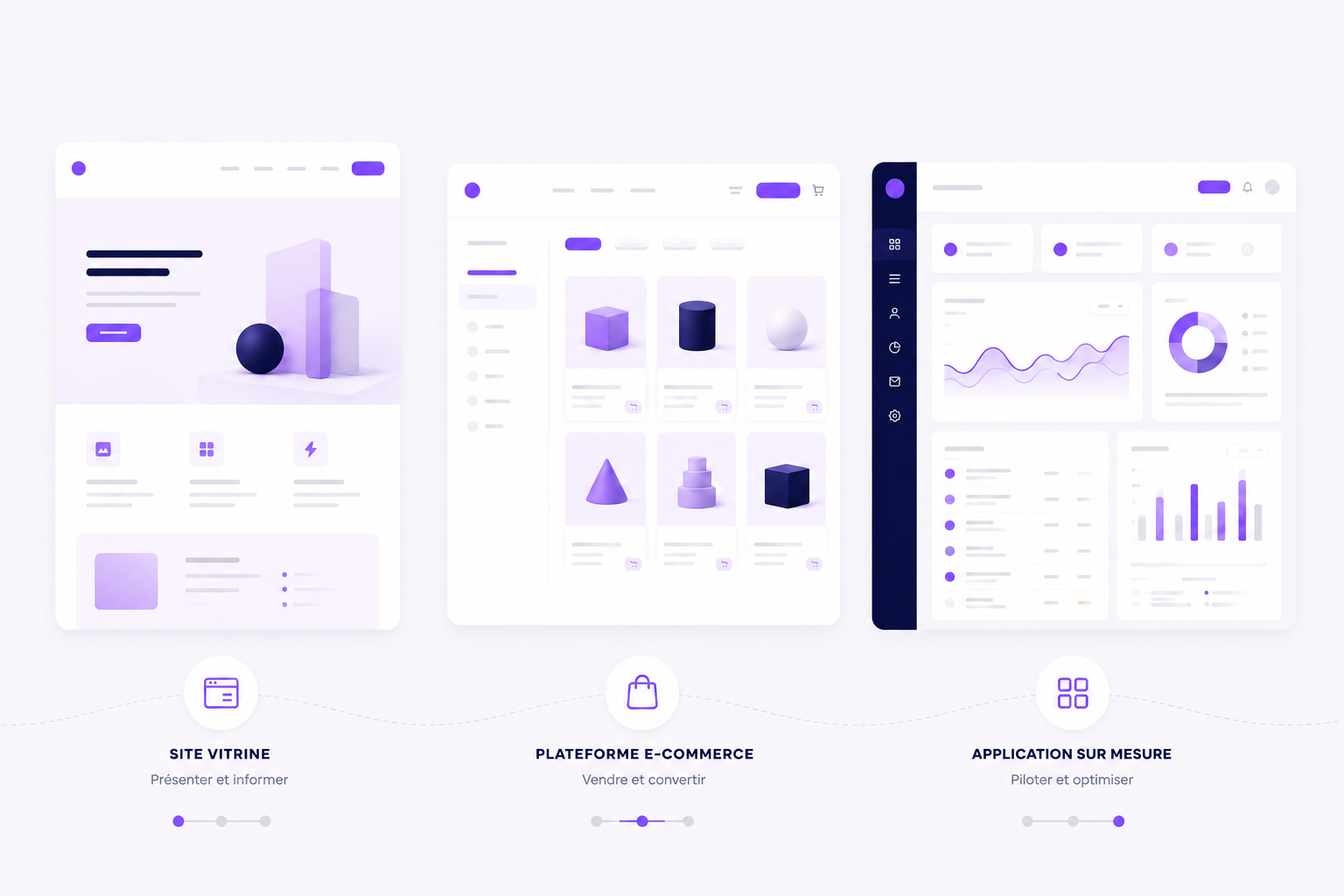
Budget depends first on the nature of the asset. Here are the three main families and what they cover.
Price of a custom brochure site
An agency-built professional brochure site generally costs €3,000 to €8,000. It presents an offer, gives a brand credibility and captures leads. For a signature corporate version or a fully bespoke build (strong identity, proprietary design, carefully written content, SEO built in), expect €10,000 to €30,000, and up to €50,000 for the most demanding brands (Seedweb). For reference, a build-it-yourself solution (Wix and the like) or a template starts at a few hundred euros — but with no design or strategy of your own.
Price of a custom e-commerce site
An agency-built e-commerce site sits between €8,000 and €25,000 for a standard shop, and passes €50,000 for complex catalogues, multilingual setups or B2B logic (Seedweb, L'Expert-Comptable). France Num puts the average cost between €5,000 and €20,000. The budget climbs with the number of SKUs, product variants, payment methods, logistics and integrations (ERP, marketplace). SaaS solutions such as Shopify add a monthly subscription (in the region of €33 to €384 a month) to factor into the overall budget.
Price of a business platform, web application or SaaS
A custom platform (business web application, SaaS tool) runs from €20,000 for a standard product to more than €120,000 for a multi-tenant or business-critical platform, and can exceed €300,000 on the most complex projects (Step). An MVP (minimum viable product) often starts at around €8,000 to €20,000. This is no longer a website but a product: user accounts, permissions, database, business logic, dashboards, APIs. It is also the only type of project that can generate recurring revenue.
How much does a website redesign cost?
An agency redesign most often costs €8,000 to €25,000, depending on whether it is a simple facelift or a full rebuild (new identity, new architecture, content migration, SEO). A well-run redesign does not just make things look nicer: it fixes what stopped the previous site converting.
A concrete proof point. For Gourand (textiles, a house founded in 1971), we refreshed the brand identity and built the company's first website, on Webflow, delivered in under two weeks. Speed is not a headline: it is what cuts the downtime cost of a web project.
What does website maintenance cost?
Website maintenance generally represents around 15% of the build cost per year (a common market budgeting rule). With an agency, that means €800 to €2,500 a year for a brochure or corporate site, and €200 to €500 a month for a high-traffic e-commerce site or platform (Seedweb, L'Expert-Comptable). It is the line most often left out of a budget — and the one that separates a sound purchase from a false economy.
Maintenance covers technical and security updates, backups, uptime monitoring, bug fixing, performance tracking — and, ideally, regular improvements. A living site that keeps moving pays back; a frozen site degrades (SEO, security, conversion). That is why we work in total cost of ownership from the quote onwards, not purchase price alone.
Is a website an expense or an investment?
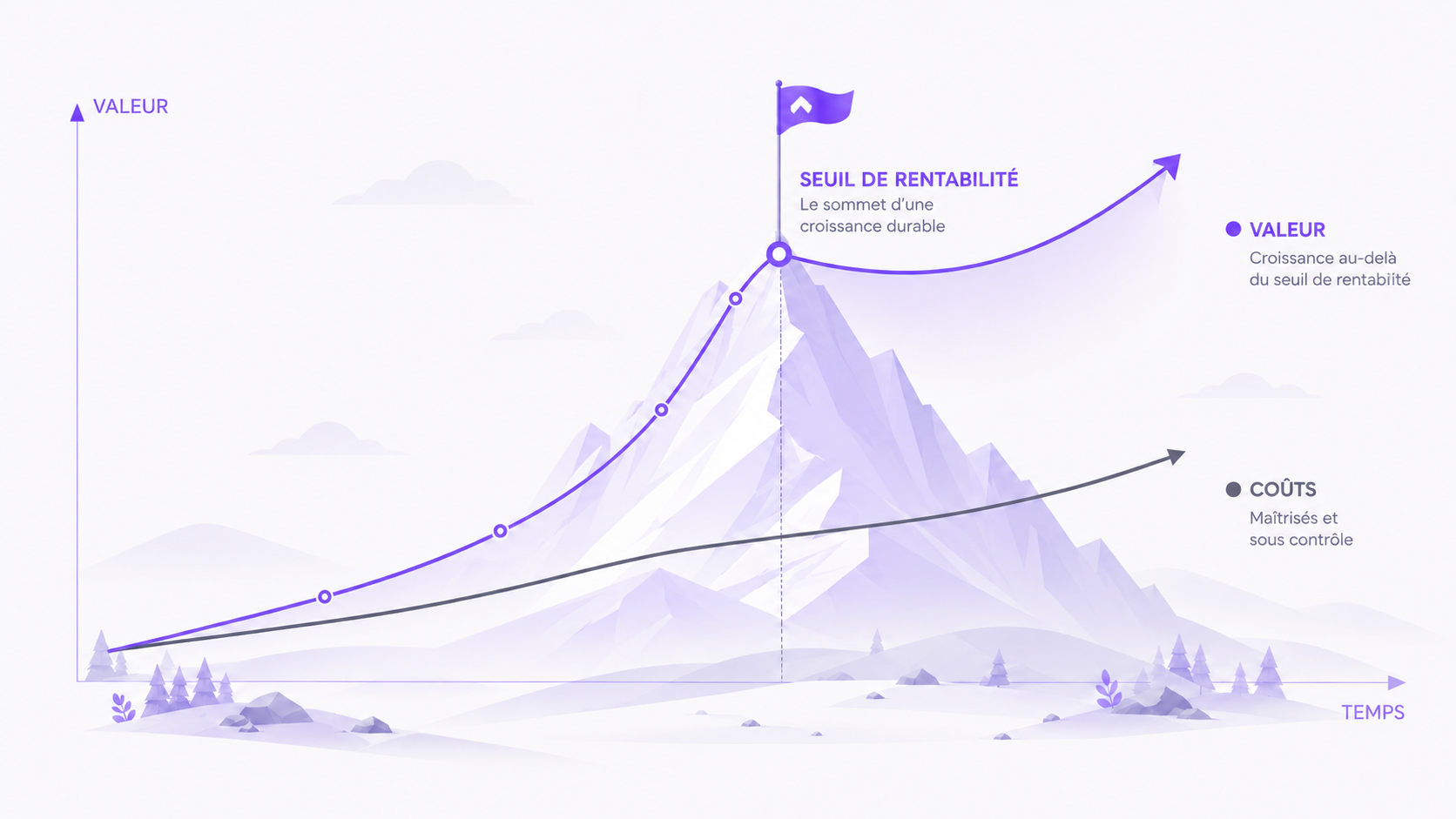
A custom website is an investment, not a cosmetic expense: it is the asset that generates leads, gives the brand credibility and supports sales. The right question is not “what does it cost?” but “what does it return?”. Over time the maths speaks for itself: for a team of 20 people, a custom-built tool can cost half as much over five years as a per-user subscription to an off-the-shelf solution (Step). A site designed for conversion and maintained over time pays for itself through the leads and sales it generates — and that impact, not the purchase price, should drive the decision.
At METASENSE we wear two hats: strategy and creative on one side, in-house technical expertise on the other — from idea to deployment. That avoids the classic pitfall: a beautiful site that does not convert, or a technical machine with no business vision. A few reference points from our portfolio:
- CPX Group (international logistics): a corporate site shipped in 72 hours (Nuxt + Vercel + headless CMS), that is 75% less time than a conventional project.
- Gourand: a refreshed brand identity and a first Webflow site, delivered in under two weeks.
- The RYM platform: a custom SaaS tool for marketing management (Nuxt), generating recurring revenue — the textbook case of a website that became a product.
To go further on designing a site that performs (method, 2026 standards), read our article Building a website in 2026: a high-performing site that generates leads. This article covers the budget; that one covers the method.
How do you read a website quote without getting it wrong?
A good quote never fits on one line: it details the scope and explains why each stage is necessary (iti-conseil). Here are the traps to avoid and the right reflexes.
- Be wary of a single price with no breakdown. Demand the scope: strategy, design, development, content, integrations, testing, training, maintenance.
- Compare like for like. A quote three times cheaper often excludes bespoke design, SEO or maintenance.
- Look at how past projects performed, not just the mock-ups: a site still gaining traffic 18 months on says more than a good-looking visual.
- Check who designs AND builds. An agency that subcontracts everything dilutes both accountability and coherence.
- Include total cost of ownership in the comparison, not just the purchase price.
Let's talk about your project (and its right budget)
The right price for a website is the one that matches what it has to produce for your business. Rather than a generic range, we scope your project in a single meeting: objectives, scope, a realistic range and a return-on-investment path. METASENSE is a Creative Tech agency based in Vélizy-Villacoublay, and we both design AND build — from consulting to deployment.
Explore our web development & design expertise · Request a budget scoping session
FAQ — The price of a custom website
How much does a custom website cost in 2026?
In France in 2026, an agency-built custom website costs from €3,000 for a professional brochure site to more than €120,000 for a platform. A corporate brand site sits at around €10,000 to €50,000, and an e-commerce site between €8,000 and €25,000. Price depends above all on functional complexity and design.
What is the price difference between a template site and a custom site?
A custom site generally costs two to four times more than a template. A template only bills integration, whereas a custom build pays for strategy, proprietary design and specific development. A DIY solution or template starts at a few hundred euros; an agency-built custom site at around €3,000 to €8,000.
How much does a professional brochure site cost?
An agency-built professional brochure site most often costs €3,000 to €8,000, and €10,000 to €50,000 in a signature corporate or fully bespoke version (strong identity, SEO built in, carefully written content). A build-it-yourself solution starts at a few hundred euros, but with no design or strategy specific to your brand.
How much does an e-commerce site cost?
An agency-built e-commerce site costs between €8,000 and €25,000 for a standard shop, and passes €50,000 for complex catalogues, multilingual setups or B2B. France Num puts the average cost between €5,000 and €20,000. The budget rises with the number of products, variants, payment methods and integrations (ERP, logistics).
How much does a custom web application or SaaS platform cost?
A custom business platform, web application or SaaS runs from €20,000 for a standard product to more than €120,000 for a multi-tenant or business-critical platform, and can exceed €300,000 on complex projects. An MVP often starts at around €8,000 to €20,000. It is also the only type of project able to generate recurring revenue.
How much does a website redesign cost?
An agency redesign most often costs €8,000 to €25,000, depending on whether it is a facelift or a full rebuild with a new identity, new architecture and migration. A successful redesign fixes what stopped the previous site converting, not just the aesthetics.
What is the annual maintenance cost of a website?
Website maintenance represents around 15% of the build cost per year. With an agency, that means €800 to €2,500 a year for a brochure or corporate site, and €200 to €500 a month for an e-commerce site or platform. It covers security updates, backups, monitoring, bug fixing and ideally further development.
How long does it take to build a website?
A brochure site generally takes 2 to 6 weeks, an e-commerce site 6 to 12 weeks, a platform 1.5 to 9 months. With an intensive agile method those timelines compress: we delivered a corporate site (CPX) in 72 hours and a first Webflow site (Gourand) in under two weeks.
Why can two quotes for the same site be so different?
Because they do not describe the same scope. A low quote often excludes bespoke design, strategy, SEO, integrations or maintenance. Always compare like for like and demand the detail: strategy, design, development, content, testing, training, maintenance.
Is a website an expense or an investment?
It is an investment: a business asset that generates leads, gives the brand credibility and supports sales. The right criterion is not “what does it cost” but “what does it return”. A professional site designed for conversion and properly maintained pays for itself through the leads and sales it generates.
How do I know what budget to allocate to my site?
Start from the business objective, not the page count: a site that has to generate B2B leads does not carry the same budget as a simple online presence. Scope the perimeter, the functional complexity and the total cost of ownership. A good partner helps you make those trade-offs from the first meeting.
Where is METASENSE based?
METASENSE is a Creative Tech agency based in Vélizy-Villacoublay, France, specialising in custom websites, platforms and applications, 3D, AI and immersive experiences. Its distinctive feature is the double role: it designs (strategy, creative) and builds (development, deployment) in-house.
Sources
- France Num (French government) — Combien payer pour un site web ou un site e-commerce ?
- Seedweb — Prix site internet : guide complet des tarifs 2026
- L'Expert-Comptable — Prix d'un site e-commerce : quel budget en 2026 ?
- Shopify — Prix d'un site e-commerce : le guide complet des coûts
- Wix — Prix d'un site e-commerce : le guide complet des coûts en 2026
- Codeur — Combien coûte un site e-commerce : tarifs et simulateur
- Step — Combien coûte un SaaS sur-mesure en 2026 ? (prix réels)
- Nanogramme — Site template vs design sur mesure : les différences de prix