


A gamification setup costs anything from a few tens of euros per month to more than €70,000, and the gap almost never comes from the technology: it comes from the mechanic you choose, the volume you target and the prize. Market benchmarks published in 2025-2026 put a campaign running on a SaaS platform between €20 and €100 per month at entry level, an augmented reality setup with no app to download between €3,000 and €25,000, a custom-built game between €15,000 and €50,000 — and above €70,000 as soon as an existing system has to be integrated — while an interactive kiosk costs €1,000 to €5,000 per unit, excluding development and excluding the prize.
These ranges are there to place a project, not to price it. Because the real budget question is not “what does the platform cost?” but “what does one participant cost me?” — that is the only figure you can compare with your other acquisition lines, and it structures the end of this article.
In short
- SaaS platform (quiz, instant-win, white-label prize game): from €20/month for 1,000 entries, €99/month on French-language SME plans, premium tiers on quotation (Repha, 2026).
- Augmented reality setup with no app download: €5,000 excl. VAT for an AR viewer, €9,000 excl. VAT for an AR mini-game (Filtre Experience, 2026); €3,000 to €25,000 depending on complexity (Yeeply, 2025).
- Custom-built game / multi-mechanic setup: €15,000 to €50,000, over €70,000 for complex integration or high volumes (Albus Factory, 2026 — benchmarks drawn from enterprise gamification).
- Phygital setup with a kiosk: €1,000 to €5,000 per kiosk to buy (HelloPro, 2026); €300 to €1,200 to rent for an event of 1 to 7 days (Wawacom).
- Cost lines that are systematically underestimated: the prize, the peak load, the media spend and the legal framework (filed rules: €59 to €200 excl. VAT).
- The metric that settles the argument: cost per participant = (setup + prize + media) ÷ actual participants. Compare it with the median cost per contact of €20 observed in online advertising in France (Talyco, 2026).
- Gamification is not the subject: engagement is. The game is only a tool — and a budget is judged on what it produces, not on what it displays.
How much does a gamification setup cost by mechanic?
There is no single price for gamification, only a price per mechanic — and the gap between the cheapest and the most expensive runs from 1 to 100. The table below gathers benchmarks published by software vendors, agencies and comparison sites between 2025 and 2026. These are orders of magnitude to position yourself, not quotations: each of these players sells the product it prices.
| Mechanic | Market benchmark | What the amount covers | Source |
|---|---|---|---|
| Quiz, poll, simple mechanic | €20 to €99/month | SaaS platform, customisable template, hosting, data capture | Repha, 2026 |
| Prize game / instant-win (SaaS) | €20/month (1,000 entries) to €99/month; premium plans on quotation | Same base, tiers indexed on entry volume | Repha, 2026; Drimify, 2026 |
| Score-based game, challenge, competition (custom-built) | €20,000 to €45,000; €15,000 to €35,000 for a short format | Design, development, graphics, multiple sessions | Albus Factory, 2026 |
| Augmented reality setup (no app) | €5,000 excl. VAT (viewer), €7,000 excl. VAT (virtual try-on), €9,000 excl. VAT (AR mini-game); €3,000 to €25,000 depending on complexity | 2D/3D creation, development, publishing, hosting, analytics, maintenance | Filtre Experience, 2026; Yeeply, 2025 |
| Full narrative setup (escape game, serious game) | €25,000 to €50,000, > €70,000 for complex or multilingual integration | Script, production, platform, integration | Albus Factory, 2026 |
| Phygital setup with a kiosk | €1,000 to €5,000 per kiosk (purchase); €300 to €1,200 for 1 to 7 days (rental); software maintenance ~€20/month per kiosk | Hardware only — software and casing are separate | HelloPro, 2026; Wawacom |
Three points to make before you take this table into a budget meeting.
SaaS and custom-built are not measured in the same unit. A platform is paid per month and per volume: at Drimify, tiers run from 100 to 1,000 then 25,000 monthly entries, with the enterprise plan on quotation (prices shown in local currency when we consulted them, in August 2026). A custom-built setup is paid once, then maintained. Comparing “€99/month” with “€30,000” means nothing until you have fixed a duration and a volume.
Custom-build benchmarks mostly come from enterprise gamification. The Albus Factory ranges (€15k to €50k, over €70k for complex integration) cover training, onboarding and employee engagement setups. They remain the best-documented public benchmark for a custom-built game — but the consumer brand-game market itself is very poorly documented in public: almost no agency publishes a rate card, and the few figures in circulation come from undated pages. We prefer to say so rather than fill the gap with an invented average.
None of these lines includes the prize. Yet on a consumer campaign, that is the line that actually buys attention. A strong prize moves tens of thousands of people; a €50 voucher moves none. We set out that trade-off in our article on how to run an online prize game.
What exactly are you paying for in a gamification setup?
An engagement setup quote reads as seven cost lines, and the platform is almost never the heaviest one. Here is the breakdown we set out during scoping, before any technology is discussed.
| Cost line | What it covers | Typical weight |
|---|---|---|
| 1. Designing the mechanic | Quantified objective, choice of game driver, rules, reward economics, entry scenario | Low in volume, decisive in impact |
| 2. Development | Web journey, back office, draw and prize allocation, anti-fraud, tracking, integrations (CRM, CMS, e-commerce) | The most variable |
| 3. Graphic and 3D creation | Art direction, interfaces, illustration, 3D models and their web optimisation | Heavy as soon as 3D is involved |
| 4. Hosting and peak load | Infrastructure sized not on the average but on the peak of participation | Underestimated |
| 5. Prize and logistics | Main prize, secondary prizes, delivery, tax treatment, winner management | Often the largest line |
| 6. Legal framework | Drafting the rules, filing them where needed, GDPR compliance of the forms | Low in euros, critical in risk |
| 7. Activation and distribution | Media, social amplification, activating the store network, community management | Often the second largest line |
Two lines deserve a closer look, because they tip whole budgets.
Peak load. An engagement setup does not receive linear traffic: it takes most of its entries in a few hours, when a creator shares it, when the email goes out or when the event opens. Sizing infrastructure on the average costs less — and costs you the campaign on the day, because an audience that hits an error page does not come back a second time. It is the budget line you only see once it has been missed.
3D creation. As soon as a setup carries 3D models — augmented reality, 3D games, product personalisation — asset production becomes a cost line in its own right, separate from development. We priced it in detail in our article on the cost of a 3D configurator: it is exactly the same cost mechanic, and the same recurring omission in quotes that “forget” modelling.

Worth remembering. A quote that does not separate design, development, creation, infrastructure, prize, legal framework and distribution does not underestimate the price: it moves it. Whatever is not priced at the start will be paid under pressure, at a point where you no longer have any negotiating room.
What makes the price of a gamification setup vary?
Seven factors explain most of the gap between a €5,000 setup and a €70,000 one. Knowing them lets you read a quote — and, above all, know what to trade off when the budget is tight.
| Factor | Pushes the price down | Pushes the price up |
|---|---|---|
| 1. Volume and participation peak | A few thousand entries spread over time | A peak of tens of thousands within hours |
| 2. Degree of customisation | Platform template in the brand's colours | Fully bespoke art direction and journey |
| 3. 3D / AR content | No 3D assets | 3D models, augmented reality, web optimisation |
| 4. Integrations | Standalone setup, file export | CRM, e-commerce, loyalty programme, SSO |
| 5. Physical footprint | 100% online | Kiosks, terminals, store network, logistics |
| 6. Lifespan | One-off four-week campaign | Permanent engagement loop, successive seasons |
| 7. Legal scope | One country, one language, one set of rules | Multi-country, multilingual, sector-specific constraints |
The most structural factor is the fifth, and it is the one discovered last. A setup that leaves the screen changes budget nature: it needs hardware, casing, installation, on-site maintenance, a rollout plan and day-to-day operation in each outlet. Conversely, it is also the one that captures the contact closest to the point of purchase — the subject we cover in drive-to-store: how 3D and AR bring customers into your stores.
The sixth is the worst arbitrated. A one-off campaign produces a peak then falls back to zero; an engagement loop designed to last costs more to build but amortises over twelve months. That is neither the same accounting line nor the same profitability calculation — a distinction we develop in our guide gamification marketing: beyond the instant-win.
How much does the legal framework of a prize game cost in the budget?
It is the cheapest line in the setup and the one whose omission costs the most: between €59 and €200 excl. VAT for rules drafted and filed, against tens of thousands of euros in fines for a non-compliant data capture form. (What follows is a documentary summary, not legal advice: the structure of a campaign should be validated by a lawyer.)
- Drafting and filing the rules. Going directly through a judicial commissioner, expect €160 to €200 excl. VAT; through a specialist platform, the service drops to around €59 excl. VAT, filing and proof included (Winbuz / Reglementdejeu.com). Filing has no longer been a general obligation since 2014, but it remains the only document with undisputed value in a dispute.
- GDPR compliance of forms. The CNIL is clear: the data collected serves the game and the delivery of the prize; any advertising use requires express and separate consent, which cannot be buried in acceptance of the terms and conditions. This is not a budget line in euros — it is a journey design requirement, and it decides the value of the database you collect.
- Bailiff's record of the draw. Optional, recommended as soon as the prize is significant.
In other words: a few hundred euros secure the heaviest line in the setup (the prize) and the only thing left after the campaign (the contact database). The detail of the French framework and CNIL penalties is covered in our article running an online prize game.
SaaS platform or custom-built setup: which budget should you favour?
SaaS minimises the upfront investment and caps your ambition; custom-built requires a project budget but removes the software rent and frees the mechanic. As with any digital purchase, the honest trade-off is made on total cost over three years, not on the price shown in year one.
| SaaS platform | Custom-built setup | |
|---|---|---|
| Upfront cost | Low (tens to hundreds of euros per month) | Project investment (tens of thousands of euros) |
| Recurring cost | Subscription indexed on entry volume | Hosting + maintenance, no licence |
| Mechanic | Catalogue of existing games | Mechanic designed for the objective |
| Brand and journey | Customisation limited to the template | Complete |
| Peak load | Handled by the vendor, within the limits of your tier | Sized for your actual peak |
| Data | Hosted by the vendor | With you, integrated into your ecosystem |
| Good use case | Testing a mechanic, running a regular rhythm | High-stakes campaign, physical network, demanding brand |
The reflex that “SaaS is cheaper” holds for a recurring, low-volume activation, and becomes false the moment success arrives: entry tiers are precisely where a campaign that works triggers an overspend. Conversely, custom-building a monthly quiz for 800 participants makes no economic sense. The right choice is not ideological, it is arithmetic — and it is settled with the metric in the next section.
Why think in cost per participant rather than platform price?
Because the price of a setup means nothing until you divide it by the number of people it actually engaged — and that quotient compares directly with all your other acquisition lines. It is the only way to put a €99/month platform, a €9,000 AR setup and a €60,000 network rollout side by side.
The calculation fits on one line:
Cost per participant = (cost of the setup + prize + distribution) ÷ number of actual participants
As an arithmetic illustration: a complete setup at €30,000 all in that draws 10,000 participants comes to €3 per participant; the same setup drawing only 1,500 comes to €20. The technology is identical, the budget is identical — performance varies by a factor of seven. It is not the platform that changed: it is the prize, the amplification and the friction in the journey.
That figure becomes genuinely useful when you set it against what attention costs elsewhere. Talyco's observatory of online advertising prices in France, built on €460,000 of real spend by French advertisers over a rolling twelve months (2026), reports a median CPM of €3.40 on Meta, a median CPC of €0.58 on Google Ads and a median cost per contact of €20. Three lessons for your trade-off:
- An ad impression is not a participation. Paying €3.40 per thousand impressions buys a one-second glance; an engagement setup buys several minutes of voluntary attention, a consent and a declared piece of data. Pricing the two the same would be dishonest — but comparing their unit costs remains the only common language with a finance department.
- There is a credibility threshold. If your setup produces a participant at €25 while your advertising produces a contact at €20, it is only justified by what it adds: data quality, recall, generated content, store footfall. If it produces a participant at €3, the budget discussion is already won.
- Cost per participant is steered before, not after. It depends on three variables, all decided at scoping: the prize (it buys volume), amplification (it buys reach) and friction in the journey (it destroys conversion). The platform only affects that quotient at the margin.
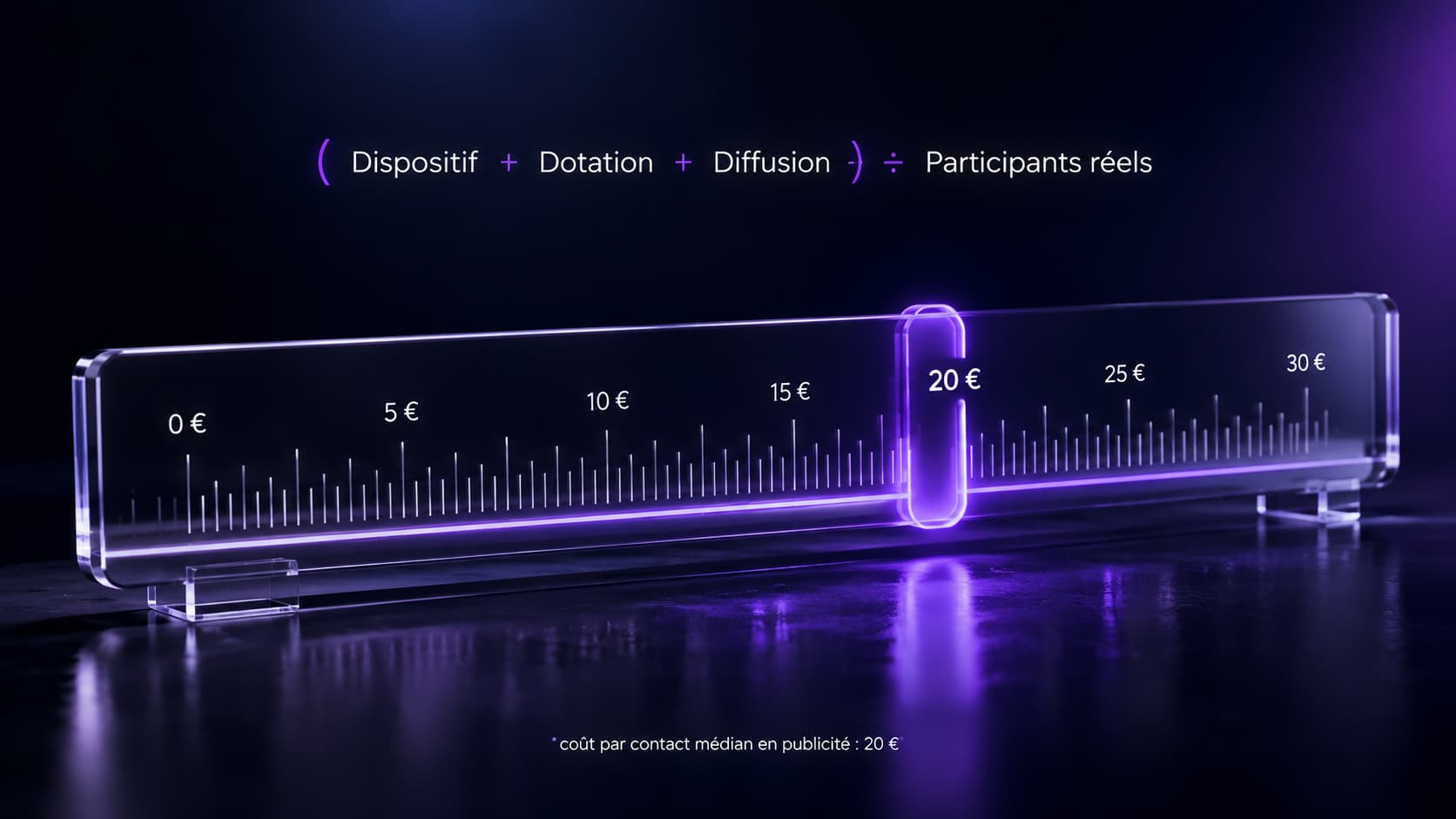
Worth remembering. An expensive setup that engages massively costs less than a cheap one nobody sees. Price is negotiated; cost per participant is designed.
How do you build the budget of a gamification setup, step by step?
You never start from the price of a tool: you start from the number of participants you are targeting, and work back to the budget. Here is the calculation path we apply during scoping.
- Set the objective in participants, not in euros. How many people must you engage for the campaign to make business sense — and over what period? That number is your denominator.
- Determine an acceptable cost per participant. It follows from your existing benchmarks: cost of acquiring a contact, customer value, unit margin on the product concerned. That is your ceiling.
- Derive the overall envelope. Objective × ceiling = a defensible total budget, prize and distribution included. The figure lands before any tender — and it changes the conversation with suppliers entirely.
- Split it across the three levers. Prize, distribution, setup. On a consumer campaign, the prize and distribution often weigh more than the technology; the reverse is true for an engagement loop built to last.
- Choose the mechanic that fits the envelope. A €5,000 budget points to a platform and a simple mechanic; a €40,000 budget opens up custom-built work, AR or phygital. The budget selects the mechanic, never the other way round.
- Price all seven lines, including peak load and the legal framework. A line that is not priced is not a line you saved.
- Set up measurement before launch. Actual participants, observed cost per participant, share of the database that is usable, contribution per outlet. Without that plan, the next campaign will be budgeted blind.
Why METASENSE does not publish a rate card
Because a price taken from a catalogue is wrong nine times out of ten: the same prize game costs one to ten times as much depending on the volume to absorb, the network to activate and the prize at stake. We price after scoping, once the objective in participants is set — not before.
What we can show, on the other hand, are mechanics that produced real volume. For Akram × CDLA (Les Compagnons de l'Auto), a prize game backed by a shop sized for the peak, with a BMW as top prize, drew 30,000 visitors in under three months, with no technical or logistical incident. For Gocad, a phygital kiosk setup coupled with a Web AR game brought in over 6,000 participants across a network. For Diffusion Plus, an interactive stand combining an instant-win AR terminal with connected packaging offering personalised cocktail recipes extended engagement well beyond the trade show — a logic close to the one described in our article on augmented reality applied to packaging.
These three setups share neither budget, nor ground, nor sector — and that is exactly the point. What we transpose is not a sector, it is a mechanic: a prize calibrated on a community, a frictionless mobile journey, infrastructure that holds the peak, and measurement set up before launch. That mechanic works just as well in retail as in culture, events or e-commerce — a subject we go into in gamification in e-commerce and retail.
A word on vocabulary, finally, because it drives the budget. Gamification is not the subject: engagement is. The game is a tool, just like 3D, augmented reality or an in-store kiosk. A setup is judged on the attention it captures and on what remains afterwards — not on the number of mechanics it stacks. For context, the global gamification market is estimated at $36.46 billion in 2026, projected at $112.32 billion in 2031, with retail accounting for 27.55% (Mordor Intelligence): the budget line exists, it is structured, and it deserves better than a tool quote.
At METASENSE, a Creative Tech agency based in Vélizy-Villacoublay, the design of the mechanic, the design work and the development are carried by the same team. That is what lets us say, at scoping, whether the budget you have in mind can reach the number of participants you are targeting — or whether it is better not to launch.
Let's price your setup from your participants
You have an envelope and an engagement objective, and you want to know what they actually buy? We start from the number of participants you are targeting, the cost per participant your model can accept and your ground — online, in store, at an event — to size the setup and tell you honestly whether the equation holds.
Price your engagement setup → · Read the Akram × CDLA case study
FAQ — Pricing and budgeting a gamification setup
How much does a gamification setup cost?
From a few tens of euros per month to more than €70,000. The 2025-2026 benchmarks put a SaaS platform between €20 and €99/month, an augmented reality setup between €3,000 and €25,000, a custom-built game between €15,000 and €50,000, and an interactive kiosk between €1,000 and €5,000 per unit — excluding the prize and excluding distribution.
Which gamification mechanic is the cheapest?
Quizzes and simple mechanics: they fit within the standard plans of SaaS platforms, from around €20/month for 1,000 entries. They need little design work and no 3D assets. In exchange, customisation stays limited to the vendor's template and the cost climbs with volume.
How much does an online prize game cost?
The technical setup can start at a few tens of euros per month on a platform, or run to several tens of thousands of euros when custom-built. But on a consumer campaign, the prize and distribution generally weigh more than the technology: they are what determine the number of participants.
How much does an augmented reality setup cost?
Public benchmarks put an AR viewer at €5,000 excl. VAT, a virtual try-on at €7,000 excl. VAT and an AR mini-game at €9,000 excl. VAT, as packages including creation, development, publishing, hosting and maintenance (Filtre Experience, 2026). Other sources widen the range to €3,000-€25,000 depending on complexity and the volume of 3D assets.
How much does an interactive kiosk in store cost?
The hardware costs €1,000 to €5,000 per kiosk depending on screen size, with software maintenance of around €20/month per unit (HelloPro, 2026). For event rental, expect €300 to €1,200 for 1 to 7 days (Wawacom). These amounts cover hardware only: software, casing and operation are separate lines.
What makes the price of a gamification setup vary?
Seven factors: volume and participation peak, degree of customisation, the presence of 3D or AR content, integrations with CRM or e-commerce, whether there is a physical footprint, the lifespan of the setup and the legal scope. Moving onto physical ground is the most structural of them.
Is a SaaS platform really cheaper than custom-built?
For a recurring, low-volume activation, yes. As soon as the campaign succeeds, entry tiers trigger an overspend, and customisation stays capped by the template. The honest trade-off is made on total cost over three years, at realistic volume, not on the price shown in year one.
How much do the rules of a prize game cost?
Between €160 and €200 excl. VAT going directly through a judicial commissioner, or around €59 excl. VAT through a specialist platform that drafts, files and supplies proof of filing. Filing has no longer been a general obligation since 2014, but it remains the only document with undisputed value in a dispute.
What is cost per participant and how do you calculate it?
It is the total (setup + prize + distribution) divided by the number of actual participants. It lets you compare setups of very different natures and set them against your other acquisition lines — the Talyco observatory reports a median cost per contact of €20 in online advertising in France in 2026.
Should the prize be included in the setup budget?
Yes, always. The prize is the line that buys attention: far more than the platform, it determines how many people will take part. A budget that isolates the technology and treats the prize “separately” mechanically produces a cost per participant that is out of control.
What budget should you allow for hosting a prize game?
It depends on the peak, not the average. A setup concentrates most of its entries in a few hours, at the moment of a media or social push. Infrastructure is sized on that peak: a modest line compared with the prize, and the only one whose shortfall cancels the entire campaign.
Is a gamification setup profitable?
It is when its cost per participant stays below what you pay elsewhere for equivalent attention — allowing for what it adds: declared data, recall, generated content, store visits. Profitability is modelled at scoping, starting from the number of participants targeted.
Sources
- Repha — Les 10 plateformes incontournables pour lancer vos jeux-concours en 2026 (2026): Woorise €20/month for 1,000 entries, Socialshaker €99/month, Drimify ≈ $226/month, Qualifio on quotation: repha.fr
- Drimify — Tarifs (accessed 13 August 2026): tiers indexed on entry volume (100 / 1,000 / 25,000 per month), enterprise plan on quotation, white label as an option: drimify.com
- Albus Factory — Gamification sur mesure (2026): digital escape game €15k-35k, challenges/quizzes/gamified platforms €20k-45k, serious game €25k-50k, above €70k for complex or multilingual integration (context: enterprise gamification): albusfactory.com
- Filtre Experience — Prix d'un filtre Web AR (2026): AR viewer €5,000 excl. VAT, virtual try-on €7,000 excl. VAT, mini-game €9,000 excl. VAT, including creation, development, publishing, hosting, analytics and maintenance: filtre-experience.fr
- Yeeply — Combien coûte la réalité augmentée ? (September 2025): interactive filter €3,000-8,000, virtual try-on €8,000-20,000, AR catalogue app €15,000-30,000, complex projects €20,000-60,000+: yeeply.com
- HelloPro — Prix d'une borne tactile en 2026 (August 2026): average €1,000-5,000, broken down by screen size (22": €1,000-1,800 · 43": €2,300-4,500 · 65": €3,000-4,600), software maintenance ≈ €20/month per kiosk: conseils.hellopro.fr
- Wawacom — Borne tactile : location, prix et conseils: rental for 1 to 7 days €300-500 (standard kiosk), €700-1,000 (interactive models), €800-1,200 (event units); monthly rental from €1,500, installation and removal included: wawacom.fr
- Winbuz / Reglementdejeu.com — Le coût d'un commissaire de justice pour son jeu ou concours: €160-200 excl. VAT direct, €59 excl. VAT through a specialist platform (drafting, checking, filing, proof): winbuz.com
- Talyco — Observatoire des prix de la publicité en ligne en France 2026: €460,000 of real spend by French advertisers over a rolling 12 months; median Meta CPM €3.40, median Google Ads CPC €0.58, median cost per contact €20: talyco.io
- Mordor Intelligence — Gamification Market: $36.46bn in 2026, projected $112.32bn in 2031 (CAGR 25.24%), retail 27.55% of the market in 2025: mordorintelligence.com
- CNIL — Organisation de jeux-concours : que faire ? (express and separate consent for any advertising use of the data collected): cnil.fr
- METASENSE — Étude de cas Akram × CDLA (30,000 visitors in under 3 months, zero incidents): meta-sense.fr