

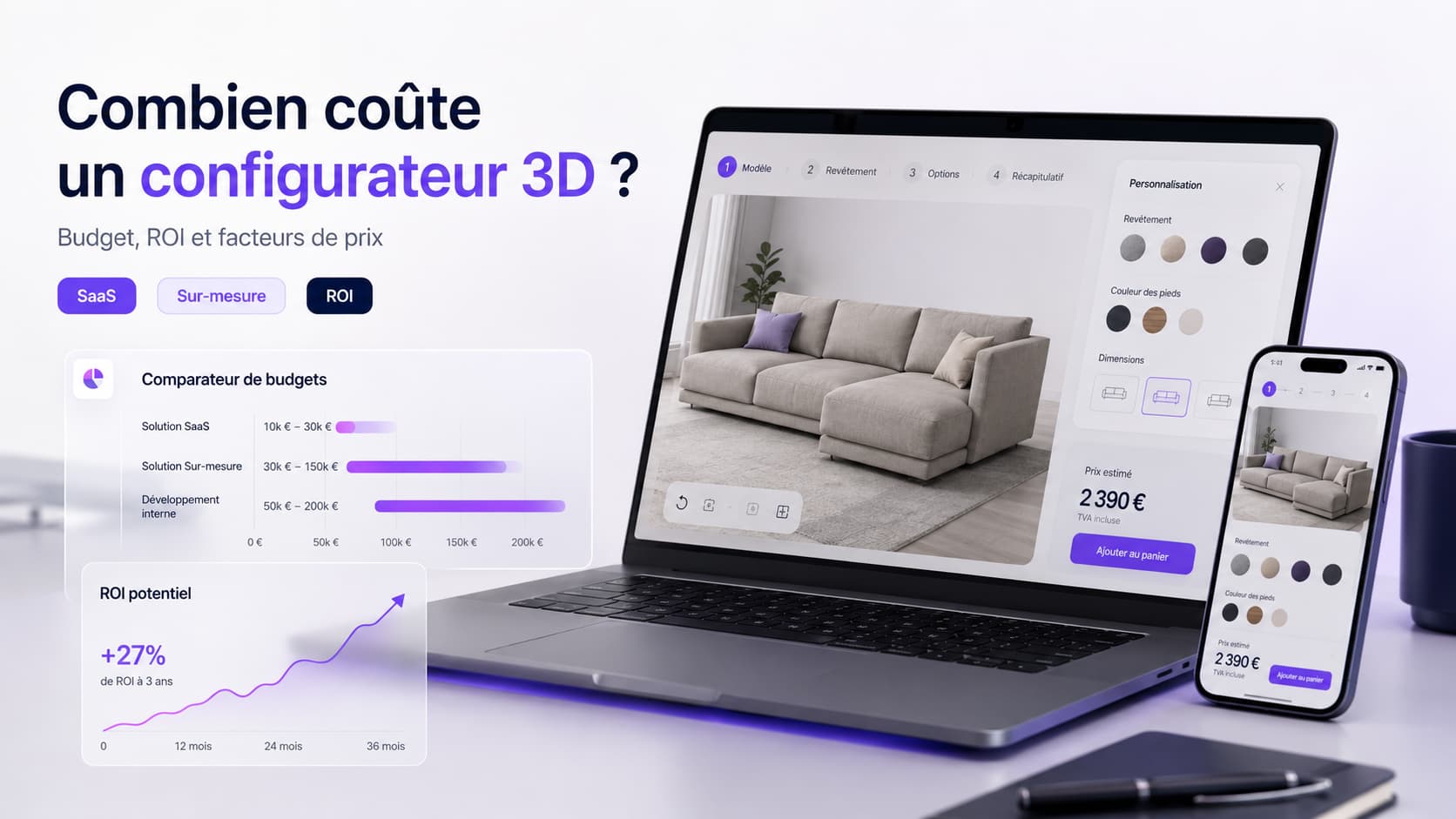
A 3D configurator costs between €3,000 for an entry-level SaaS module and more than €100,000 for a large custom-built setup, with most professional projects landing between €7,000 and €50,000, according to the market ranges published by vendors in 2025. That spread is not commercial vagueness: it reflects two very real cost items — 3D modelling (one model per product or per range) and development of the configurator — plus a handful of factors that tip a project from one order of magnitude to the next.
This article is the budget deep-dive of our reference guide 3D product configurator: personalisation in the service of conversion. We will not revisit integration techniques or product selection here. We settle what it costs, why the price varies so much, and how to know whether it pays off for you — with sourced market figures.
In short
- SaaS / off-the-shelf: around €3,000 to €25,000 (often as an annual subscription) for a standardised configurator.
- Custom-built and integrated: from around €20,000, and well beyond for a fast, deeply integrated, on-brand setup.
- 3D modelling: a separate line item, around €1,000 to €3,000 per product for a quality e-commerce model.
- What moves the price: number of variants and options, quality of the 3D models, e-commerce integration, adding AR, and maintenance.
- ROI is calculated, not guessed: one point of conversion and 20% fewer returns are not worth the same on a custom sofa as on a mug.
How much does a 3D configurator cost in 2025? (market ranges)
There is no single price: the market runs from a few thousand euros for a simple SaaS module to more than €100,000 for a complex custom-built setup. Here are the ranges published by specialist vendors in 2025. Read them as markers to position your project, not as quotes.
| Tier | Market range | For whom / what |
|---|---|---|
| Entry-level SaaS module | ~€3,000 – €5,000 | Simple product, few options, standardised model |
| Professional solution | ~€7,000 – €18,000 | 3D + AR + moderate configuration logic (SMEs) |
| Enterprise tier | €20,000 and above | Photorealistic rendering, complex logic, deep integrations |
| Large custom-built project | €50,000 – €100,000+ | Wide catalogue, PIM/ERP integration, performance requirements |
Depending on the commercial model, a recurring subscription sits on top of these amounts on the SaaS side: iONE360 quotes annual tiers of £5,000 to £25,000 (entry), £25,000 to £100,000 (mid) and over £100,000 (enterprise). In other words, a SaaS configurator is not a one-off purchase: it is a cost that returns every year for as long as the module runs.
Reading these figures honestly. They come from platforms that sell configurators. They frame the orders of magnitude well, but every vendor pulls the grid towards its own model. The real price depends on your catalogue, not on a market average.
Why a "3D modelling" line item is always added to the price
Because a configurator displays 3D models that do not exist by default: they have to be created, one per product or per range, and that cost is separate from the software. It is the most underestimated line item in a configurator project.
For an e-commerce product, the market puts a quality 3D model at €1,000 to €3,000 per product, depending on complexity and the number of variants (Dizz Agency, 2025). 3D providers charge around €50 to €200 per hour. AI-automated solutions break those prices — some players advertise models from around €80 each — but at the expense of control over rendering and product fidelity.
What drives the modelling bill up:
- The number of products. A configurator for 5 references is not a 200-SKU catalogue.
- The level of realism: PBR rendering (physically based materials) takes more work than a low-poly model.
- Material variants: every finish, texture or material to model properly adds time.
- Web optimisation: a model that looks good in a 3D package is not necessarily light enough for a browser. Re-optimising it (glTF/GLB, compression) so it does not sink page performance is a job in itself, covered in the reference guide.
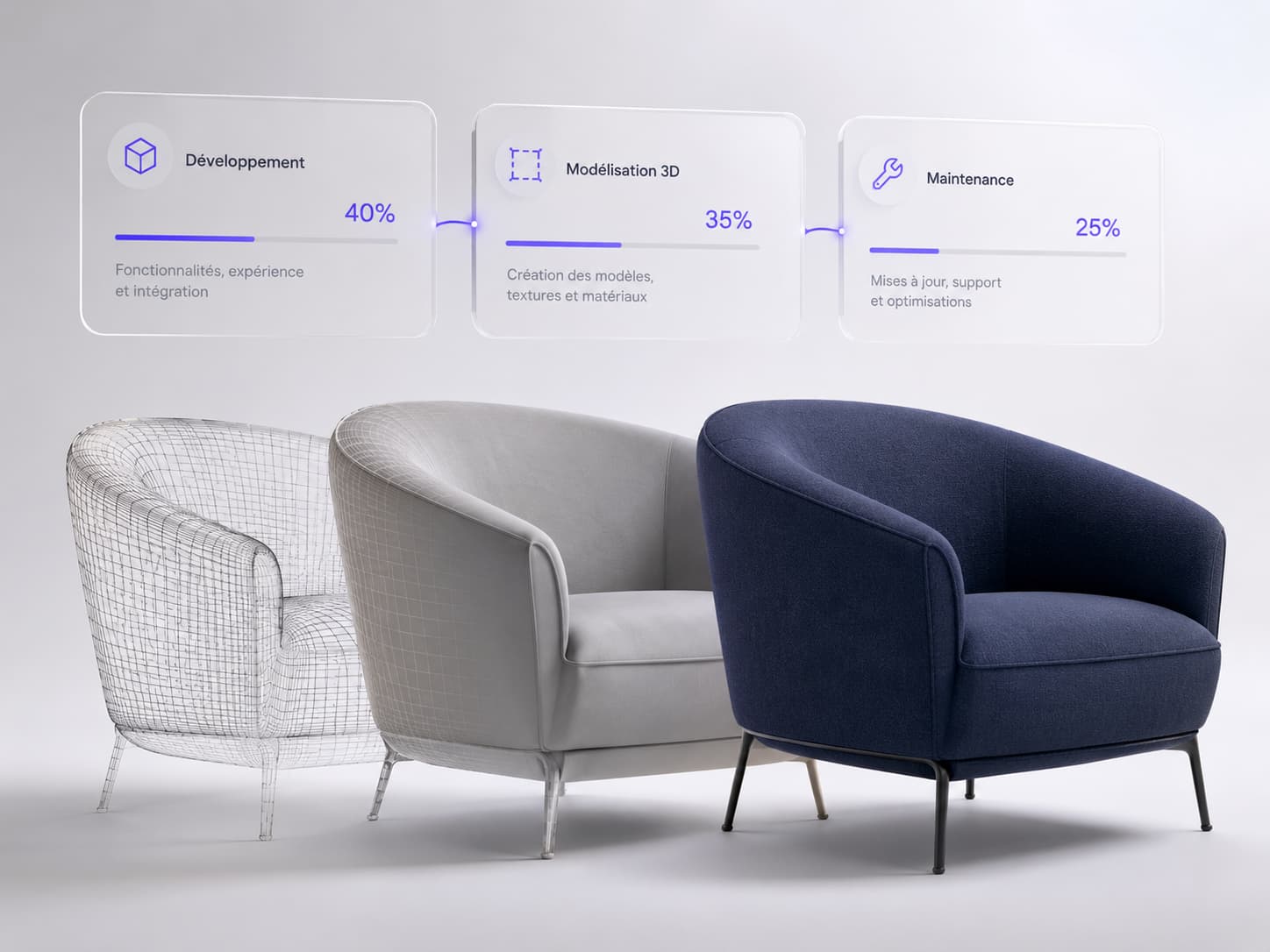
Worth remembering. The price of a configurator is software plus modelling. A quote that does not separate the two — or that "forgets" the 3D — mechanically understates the real budget.
What makes the price of a 3D configurator vary?
Six factors explain most of the gap between a €5,000 project and an €80,000 one. Knowing them lets you read a quote and understand where the budget goes.
| Factor | Pulls the price down | Pushes the price up |
|---|---|---|
| 1. Number of variants / options | 3 colours, few combinations | Hundreds of combinations plus compatibility rules |
| 2. Quality of the 3D models | Simple model, standard rendering | PBR photorealism, animation, several ranges |
| 3. E-commerce integration | Standalone module | Variants, dynamic pricing, stock, PIM/ERP in sync |
| 4. Augmented reality (AR) | No AR | Web AR at 1:1 scale, mobile fallback |
| 5. Performance & accessibility | Platform standard | Core Web Vitals tuning, mobile QA, a11y |
| 6. Maintenance & evolution | Fixed template | New ranges, recurring updates, support |
Two factors deserve a word, because budgets often overlook them:
- Configuration logic. Three independent colours is trivial. Dependency rules ("this finish requires that base", "this option is incompatible with that one", "this module changes the price") are genuine business modelling work — and that is what separates a configurator from a simple 3D viewer.
- Maintenance. A configurator is not a frozen deliverable. Every new range, every new material calls for modelling and integration. On the SaaS side, that is the annual subscription; on the custom side, it is an evolution budget to plan from day one.
Does a 3D configurator pay off? What ROI should you expect?
Yes, on the right products — and ROI is calculated from two documented levers: higher conversion and fewer returns. Vendors publish converging orders of magnitude, which should be treated as calculation assumptions, not promises.
The most widely quoted market figures:
- Conversion: Shopify reports a conversion rate up to 94% higher on product pages with 3D/AR content (self-reported average); specialist vendors claim +30% to +40% depending on the case (Threekit).
- Returns: -40% returns among Shopify merchants using 3D/AR, up to -50% according to Threekit — because the buyer sees exactly what they are ordering.
- Engagement / basket: when buyers take part in creating their product, they are 60% more likely to buy (Threekit), and AOV rises through upsell of options visualised in 3D.
The right question is not "how much does it cost" but "how much does it return on THIS product". The calculation fits in five lines:
- Unit margin on the product concerned (€ per sale).
- Monthly traffic on the product page (visitors).
- Estimated conversion gain (a conservative assumption, say +20% rather than +94%).
- Savings on returns (logistics cost avoided × volume of returns avoided).
- Total cost of the configurator (build + modelling + annual maintenance).
The break-even point comes from dividing total cost by estimated additional monthly margin. On a high-margin, high-traffic product, a configurator can pay for itself in a few months; on a low-margin, low-volume product, never. That is exactly the calculation we run during scoping, before we recommend — or advise against — a configurator.
An honest caveat. These percentages are averages published by companies that sell 3D. Use them as optimistic assumptions to discount, never as a guarantee. The only ROI that counts is the one your margins, your traffic and your return rate produce — which is why the calculation belongs before the investment.
Custom-built or SaaS configurator: which budget makes sense?
SaaS minimises the upfront investment but installs a recurring cost and a ceiling on personalisation; custom-built demands a higher project investment but removes the subscription, frees the brand and the performance, and often costs less over the medium term. The right call is less about the sticker price than about total cost over three years.
| SaaS / off-the-shelf | Custom-built (agency) | |
|---|---|---|
| Upfront cost | Low to moderate | Higher (project investment) |
| Recurring cost | Annual subscription (can exceed £100k/year at enterprise tier) | Controlled maintenance, no licence |
| Brand / UX personalisation | Limited to the template | Complete |
| Performance & SEO | Inherited (third-party module) | Controlled and optimised |
| Ownership | Dependent on the platform | A block of your own code |
| Total cost over 3 years | Can exceed custom-built if the subscription runs | Investment amortised, no software rent |
The reflex that "SaaS is cheaper" is true in year one and often false over three years: an annual subscription eventually meets, then overtakes, the cost of development you own. SaaS remains the right choice to test a hypothesis quickly on a small budget; custom-built becomes necessary as soon as performance, identity and integration turn strategic for conversion. The technical side of this trade-off is covered in the reference guide.
Why METASENSE prices each project individually (and publishes no rate card)
Because a configurator price taken from a catalogue is almost always wrong: it depends on your catalogue, your conversion goals and your stack — not on an average. We do not resell a SaaS product and we publish no rate card, for a simple reason: an honest quote starts with scoping, not with a price line.
Our credibility here is technical and proven. On Nîmes-la-Romaine (with Aura, formerly EDEIS), we delivered a WebGL 3D web app reachable from a simple QR code, which handled thousands of simultaneous connections with no installation — the same performance requirement that separates a configurator that converts from a gadget that stutters. And for dealer group Edenauto, we built a WebGL 3D configurator with Web AR (the Kia viewable at full scale, drive-to-store logic). That combination of advisory and technical work is what lets us say, upfront, whether the game is worth the candle for your products — and price accurately, rather than high or low.

The right starting point: your target budget. Rather than a blind quote, we start from your product, your margin and your traffic to model the ROI and size the investment. To position your project, let's talk directly.
Let's talk budget and ROI for your 3D configurator
You have a customisable product and you want to know what a 3D configurator would cost — and return — in your case? The answer is not in a rate card: it is in the calculation. We start from your margins, your traffic and your return rate to tell you honestly whether the investment stands up, and at what level to size it.
Let's talk about your project and its ROI →
FAQ — Price and ROI of a 3D configurator
How much does a 3D product configurator cost?
The 2025 market ranges run from around €3,000 for a simple SaaS module to more than €100,000 for a complex custom-built setup, with most professional projects between €7,000 and €50,000. On top of that come 3D modelling (around €1,000 to €3,000 per product) and, with SaaS, an annual subscription.
What makes the price of a 3D configurator vary?
Six factors: the number of variants and the complexity of the option rules, the quality of the 3D models (PBR realism), e-commerce integration (variants, pricing, stock, PIM/ERP), adding augmented reality, the level of performance and accessibility targeted, and maintenance. The richer the configuration logic, the higher the budget.
Does a 3D configurator pay off, and what ROI should you expect?
Yes, on the right products. Vendors quote a conversion rate up to 94% higher (Shopify) and 40% to 50% fewer returns. But ROI is calculated case by case: unit margin × conversion gain + savings on returns, set against total cost. On a high-margin, high-traffic product, payback takes a few months; on a low-price item, never.
How much does 3D modelling a product cost?
For an e-commerce product, budget around €1,000 to €3,000 per product for a quality model, or €50 to €200 per hour with a 3D provider. AI-automated solutions come down to around €80 each, at the cost of less control over the rendering. It is a line item separate from the configurator software.
Custom-built or SaaS configurator: which budget should you choose?
SaaS minimises the upfront investment (from a few thousand euros) but adds an annual subscription and caps personalisation. Custom-built requires a higher project budget but removes the licence and frees performance and brand. Over three years, custom-built often works out cheaper if the SaaS subscription runs for long.
Are there hidden costs in a 3D configurator?
Yes, mainly 3D modelling (often missing from quotes), web optimisation of the models so they do not sink performance, and maintenance: every new range or material calls for 3D and integration. With SaaS, the recurring subscription is the heaviest hidden cost over the long run.
Does adding augmented reality push the price up a lot?
Web AR adds a cost, but a moderate one when it builds on 3D models already produced for the configurator. It pays off above all on products where size matters (furniture, vehicles), where it sharply reduces returns linked to dimensions. It is an ROI trade-off, not a default option.
How do you estimate ROI before starting the project?
Model five variables: unit margin on the product, traffic on the page, estimated conversion gain (a conservative assumption), savings on returns, and total cost (build + modelling + maintenance). Break-even = total cost ÷ additional monthly margin. That calculation, run during scoping, is what says whether a configurator stands up.