

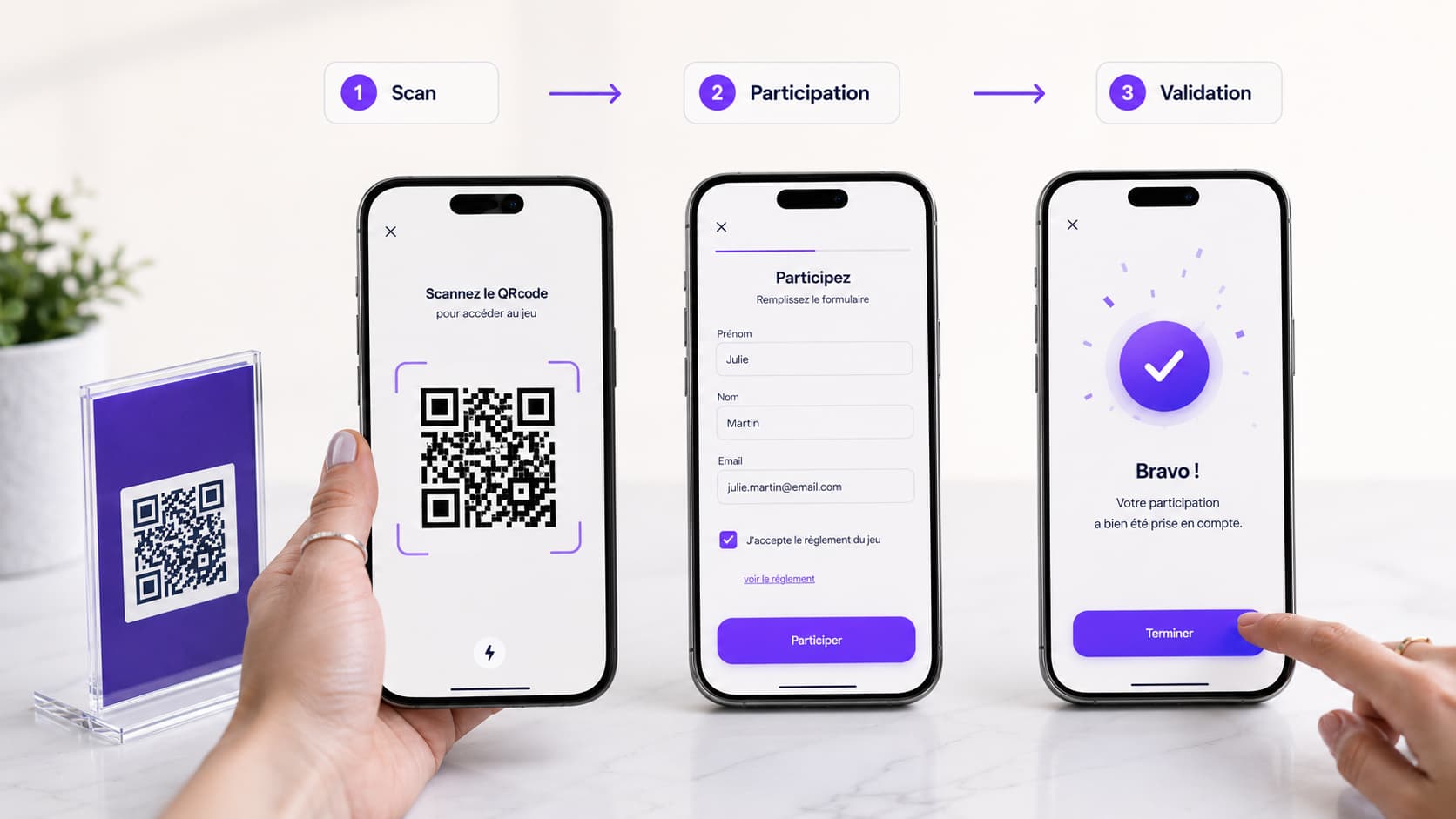
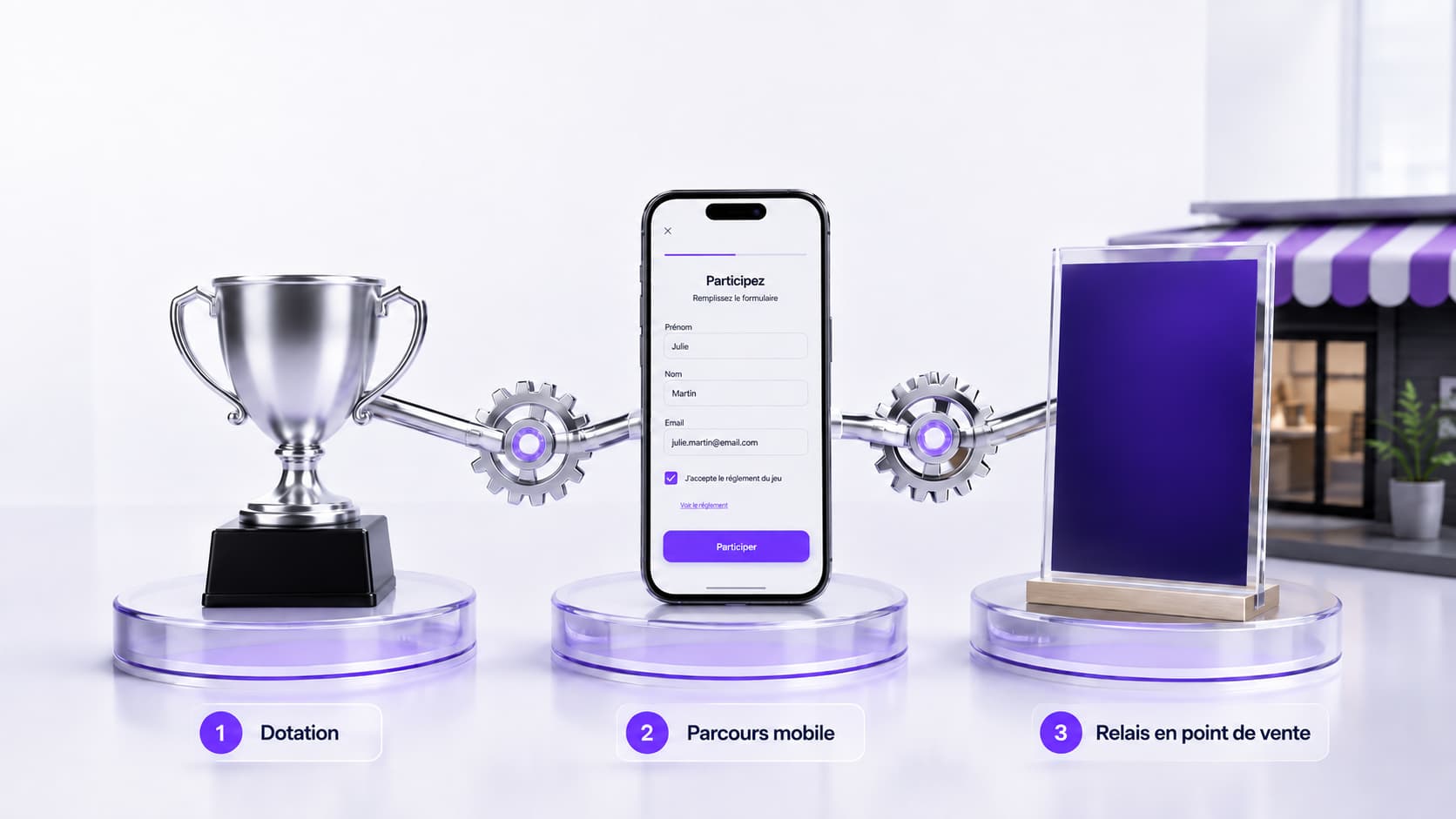
How do you run an online prize game that brings in traffic, and not just email addresses? Three parameters decide the outcome, and all three are settled before launch: a prize strong enough to be talked about, a mobile journey short enough to be completed, and a relay — a community, a social platform, a retail network — that puts the campaign in front of the right people. The platform only has to hold the load. It does not create participation.
We verified this on a campaign we ran end to end: for Akram × CDLA (Les Compagnons de l'Auto), a prize game built around a BMW 2 Series drew 30,000 visitors in under three months, with no technical or logistical incident. That is not a platform record: it is the result of a prize calibrated for a specific community, a purchase-and-entry journey stripped back to essentials, and a social relay that did the work of distribution.
In short
- An online prize game is a promotional campaign that awards a prize either by random draw (an element of chance) or on merit (knowledge, creativity), in exchange for a digital entry. The two do not fall under the same legal regime.
- The prize drives volume, the journey drives conversion, the relay drives reach. Take away any one of the three and the campaign produces an email list without traffic.
- Mobile is the real playing field: 53% of mobile visits are abandoned when a page takes more than 3 seconds to load (Google). Every extra form field is paid for in lost entries.
- French law has moved a long way: since 2014 there is no general obligation to lodge the rules with a judicial officer, and since 2011 a promotional lottery with a purchase requirement is no longer prohibited in principle — under strict conditions.
- The GDPR is where it really breaks: the CNIL fined an operator of prize-game websites €75,000 for misleading data-collection forms (reduced to €50,000 by the Conseil d'État in 2026).
- The result is not measured in entries but in the database you can activate afterwards: that is what turns a one-off campaign into an acquisition asset.
Launch your prize game with Playwiz →
What exactly is an online prize game?
An online prize game is a promotional campaign in which a brand puts up a prize and awards it either by random draw — with an element of chance — or on the basis of the entrant's performance (knowledge, creativity, a public vote), in exchange for an entry made through a website, an app or a social platform. The everyday phrase covers two regimes that French law keeps apart, and that distinction governs everything else in the build.
- The game rests on chance: a draw, a wheel, a scratch card, an instant win. In legal terms it is a promotional lottery.
- The contest rests on merit: a knowledge quiz, a photo, a strapline, a creation judged by a panel. Chance plays no part — or only to separate tied entries.
- The instant win is a sub-family of the game: the result is revealed immediately, which makes it a steady collection mechanic rather than a spike.
The French Consumer Code sets the reference definition: a promotional lottery is a commercial practice taking the form of a promotional operation aimed at awarding a gain or an advantage of any kind by way of a random draw, whatever its terms, or through the intervention of a chance element (article L. 121-20).
| Game (random draw, instant win) | Contest (merit) | |
|---|---|---|
| What decides the winner | Chance | The entrant's performance |
| Effort required | Minimal (a few seconds) | Real (answer, create, post) |
| Entry volume | High | Lower, but better qualified |
| Content generated | None | Often reusable by the brand |
| Legal regime | Promotional lottery (Consumer Code, art. L. 121-20) | Outside lottery rules as long as chance plays no part |
| Typical use | Create a traffic spike, build a database | Generate engagement and content |
In practice, the best campaigns combine the two: a draw for volume, a merit or sharing mechanic for depth of engagement. For the wider picture of game mechanics applied to marketing — and the difference between a one-off activation and a lasting engagement loop — see our article Gamification marketing: au-delà de l'instant gagnant.

Why do most prize games only produce an email list?
Because they are designed backwards: a tool is chosen first, then a prize funded with whatever budget is left, and at the end nobody has any reason to talk about it. The setup works technically, it collects a few thousand addresses from people who already follow the brand — and traffic stays flat.
Three causes come up almost every time:
- A neutral prize. A sensible prize — a voucher, a catalogue product — rewards the people who were already there. It triggers no curiosity, no sharing, no conversation. And sharing is what builds traffic, not the form.
- A journey that is too long. Every extra field, every account to create, every intermediate page costs a share of entrants. On mobile the margin is thin: Google reports that 53% of mobile visits are abandoned when loading takes more than three seconds. An eight-field form on a slow site is not a prize game, it is a filter.
- No relay. A campaign published on the brand's own channels reaches the brand's own audience. Without a driving community, a retail network, a partner or a creator carrying it, it never reaches the people who were not thinking about it.
There is a fourth blind spot, a quieter one: what comes after. A database collected without clean consent for marketing is a database you cannot use — we cover this below, and it is far from theoretical.
Worth remembering — A prize game is not judged on the number of entries but on how much new traffic it created and what share of that database you will be able to reactivate legally. Both are decided at the scoping stage, not at launch.
Which prize actually brings people in?
The right prize is not the most expensive one: it is the one that carries strong symbolic value for a specific community, to the point that it deserves to be told as a story. It is the only line item that buys attention. Everything else — platform, design, tracking — exists so that attention is not wasted.
That is exactly what drove the campaign we ran for Akram × CDLA (Les Compagnons de l'Auto). The prize was not a voucher: it was a BMW 2 Series, put up for a car community for whom that object means something immediately. The journey linked merchandise purchases to entries, on a custom-built Shopify store sized to absorb heavy traffic spikes. The outcome: 30,000 visitors in under three months, zero technical or logistical incident, and a social audience converted into customers.
What makes this case instructive is not the car, and not the automotive sector. It is the fit between the prize and the target audience. The same mechanic transfers to any field as soon as three conditions are met:
- The prize is identity-carrying. It says something about the community that plays — a cult object, an experience you cannot buy, restricted access. A perfectly targeted prize beats an expensive, badly targeted one.
- It is single and visible. One strong prize concentrates attention; a hundred small ones dilute it. Secondary prizes can be added, never in place of the headline prize.
- It can be told in one sentence. If an entrant cannot explain the campaign in a single message to a friend, there will be no organic relay.
The prize budget is therefore not an adjustment variable: it is the first decision of the campaign. (We cover the budget of a gamification setup in a separate article — mechanics, cost lines, and reasoning in cost per participant.)
Why does the mobile journey decide the entry rate?
Because a prize game is played on the move, often from a social feed, in a short window of attention: every second of loading and every form field is paid for in lost entries. You bought the traffic with the prize; the journey decides how much of it you keep.
Four design decisions do most of the work:
- Zero installation. The journey opens in the browser, from a link or a QR code — never behind an app to download. The same rule applies to augmented reality experiences with no app: every installation step halves the audience.
- The fewest possible fields. Ask only for what is needed to award the prize and to serve the stated purpose. Everything else — preferences, segmentation — is asked later, of an entrant who is already engaged.
- Immediate proof of entry. A clear confirmation screen, a reference number, an email: the entrant must know they are in. That is what triggers sharing.
- Resilience under peak load. A successful campaign concentrates its traffic into a few hours. A platform that goes down on the day a creator posts or a media campaign starts does not get a second chance: the audience does not come back twice. On the Akram × CDLA campaign, holding 30,000 visitors without incident was part of the brief, on the same footing as the design.
This is where working across both disciplines really counts. Designing a good journey and making it unshakeable under load are two crafts; when they are split between a creative agency and a technical supplier, launch day settles the argument. At METASENSE, a Creative Tech agency based in Vélizy-Villacoublay, concept, design and development are carried by the same team — because a prize game only has one launch date.
How does the point of sale extend an online prize game?
The physical relay is the most underused lever in a prize game: it turns an online campaign into a network activation, and it captures the contact as close as possible to the moment of purchase. A purely digital campaign reaches the people already following the brand; a campaign relayed in store reaches the people walking into it.
The relay mechanics that work:
- A QR code on the shelf, in the window or on the packaging — the step from aisle to screen, with no app.
- A kiosk in store — a physical setup that lets people play on the spot. For Gocad, the setup we designed (phygital kiosks, an NFC/AR Web AR game and a proprietary platform) drew over 6,000 participants across a network, capturing a qualified contact close to the point of purchase.
- An instant win on a stand or at an event — for Diffusion Plus, an AR "jackpot" terminal with instant wins, extended by connected packaging in augmented reality offering personalised cocktail recipes: you capture on site, you extend engagement at home.
- A drive-to-store mechanic — a unique code, a coupon redeemable in store, a configurator that makes people want to see the real thing. For dealer group Edenauto, we designed a campaign around the Kia brand combining a WebGL 3D configurator, life-size augmented reality and a FOOH campaign, with the showroom visit as the objective.
The benefit is not only volume: it is traceability. A dedicated activation code or parameter per outlet tells you which store generated which entries — so you can steer the network rather than contemplate a vague total. We detail these digital-to-store mechanics in our article Drive-to-store : comment la 3D et l'AR font venir vos clients en magasin, and their integration into the purchase journey in Gamification e-commerce & retail.
What does French law say about online prize games?
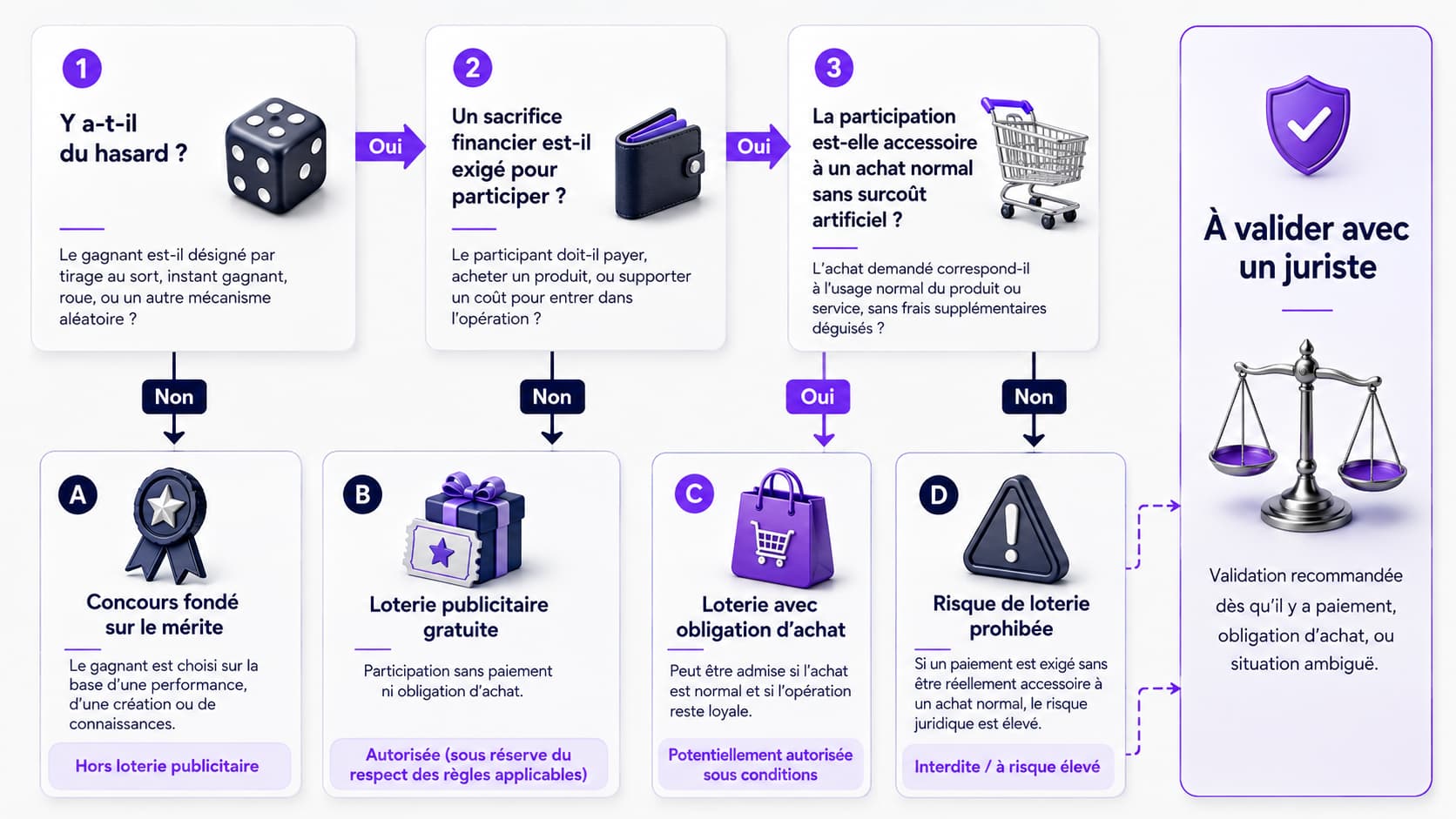
The French framework has changed considerably in fifteen years: lodging the rules with a judicial officer has not been compulsory since 2014, and a campaign with a purchase requirement has not been prohibited in principle since 2011 — but the red line of the prohibited lottery has not moved. Here are the points every marketing department should know before launching. (What follows is a documentary summary, not legal advice: the structure of a campaign should be validated by a lawyer.)
| Question | What French law says | Reference |
|---|---|---|
| Are written rules compulsory? | The Hamon Act of 17 March 2014 removed the general obligation to draft and lodge the rules. They remain the document that proves the campaign was fair and settles disputes. | Act no. 2014-344 |
| Do you need a judicial officer (formerly a bailiff)? | Not compulsory since 2014, but strongly advised: it is the only form of validation with indisputable legal weight if the campaign is challenged. | Act no. 2014-344 |
| Can you require a purchase? | A promotional lottery with a purchase requirement has not been prohibited in principle since the Act of 17 May 2011, passed in the wake of European case law. It remains unlawful if it is unfair within the meaning of the Consumer Code. | Act no. 2011-525; CJEU, 14 Jan. 2010, case C-304/08 |
| Where is the red line? | A campaign that combines a public offer, the expectation of a gain, chance and a financial sacrifice required to enter falls under the prohibited lotteries of the Internal Security Code. This is the point to have settled by a lawyer. | Internal Security Code, art. L. 320-1 |
| What about entry costs? | Postage, connection or communication costs are allowed provided they carry no premium rate, the entrant is informed in advance, and they can be reimbursed. | Act no. 2014-344 |
| What is the general principle? | Promotional campaigns awarding a gain by random draw are prohibited where they are unfair. Fairness means equal chances, clear information and no misleading practice. | Consumer Code, art. L. 121-20 and L. 121-1 |
What the rules must state, in practice: the identity of the organiser, the start and end dates, the territory and conditions of entry (age, exclusions), the exact terms of participation, the nature, number and commercial value of the prizes, how winners are designated, how prizes are handed over, how complaints are handled, and the identity of the data controller.
And the GDPR? That is where the value of your database is decided
The rule is simple and rarely respected: it must be possible to enter a prize game without agreeing to receive marketing. The CNIL is explicit — the information collected may only be used for the game itself and for handing over the prize; using contact details for advertising requires express, separate consent, which cannot be buried in acceptance of the general terms.
The penalty is not theoretical. In a decision of 29 December 2023, the CNIL imposed a €75,000 fine on TAGADAMEDIA, an operator of prize-game and product-testing websites, holding in particular that the misleading appearance of its forms — a prominent accept button, a barely visible refusal, small-print wording — could not produce free, informed and unambiguous consent (reduced to €50,000 by the Conseil d'État on 20 May 2026). In other decisions concerning the use of data bought from brokers, the amounts rose to €310,000 (FORIOU, January 2024) and €525,000 (HUBSIDE.STORE, April 2024).
Put in marketing terms: a pre-ticked box or a vague purpose does not win you contacts, it loses you your database. A clean form — entry on one side, marketing consent on the other, a defined retention period — produces a smaller database that you can actually use. That is what separates a list from an asset.
How do you run an online prize game, step by step?
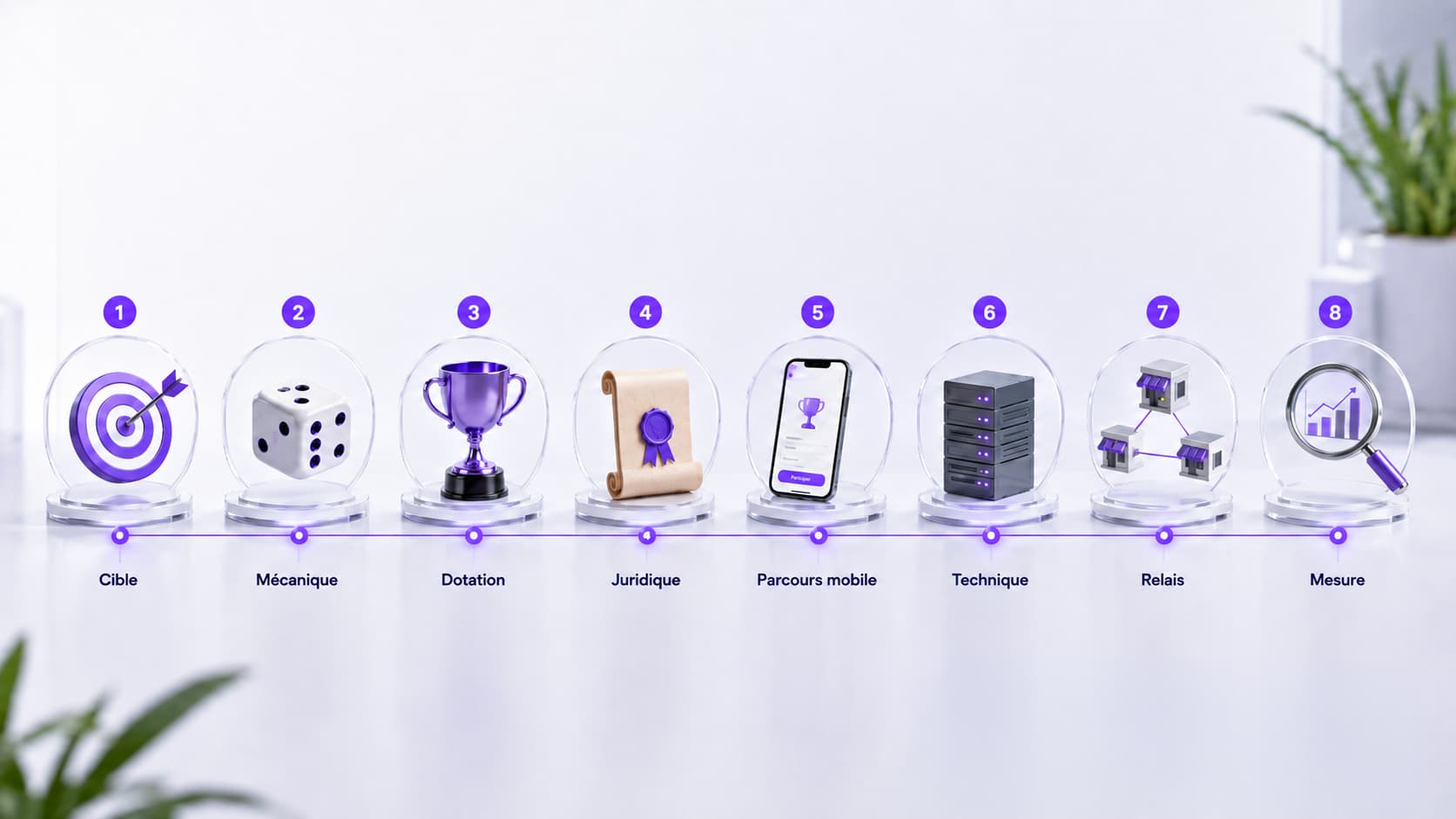
You never start from the platform: you start from a quantified objective, then choose the mechanic that serves it. This is the sequence we apply, from scoping to reactivating the database.
- Set the quantified objective. New traffic? An opt-in database? Store visits? Content generated by entrants? One objective, with a number attached — the other three may follow, but they do not drive the trade-offs.
- Choose the mechanic. A draw for volume, an instant win for steady collection, a merit contest for engagement and content. The choice follows the objective, not the trend.
- Calibrate the prize on the audience. Identity-carrying, single, tellable in one sentence. This is the line item that buys attention: decide it first, not last.
- Secure the legal structure. Draft the rules, decide on any purchase requirement, consider lodging them with a judicial officer, check the forms against the GDPR. Have all of it validated by counsel before any development starts.
- Design the mobile journey. No installation, the fewest possible fields, immediate confirmation, entry time measured in seconds. Test the journey on a real phone, on a real mobile network.
- Size the build for the peak. Prize-game traffic is not linear: it arrives within hours. The platform, the hosting and the prize logistics are sized on that peak, not on the average.
- Organise the relay. Community, creators, retail network, packaging, media campaign: who puts the campaign in front of people who do not follow you yet? Without an answer to that question, there will be no new traffic.
- Measure and reactivate. New traffic, journey conversion rate, entries per outlet, the genuinely opt-in share of the database — then a reactivation plan, budgeted from the start.
Step 8 is the one most often skipped, and it is the most profitable: a database collected properly can then be reactivated by email, by SMS or through richer conversational channels — we described that extension in our article on le RCS, le canal d'engagement après le SMS.
How do you measure the result of an online prize game?
A prize game is measured on four indicators, and the number of entries is only the first — and the least revealing. The table below is the one we put on the table at scoping, before any technology is chosen.
| Indicator | What it really tells you | How to read it |
|---|---|---|
| New traffic | Whether the campaign went beyond your existing audience | Share of new vs returning visitors over the period |
| Journey conversion rate | Whether friction is costing you entrants | Visitors to the game page → validated entries |
| Usable opt-in share | Whether you built an asset or a dead list | Contacts with valid marketing consent / total |
| Contribution per outlet | Which part of the network actually played along | Dedicated code or parameter per store / dealership |
Two context markers to situate the investment. The gamification market is estimated at $29.11 billion in 2025, with a projection of $92.51 billion by 2030 (26% annual growth), retail accounting for 27.55% in 2025 according to Mordor Intelligence: this is no longer an experiment, it is a structured budget line. On cost, benchmarks published by market players put a standard online prize game between €2,500 and €10,000, excluding the prize — an order of magnitude for a simple setup, nothing like a build integrated with the CRM and rolled out across a network. METASENSE does not publish a rate card and prices each setup after scoping.
Your next prize game deserves better than a form
Consumer brand, retail network, e-commerce, media: if you want a campaign that creates real traffic and leaves you a database you can reactivate, let's talk. We design and build engagement setups end to end — mechanic, design, development, resilience under peak load and measurement plan — with a single team.
Launch your prize game with Playwiz → · Read the Akram × CDLA case study · Get in touch
FAQ — Running an online prize game
How do you run an online prize game?
In eight steps: set a quantified objective, choose the mechanic (random draw, instant win, merit contest), calibrate the prize on the target audience, secure the legal and GDPR structure, design a short mobile journey, size the build for the peak, organise the distribution relay, then measure and reactivate the database.
What is the difference between a game and a contest?
A game awards the prize by chance (random draw, instant win): it falls under promotional lottery rules. A contest awards it on merit — knowledge, a creation, a vote — with no element of chance. A contest generates fewer entries, but more committed entrants and often reusable content.
Are written rules compulsory for a prize game in France?
The Act of 17 March 2014 removed the general obligation to draft and lodge written rules. They remain essential in practice: they are the document that proves the campaign was fair, frames complaints and protects the organiser if an entrant challenges the outcome.
Must the rules be lodged with a bailiff or judicial officer?
Not compulsory since 2014, but strongly advised for any campaign with a significant prize. The judicial officer checks that the game is lawful and fair, and their validation is the only one with indisputable legal weight in a dispute.
Can a prize game require a purchase?
Since the Act of 17 May 2011, passed in the wake of European case law, a promotional lottery with a purchase requirement is no longer prohibited in principle: it remains unlawful if it is unfair. The boundary with the prohibited lottery of the Internal Security Code is a fine one — have this structure validated by a lawyer.
Which prize should you choose for a prize game?
One that carries identity for the community you are targeting, single rather than fragmented, and tellable in one sentence. A perfectly targeted prize beats an expensive, badly targeted one: it is the only line item that genuinely buys attention and triggers sharing.
How many entrants can you expect?
That depends almost entirely on the prize and the relay, and very little on the platform. As an order of magnitude, on a campaign we ran, the Akram × CDLA prize game built around a BMW 2 Series drew 30,000 visitors in under three months, carried by a highly engaged car community.
How much does an online prize game cost?
The budget reads in two blocks: the prize and the build. Benchmarks published by market players put a standard campaign between €2,500 and €10,000 excluding the prize; a build integrated with the CRM and rolled out across a network is another order of magnitude. METASENSE prices each project after scoping, with no public rate card.
Can you use the emails collected for marketing?
Only with express consent, separate from the entry itself and not buried in the general terms. In December 2023, the CNIL fined an operator of prize-game websites €75,000 because its forms, misleading in appearance, could not produce valid consent.
How long can you keep entrants' data?
For as long as the stated purposes require: the game, handing over the prizes and, where applicable, consented marketing. The CNIL has held that five years in an active database, with no sorting or intermediate archiving, is excessive. The retention period must be defined and written down before collection.
Do you need an app to enter a prize game?
No, and it is actively counterproductive. The journey should open in the phone's browser, from a link or a QR code, with no installation and no account to create. Every extra step mechanically reduces entries, all the more so since 53% of mobile visits are abandoned beyond three seconds of loading.
Does a prize game work for bringing people into stores?
Yes, provided the physical relay is planned from the design stage: a QR code on the shelf or the packaging, a kiosk in store, a coupon redeemable in store, a unique code per site. That is also what makes performance traceable store by store rather than as one global total.
Sources
- Légifrance — Code de la consommation, article L. 121-20 (definition and regime of promotional lotteries): legifrance.gouv.fr
- DGCCRF / economie.gouv.fr — Loterie : des pratiques commerciales réglementées (practical guide): economie.gouv.fr
- August Debouzy — Les ventes avec primes, ventes subordonnées et loteries publicitaires payantes sont désormais licites dès lors qu'elles ne revêtent pas un caractère déloyal (Act no. 2011-525 of 17 May 2011; CJEU, 14 January 2010, case C-304/08): august-debouzy.com
- Solon — Toutes les loteries commerciales ne sont pas autorisées (distinction between Consumer Code art. L. 121-20 and Internal Security Code art. L. 320-1): solon.law
- Journal du Net — Loteries et jeux-concours : exit, l'obligation de rédiger un règlement (Act no. 2014-344 of 17 March 2014, entry costs and reimbursement): journaldunet.com
- CNIL — Organisation de jeux-concours : que faire ?: cnil.fr
- CNIL — Courtiers en données : sanction de 75 000 euros à l'encontre de la société TAGADAMEDIA (decision of 29 December 2023; prize-game forms with a misleading appearance, invalid consent; reduced to €50,000 by the Conseil d'État on 20 May 2026): cnil.fr
- CNIL — Prospection commerciale : sanction de 310 000 euros à l'encontre de la société FORIOU (31 January 2024): cnil.fr
- CNIL — Prospection commerciale : sanction de 525 000 euros à l'encontre de la société HUBSIDE.STORE (4 April 2024): cnil.fr
- Google — Accélérez le chargement des pages mobiles (53% of mobile visits abandoned beyond 3 seconds): support.google.com
- Mordor Intelligence — Gamification Market ($29.11bn in 2025 → $92.51bn in 2030, CAGR 26.02%; retail 27.55% in 2025): mordorintelligence.com
- ConseilsMarketing — Comment organiser un jeu concours ? (market benchmark: €2,500 to €10,000 excluding the prize): conseilsmarketing.com
- METASENSE — Akram × CDLA case study (BMW 2 Series, 30,000 visitors in under 3 months, zero incident): meta-sense.fr