


Why cultural mediation has to change
Cities, museums and heritage sites share one challenge: how do you keep attracting audiences when digital habits move faster than ever and visitors expect more interaction every year?
Most cultural mediation setups still rest on a passive model: look, read, listen. That model transmits information, but it guarantees neither engagement nor recall. Visitors used to interactive digital content tolerate the gap less and less — and for heritage sites, the gap now holds back attendance.
The answer fits in one idea: turn cultural mediation into an immersive, interactive and personalised experience, built on four levers — 3D, augmented reality, artificial intelligence and gamification. These technologies are not gadgets. They make heritage more accessible, easier to grasp and, above all, more engaging.
The question is no longer whether to change, but how fast.
What visitors now expect
Today's visitor no longer consumes culture passively. They look for an experience that holds their attention and helps them understand quickly. Four expectations shape this shift.
- Immediate understanding. A visitor wants to grasp the meaning of a place in seconds, without complex interpretive effort.
- Interaction. Exploring, handling, choosing your own route: that is what turns a visit into an active experience.
- Personalisation. Content has to adapt to languages, profiles and levels of prior knowledge.
- Continuity. The experience starts before the visit, plays out on site and continues afterwards.
Meeting these expectations means rethinking cultural mediation — no longer a sequence of explanatory panels, but a user-centred journey from end to end.
3D reconstruction: showing the invisible
One of the hardest parts of interpretation is representing the past faithfully. Facing a ruin, an archaeological remain or a monument reshaped by centuries, few visitors can picture what once stood there.
3D modelling answers that problem directly: it digitally recreates, with historical rigour, the successive stages of a site's evolution. Laser scanning, photogrammetry, 3D reconstruction — these techniques turn raw data into visual narrative. In practice, they let you show:
- a monument that no longer exists, restored to its original state;
- a city evolving through the ages, period after period;
- demolished buildings, put back into their historical context;
- areas closed to the public, made virtual and open to everyone.
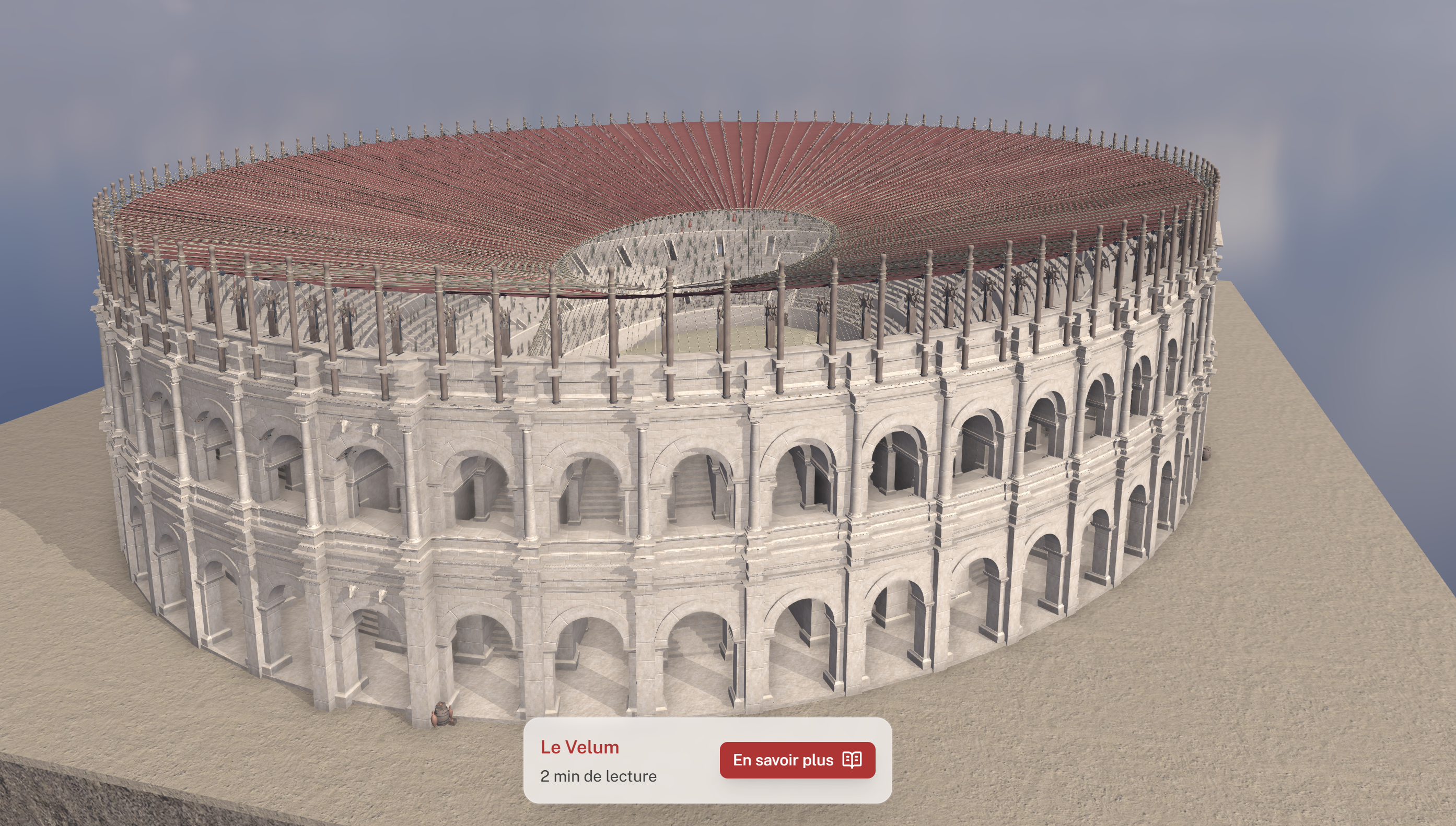
Our project · Nîmes la Romaine. This is exactly the approach we took in Nîmes, the city known as "the French Rome". With Nîmes la Romaine, a web app that runs straight from a smartphone browser, visitors and residents alike can rediscover the city as it stood two thousand years ago — with nothing to download.
The experience covers more than fifteen monuments, each with its historical record and AI-generated voice narration in three languages (French, English, Spanish). You can explore in 3D the forum and the Maison Carrée under Augustus, the Tour Magne in its Gallic and Roman states, or the amphitheatre in Roman times and again in the 10th century. Every 3D scene is scripted and can be projected in augmented reality at full scale, on the site itself. At the top of the Tour Magne, an experience driven by the phone's gyroscope overlays the Roman city on today's skyline. Mini-games then send visitors across the city — and reward them with discounts at local shops.
The project was delivered for the City of Nîmes, at the initiative of Aura (formerly Edeis), with the tourist office, the Musée de la Romanité and Aura's guides. It brings the four levers described in this article together in a single experience. Our challenge: deliver genuine immersion straight on a smartphone, with no app to install and no dedicated hardware.
Beyond the visit itself, this ability to visualise also gives local authorities a real conservation and digital memory tool for their historic sites.
Augmented reality: enriching the visit on site
Unlike a fully virtual experience, augmented reality (AR) adds a digital layer directly into the real environment, changing nothing physically on site. It enriches the visit without ever cutting the visitor off from the historical context.
From a standard smartphone, the visitor can:
- watch a building rebuild itself in front of them, revealing a lost façade;
- discover 3D objects and historical scenes unfolding on the very spot;
- reach geolocated content and follow a route guided by stories that come alive around them;
- see a monument's successive transformations, before their eyes.
This changes the visitor's stance: they no longer sit through the visit, they take part in it. And for historic centres, listed monuments and sensitive heritage spaces, the advantage is decisive — AR delivers content that can evolve without any physical work on the site.
Artificial intelligence: living, accessible storytelling
Artificial intelligence pushes past the limits of traditional formats and makes heritage storytelling both richer and more accessible. It opens four possibilities:
- Multilingual — immediate accessibility for international and regional audiences alike.
- Personalised — a narrative that adapts to each visitor's interests, age and prior knowledge.
- Interactive — historical figures embodied as avatars that explain, put things in context and answer in real time.
- Always available — virtual assistants that guide the visitor throughout the journey.
AI humanises the experience and opens it to a wider audience. It reduces cognitive friction, improves understanding and strengthens engagement.
One point deserves emphasis, because it reassures professionals in the sector: AI does not replace the human interpreter, it extends them. AI handles availability, translation and instant answers; the interpreter remains irreplaceable for shared emotion and direct contact with audiences.
Gamification and immersive staging: engaging for the long run
Gamification turns the visitor into an active explorer. Play mechanics — quizzes, challenges, contextual investigations — make the visit participatory. The benefits are concrete:
- More time spent on site, because exploration is encouraged;
- Better recall, because learning through play creates lasting memories;
- A more involved audience, younger generations and families in particular.
Immersive staging — video mapping on façades, interactive installations — completes the picture. It creates strong visual impact, encourages sharing on social media and makes the experience memorable.
What it changes for cities and museums
Beyond the cultural remit, these technologies become a genuine place marketing lever. Their impact shows on three fronts:
- Attractiveness — drawing new visitors, domestic and international, and modernising the image of a place.
- Engagement — longer visits, deeper exploration and higher satisfaction.
- Economics — indirect returns for local tourism, hospitality and retail.
Digital cultural mediation becomes a strategic tool for showcasing heritage, and it feeds directly into the vitality of a territory.
Rolling out an immersive strategy: method and priorities
An immersive strategy does not require an immediate, wholesale transformation. A staged, low-risk approach works better, in four steps:
- Pilot phase — test one setup on a defined section of the site to assess its relevance and take-up.
- Performance measurement — analyse engagement, dwell time, satisfaction and return on investment.
- Coordinated rollout — extend the experience step by step, using what the earlier phases taught you.
- Continuous optimisation — adjust and improve the setups over time.
This sequence protects the investment, gets the most out of the technology and builds a coherent whole that serves heritage over the long term.
Conclusion
Cultural mediation is entering a deep transformation. Visitor expectations, changing digital habits and what immersive technology now makes possible are redefining the standards of the cultural experience.
Combining 3D, augmented reality, artificial intelligence and gamified formats makes heritage clearer, more engaging and more accessible. In that context, the ability to design a high-quality immersive experience becomes a decisive factor of attractiveness — and the places that commit to it now build lasting value: cultural, touristic and economic.
To move on to delivery, explore our interactive installations for museums.
Let's redefine the experience of your heritage
At METASENSE, we design and build immersive experiences that hold audiences and showcase local heritage — as we have just done in Nîmes. If you are working on a heritage project, let's talk.
Contact us for a first conversation.
FAQ – Digital cultural mediation
What is digital cultural mediation?
It covers all the digital setups used to make heritage easier to understand, absorb and engage with: 3D reconstruction, augmented reality, artificial intelligence, gamified immersive experiences. These tools turn a visit into active, interactive and personalised exploration.
Is augmented reality suitable for every cultural venue?
Yes. AR works outdoors (historic streets, archaeological sites) as well as indoors (museums, monuments), without altering the existing architecture or décor. That flexibility makes it as relevant for a small regional museum as for a major national monument.
Does artificial intelligence replace cultural interpreters?
No — it complements them. AI provides continuous availability, multilingual access and real-time answers. But human interpreters remain essential for shared emotion, in-depth teaching and direct contact with audiences.
Why does gamification improve the visitor experience?
Because it turns the visitor into an active participant. Game mechanics (quizzes, challenges, investigations) spark curiosity, encourage exploration and deepen emotional involvement — which improves recall and lengthens the visit.
Are these technologies within reach of every local authority?
Yes. The solutions are modular and adapt to each territory's budget. A staged approach — start with one targeted setup, then enrich it step by step — builds a coherent strategy without a heavy upfront investment.
What is an immersive heritage experience?
It is a setup that lets visitors interact actively with a place through technologies such as 3D, augmented reality, virtual reality or AI. The aim: support understanding, emotion and engagement by turning the visitor into an actor of their own discovery.
How does 3D improve the way heritage is showcased?
It reconstructs lost monuments precisely, shows different historical periods of the same site and opens up spaces that cannot be entered. It makes heritage legible in all its historical and temporal complexity.
What is a heritage digital twin?
It is a faithful virtual representation of a monument, museum or site. It documents the current state precisely for conservation, preserves it virtually, and supports new visit experiences, remotely or on site.
How do you measure the success of an immersive cultural mediation project?
Several indicators (KPIs) can be tracked: average dwell time, interaction rate with the setups, visitor satisfaction, recommendation score (NPS), attendance trends and engagement with digital content.
What is the future of cultural mediation?
It rests on the convergence of heritage, artificial intelligence, personalised immersive experiences, gamification and real-time interaction. Visitors want participatory, memorable experiences and compelling stories rather than plain information transfer.
How do you make a heritage site more attractive to younger generations?
By combining gamification, on-site augmented reality, storytelling enriched by 3D and content designed for mobile use. These approaches strengthen both understanding of the heritage and the emotional engagement of young audiences.
Sources
Heritage, cultural tourism and mediation
- UNESCO – Culture et patrimoine mondial
- ICOM – International Council of Museums
- Ministère de la Culture
- Atout France – Tourisme culturel
Immersive experiences and digital culture
- Europeana Pro – Digital Transformation in Cultural Heritage
- ICOMOS – Digital Heritage Documentation
- CyArk – Digital Preservation of Cultural Heritage
3D reconstruction and heritage
- Historic England – 3D Modelling and Heritage
- Getty Conservation Institute – Digital Heritage Resources
Augmented reality and visitor experience
- Think with Google – Visitor Experience & Digital Engagement
- NEMO – Network of European Museum Organisations