


AI image and video generation is one of the decade's biggest creative opportunities for brands: volume, speed, cost, variants, personalisation and creative exploration have reached a level never seen before. In 2026, 78% of marketing teams already use AI-generated video in at least one campaign per quarter, and AI video advertising is estimated at $9.1 billion — around 12% of global digital video advertising (Vivideo, posteverywhere). But between a striking demo and content you can actually publish, at brand level, there is a gap. Producing a consistent asset (same character, same product, same identity from one visual to the next), on brand, technically clean and legally safe takes far more than a prompt. That is exactly where the value sits: the raw power of the tool is available to everyone, professional quality is not. Here is what generative AI really unlocks for brands, where the gap lies, and why crossing it remains a craft.
In short — the opportunity AND the standard
- The opportunity: produce more, faster, at lower cost, with endless variants and personalisation — a creative playing field brands have never had before.
- The market is shifting: 78% of marketing teams use AI video; the AI video generation market is estimated at $18.6 billion by the end of 2026 (AutoFaceless, posteverywhere).
- The gap: a demo is not a campaign. Brand consistency, controllability, broadcast quality, rights and ethics separate the "wow" from the publishable.
- The AI slop trap: the flood of generic AI content is creating visual fatigue; in 2026, 60% of internet users say they trust automated content less (Advertising Week, Brandwatch). Value is moving towards care and consistency.
- Why a professional: crossing the gap takes a double creative and technical skill set — art direction, prompt engineering, post-production, integration into brand systems. The territory of a Creative Tech agency.
What opportunities does generative AI open up for brands?
Generative AI gives brands a simultaneous gain on four axes that were long incompatible: speed, cost, volume and variety. Where a traditional video production took weeks and thousands of euros per format, teams can now explore dozens of creative directions in a single day. Agencies that have adopted these tools produce up to 11 times more video content per month without growing their teams (Vivideo). Adoption follows: AI video generation volume grew 840% between January 2024 and January 2026 (Vivideo).
In practice, here is what changes for a brand:
- Creative exploration. Test 20 poster or film concepts before producing one — AI becomes a visual ideation tool, not just a production tool.
- Volume and variants. Generate every version of a visual (social formats, languages, markets, A/B testing) from a single art direction.
- Personalisation. Adapt a message to a segment, a city, a moment — creative becomes dynamic instead of fixed.
- Lower cost of entry. Ideas once reserved for large budgets (CGI, impossible sets, spectacular staging) become explorable.
- Speed of response. React to news, a trend or a launch without waiting for a shoot.
This power is real. But it has a perverse effect: if everyone has access, then the ability to generate no longer sets anyone apart. That is where the opportunity turns into a standard to meet.

Which tools generate AI images and videos in 2026?
The 2026 landscape splits between image models (Midjourney, Flux, Adobe Firefly, plus upscaling and finishing tools such as Magnific) and video models (Google Veo, Kling, Runway, Seedance…), with one structural novelty: native audio (dialogue, ambience and music synchronised inside the generation) has become a major differentiator, sometimes more than raw image quality (Pixflow, FreeVideoGenerator). This market moves very fast: the picture above reflects the state observed in June 2026 and should be re-checked before any tool decision.
One useful marker of how volatile the sector is: OpenAI announced in March 2026 that it was discontinuing Sora (app and web shut down on 26 April 2026, API on 24 September 2026), citing compute costs, falling engagement and rights issues (OpenAI Help Center, Futurum). In other words: betting a brand's production on a single tool is risky. The durable skill is not "knowing how to use a given model", it is knowing how to orchestrate the right tool for the right need, and switching when the market moves.
Note: Adobe Firefly stands out by offering contractual indemnification on the intellectual property of generated content, which most other platforms do not (Switas) — a selection criterion in its own right for a brand, beyond visual quality alone.
Can AI produce professional video that is genuinely ready to publish?
Yes, AI can produce professional-grade assets — but a successful demo is not a publishable campaign. The gap between the two comes down to five requirements the tool alone does not cover. That gap is precisely what separates a "wow" visual on a screen from an asset a brand can stand behind in public.
1. Consistency
Challenge number one. Keeping the same character, the same product, the same identity from one visual to the next remains the main weakness of generative models. 60% of companies already struggle to hold brand consistency across their channels, and video amplifies the problem (Storyteq). Without method (references, seeds, prompt guidelines, post-production), every generation starts from scratch.
2. Respecting brand identity
Exact colours, typography, tone of voice, visual codes: AI "proposes" a generic aesthetic, it does not know your guidelines. Enforcing an identity means framing the tool (brand references, guidelines turned into instructions, quality control) — the brand book is no longer a PDF, it becomes a system that steers the generation (Markup AI, Storyteq).
3. Controllability and art direction
AI proposes, the professional directs. Framing, camera movement, intent, rhythm, emotion: getting a precise result (not just "nice by accident") requires real art direction and command of tools with granular control (camera, motion, character references). It is a creative craft, not a button.
4. Technical broadcast quality
Real resolution, per-channel formats, variants, continuity, grading, post-production: a publishable asset goes through a finishing chain (including upscaling and clean-up) that raw generation does not provide. That is the difference between a demo file and a campaign-ready master.
5. Rights, licences and ethics
The most underestimated point — and the riskiest. See the dedicated section below.
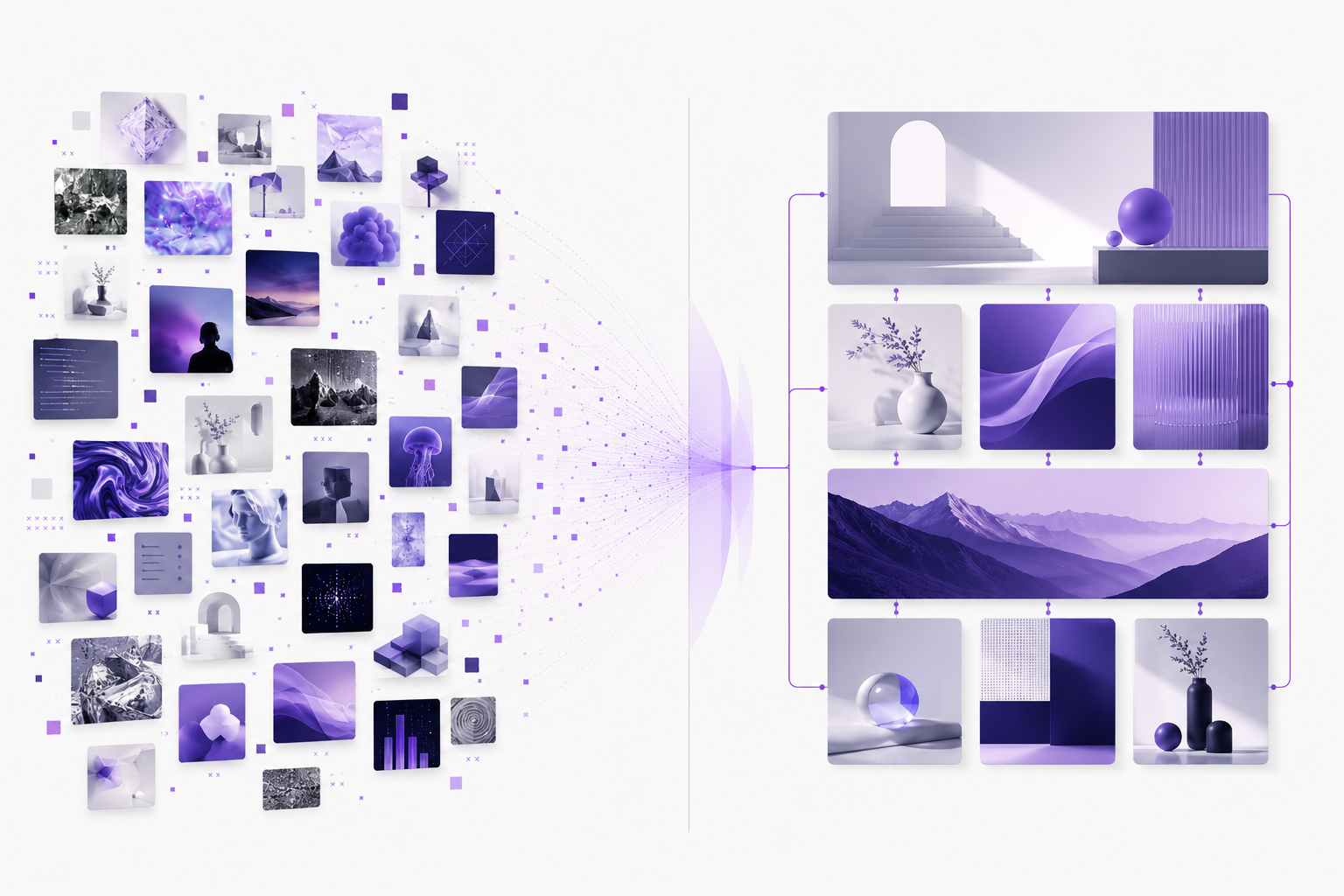
What are the legal risks of generative AI (rights, deepfakes)?
The legal risks are real and tightening in 2026: intellectual property, copyright, transparency and deepfakes. A brand that publishes AI content without safeguards is exposed — and ignorance is no protection. Three points to know:
- Ownership and copyright. In March 2026, the US Supreme Court declined to hear Thaler v. Perlmutter, confirming that only works created by a human can be protected by copyright (AIMultiple). The consequence: documenting the human creative contribution in any AI content meant to be protected is now a strategic step.
- Transparency (EU). Article 50 of the European AI Act requires disclosure that image, audio or video content constituting a deepfake has been AI-generated or manipulated; generated content must be marked in a machine-readable format. These obligations apply from August 2026 and explicitly cover advertisers, agencies and brands with a continuous social presence (EU AI Act, Bird & Bird).
- Faces, trademarks, training data. Generating an identifiable real face, a logo or a name close to an existing brand creates image-rights, confusion and infringement risks — even without intent (Varnum). Hence the METASENSE rule: no real faces and no real brand logos generated, with legal notices and provenance kept under control.
These subjects cannot be improvised. They call for safeguards built into production, not a check after the fact.
What is "AI slop" and why does it threaten brands?
"AI slop" describes the mass of low-quality, generic, repetitive AI-generated content saturating social feeds. The term has exploded — up ninefold in a year, 2.4 million mentions in 2026, 82% of them negative — to the point of being named Merriam-Webster's word of the year 2025 (Advertising Week, Brandwatch). For a brand, this is not a vocabulary footnote: it is a reputation risk.

The mechanism is simple and brutal: the more generic AI floods the platforms, the more it devalues any content that looks like it. In 2026, consumer excitement about AI has fallen back to 19%, and 60% of internet users say they trust automated content less (Storyboard18, Advertising Week). A brand that publishes slop does not merely fail to stand out: it erodes its credibility and disappears into the noise.
The consequence is counter-intuitive and decisive: the more AI democratises production, the more value shifts to what it cannot do alone — editorial judgement, art direction, brand consistency, meaning. The right use of generative AI is not "produce more", it is produce better, faster, to a standard that stands out. That is excellent news for brands that invest in quality.
Do you need a professional, or can you generate visuals in-house?
For exploratory work or low-stakes volume, doing it in-house makes perfect sense. But as soon as content carries the brand and has to be published, the gap described above justifies a professional — not to "know how to prompt", but to clear the five requirements the tool alone does not cover. The real differentiator is not access to AI: it is the double creative and technical skill set.
- On the creative side: art direction, visual judgement, brand consistency, editorial intent — knowing how to choose and direct, not just generate.
- On the technical side: prompt engineering, orchestrating the right models, post-production, upscaling, integration into the brand's systems and guidelines, compliance and provenance.
This is precisely the job of a Creative Tech agency: bringing together what the market separates — the idea and the execution, creation and engineering. For a brand, the right question is not "who has access to the best tools?" (everyone does), but "who can turn a demo into a campaign asset that is consistent, publishable and safe?".
Worth remembering — when AI is enough, when you need a professional, when to abstain
- AI alone is enough: ideation, moodboards, internal exploration, drafts, content with no brand-image stakes.
- You need a professional: published campaigns, brand-level content, character and product consistency, premium formats, sensitive subjects (rights, faces).
- Better to abstain: imitating a third-party brand, generating a real face without consent, publishing without checking rights and compliance, posting generic content "just to post".
How should a brand approach generative AI?
The right approach fits in one sentence: treat generative AI as a powerful creative accelerator, framed by a brand standard and by safeguards. Here is a five-step method to capture the value without falling into slop.
- Start from the brand, not the tool. Turn your guidelines (colours, type, tone, codes) into a reference system that steers the generation. Identity first, prompt second.
- Pick the right use cases. Start where AI excels (exploration, variants, personalisation) rather than handing it everything.
- Put art direction in charge. AI proposes, a human directs, selects and edits with intent — that is what separates your content from AI slop.
- Industrialise the finishing. Build in post-production, upscaling, per-channel variants and quality control before publication.
- Secure rights and compliance. Controlled provenance, transparency on deepfakes, respect for trademarks and faces, documented human contribution.
How METASENSE approaches AI image and video generation
At METASENSE, a Creative Tech agency based in Vélizy-Villacoublay, generative AI is a creative skill in the service of the brand — not a gimmick. We state it in our own descriptor ("…3D, AI and immersive experiences") and we carry the double capability that makes the difference here: creation and art direction on one side, in-house technical expertise on the other. That is exactly what moving from demo to publishable asset demands: directing the image and mastering the technical chain that makes it consistent, clean and ready to plug into the brand's ecosystem.
That logic — creating meaning through experience, at brand level — already runs through our work. For dealer group Edenauto (via RYM Agency), around the Kia Picanto launch, we built a WebGL 3D configurator and a Web AR experience alongside a viral CGI FOOH campaign: a textbook case where leading-edge visual creation only counts because it stays consistent with the brand and technically flawless. The same principle holds on immersive work (Nemausus / Nîmes-la-Romaine with Aura, with AI-driven storytelling and thousands of simultaneous connections) and on engagement (Gocad, over 6,000 participants): technology in the service of meaning and emotion, never the other way round. Note: these projects illustrate our creative and technical command; they are not presented as AI image or video generation campaigns.
To go further on how we design experiences that perform, read Building a website in 2026: a high-performing site that generates leads; and on the budget for a custom-built project, How much does a custom-built website cost in 2026?.
Let's talk about your next piece of brand content
Generative AI is an enormous opportunity — provided you direct it. If you want to explore its potential for your visuals and videos without falling into generic content, we will define the right use cases, the safeguards and the quality standard with you. METASENSE is a Creative Tech agency based in Vélizy-Villacoublay that designs AND builds — from the idea to the broadcast.
Explore our creative & AI expertise · Talk about your project
FAQ — AI image and video generation
Which tools generate AI images and videos in 2026?
For images: Midjourney, Flux and Adobe Firefly for creation, upscaling tools such as Magnific for finishing. For video: Veo, Kling, Runway or Seedance, with native audio now a standard. The market moves fast (Sora was discontinued in 2026), so the key skill is orchestrating the right tool for the right need.
Can AI produce professional video that is ready to publish?
Yes, but a successful demo is not a publishable campaign. The gap comes down to five requirements: consistency (character, product), adherence to brand guidelines, art direction, technical finishing (resolution, formats, post-production) and legal safety. These steps take creative and technical know-how, not a single prompt.
How do you keep brand consistency with generative AI?
By no longer treating guidelines as a PDF: colours, type, tone and codes become a reference system that steers the generation (seeds, framed prompts, quality control). 60% of companies already struggle to hold multi-channel consistency; with AI, consistency is built through method and art direction, never by chance.
What are the legal risks of generative AI?
Three main risks: ownership (in the United States, only human works can be protected — Thaler v. Perlmutter, 2026), transparency (Article 50 of the EU AI Act requires deepfakes to be flagged, applicable from August 2026), and infringement (generating a logo, a name or a real face exposes you to legal action, even without intent).
What is "AI slop"?
AI slop describes low-quality, generic, repetitive AI-generated content saturating the platforms. The term, Merriam-Webster's word of the year 2025, grew ninefold in a year. For a brand, publishing slop erodes trust: 60% of internet users trust automated content less in 2026.
Do you need a professional, or can you do it in-house?
In-house for exploration and content with no brand-image stakes; a professional as soon as content carries the brand and has to be published. The differentiator is not access to the tool — that is universal — but the double creative and technical skill set: directing the image, holding consistency and securing publication.
How much does generative AI content production cost?
AI sharply reduces the cost of exploration and adaptation, but the real cost of publishable content includes art direction, post-production and legal safeguarding. We price each engagement individually, according to the use case, the quality level and the scope — the tool is cheap, the command of it is the real value.
Is generative AI replacing creatives?
No: it shifts where their value sits. AI produces many options quickly; choosing, directing, editing with intent and holding a brand identity remain human. The more AI democratises production, the more art direction and consistency become decisive — that is what separates brand content from AI slop.
How do I stop my AI visuals looking like everyone else's?
By starting from your brand identity rather than the tool: your own references, strong art direction, editorial intent and careful finishing. The "generic AI look" comes from unframed use. A brand that injects its codes and its intent into the generation produces recognisable content, not interchangeable slop.
Which generative AI uses are most relevant for a brand?
Ideation and moodboards, multi-format and multilingual variants, personalisation by segment or market, exploring concepts that are expensive to shoot (CGI, impossible sets) and B-roll. Avoid: imitating a third-party brand, generating a real face without consent, or publishing generic content just to fill a calendar.
Do you have to disclose that content was AI-generated?
Yes for deepfakes: Article 50 of the European AI Act requires generated or manipulated image, audio and video content to be disclosed and marked in a machine-readable format, from August 2026. It explicitly covers advertisers, agencies and brands. Transparency is becoming a compliance requirement, not an option.
Does METASENSE use generative AI for its clients?
Yes: generative AI for images and video is part of our creative skill set, in the service of the brand. A Creative Tech agency based in Vélizy-Villacoublay, METASENSE combines the art direction and the in-house technical expertise needed to turn raw AI power into content that is consistent, publishable and compliant.
Sources
- Vivideo — 75 AI Video Statistics Marketers Need to Know (2026)
- posteverywhere — 75+ Video Marketing Statistics (Updated May 2026)
- AutoFaceless — AI Video Generation Statistics 2026
- Pixflow — Best AI Video Generator in 2026
- OpenAI Help Center — What to know about the Sora discontinuation
- Advertising Week — AI Slop Fatigue: Top Media Trends 2026
- Brandwatch — What is AI Slop?
- Storyteq — AI content generation and brand consistency
- EU Artificial Intelligence Act — Article 50: Transparency Obligations
- AIMultiple — Generative AI Copyright 2026