

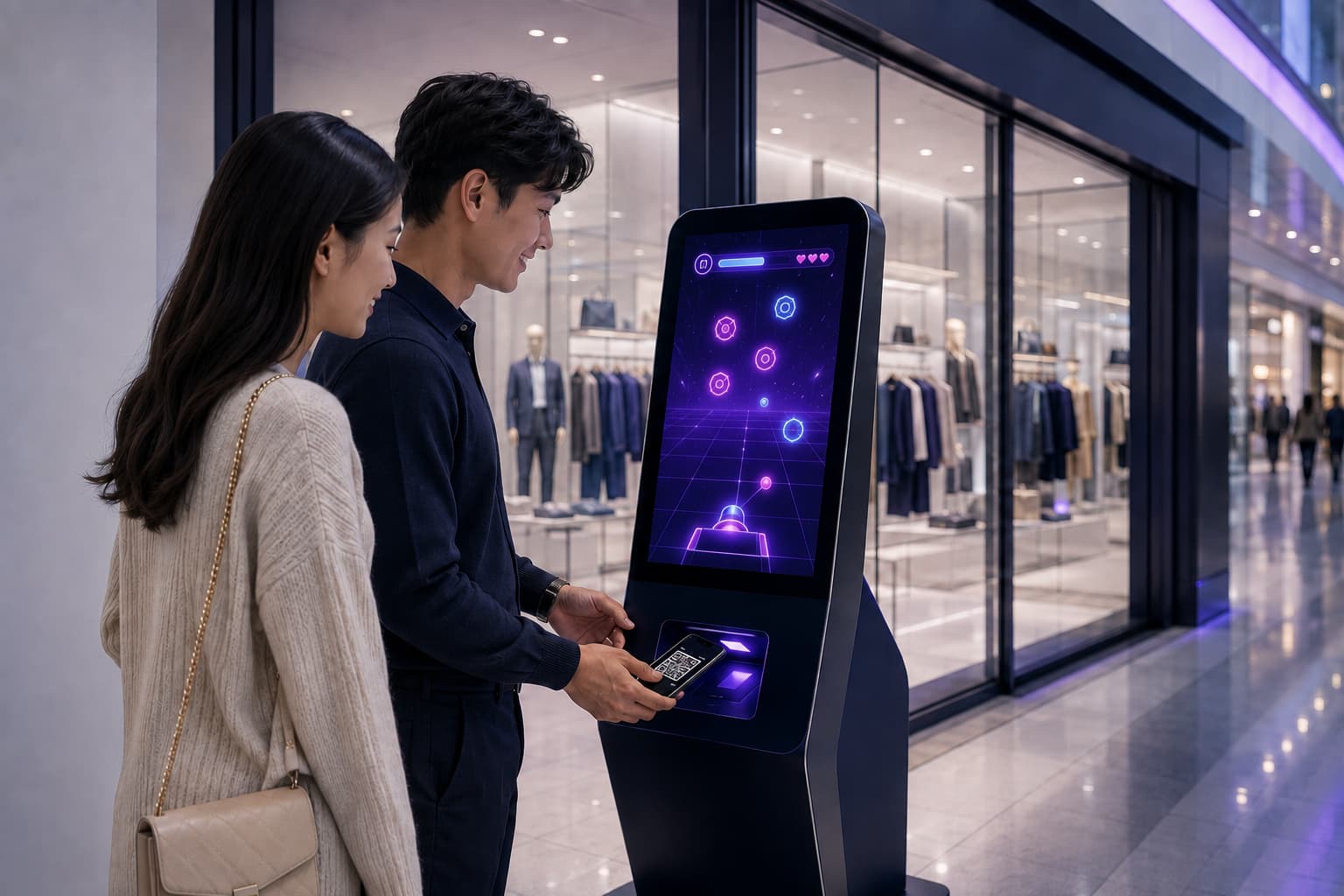
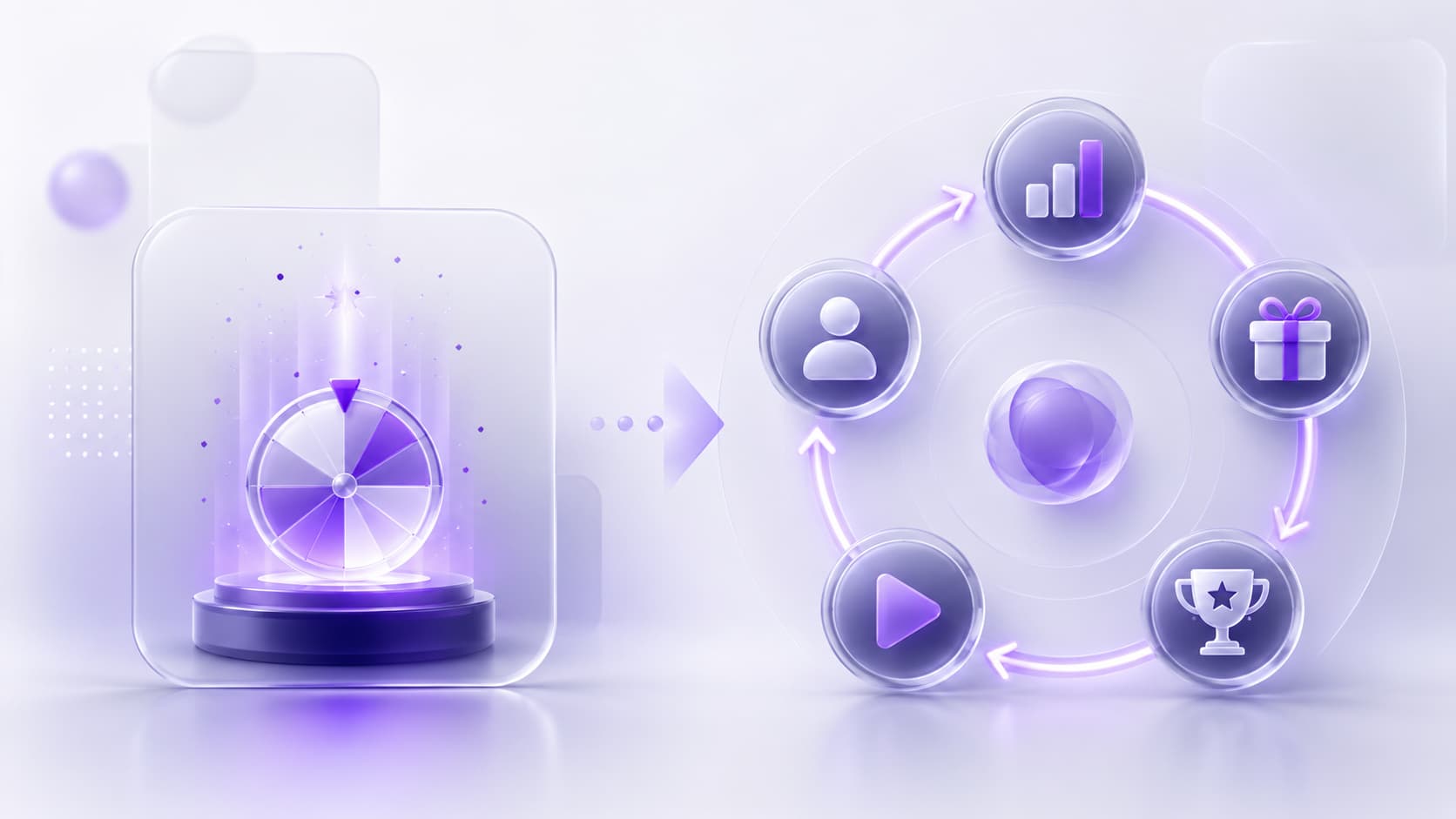
Marketing gamification means bringing game mechanics — progression, challenges, rewards, storytelling — into a customer journey to turn a passive audience into active participants. Most brands stop at the instant win: a prize wheel, a scratch card, a chance to win. It works to create a traffic spike, but it is a one-shot setup: it captures attention, hands out a prize, then goes dark. Real gamification starts where the instant win stops. It designs an engagement loop that brings people back, qualifies a database and feeds the relationship over time.
At METASENSE, a Creative Tech agency based in Vélizy-Villacoublay, we design and build engagement experiences end to end. For Gocad, our phygital setup (kiosks, a Web AR game, a proprietary platform) drew over 6,000 participants. This article explains the difference between entertaining once and engaging for the long run — and how to build the second.
In short. The instant win is a short-term acquisition tactic. Gamification is an engagement strategy that combines progression, reward, storytelling and data. Gamified setups raise engagement by 100 to 150% compared with non-playful environments (Adictiz / market studies) — provided the game is connected to a loyalty mechanic rather than left on its own.
What exactly is marketing gamification?
Marketing gamification is the use of game mechanics and game design principles — points, levels, challenges, rewards, storytelling, status — in a non-game context to increase engagement, motivation and retention. The term was popularised in the 2010s (Gabe Zichermann, Yu-kai Chou), but the underlying driver is much older: play activates powerful psychological levers — achievement, visible progress, anticipation of reward, social belonging.
In marketing, that covers a wide spectrum:
- The instant win (wheel, scratch card, jackpot): immediate result, impulsive participation.
- The prize game (draw, quiz, vote): data collected in exchange for a chance to win.
- Progression programmes (points, tiers, status): repeated engagement over time.
- Challenges and missions (quests, staged journeys, collections): active participation across several sessions.
- Phygital and drive-to-store: gamification linking digital to the physical point of sale (kiosks, AR, QR).
All of these are gamification. The question is therefore not “game or no game”, but what you do with the player once the game is over.
Why is the instant win no longer enough?
The instant win is excellent at acquiring and poor at retaining: it delivers a single gratification with no reason to come back. It produces a peak, not a plateau. A prize wheel drives a rush on the day, hands out prizes, captures email addresses — then the link breaks as soon as the prize pool runs dry. The acquisition cost is paid once, for one interaction.
The problem is not the instant win itself: it is its isolation. Used alone, it creates three blind spots:
- No progression. The participant has no reason to return: there is nothing to build, nothing to unlock.
- Data left unused. You collect an email address, rarely a behaviour or a preference. The database grows but does not qualify.
- No storytelling. The experience says nothing about the brand: it could belong to any competitor.
Yu-kai Chou, a leading theorist on the subject, puts it bluntly: most gamification gains disappear after 90 days when the setup is not built on an identified motivational driver. The instant win remains an excellent entry point — as long as it is the first link in a loop, not the whole setup.
Which engagement mechanics create a lasting bond?
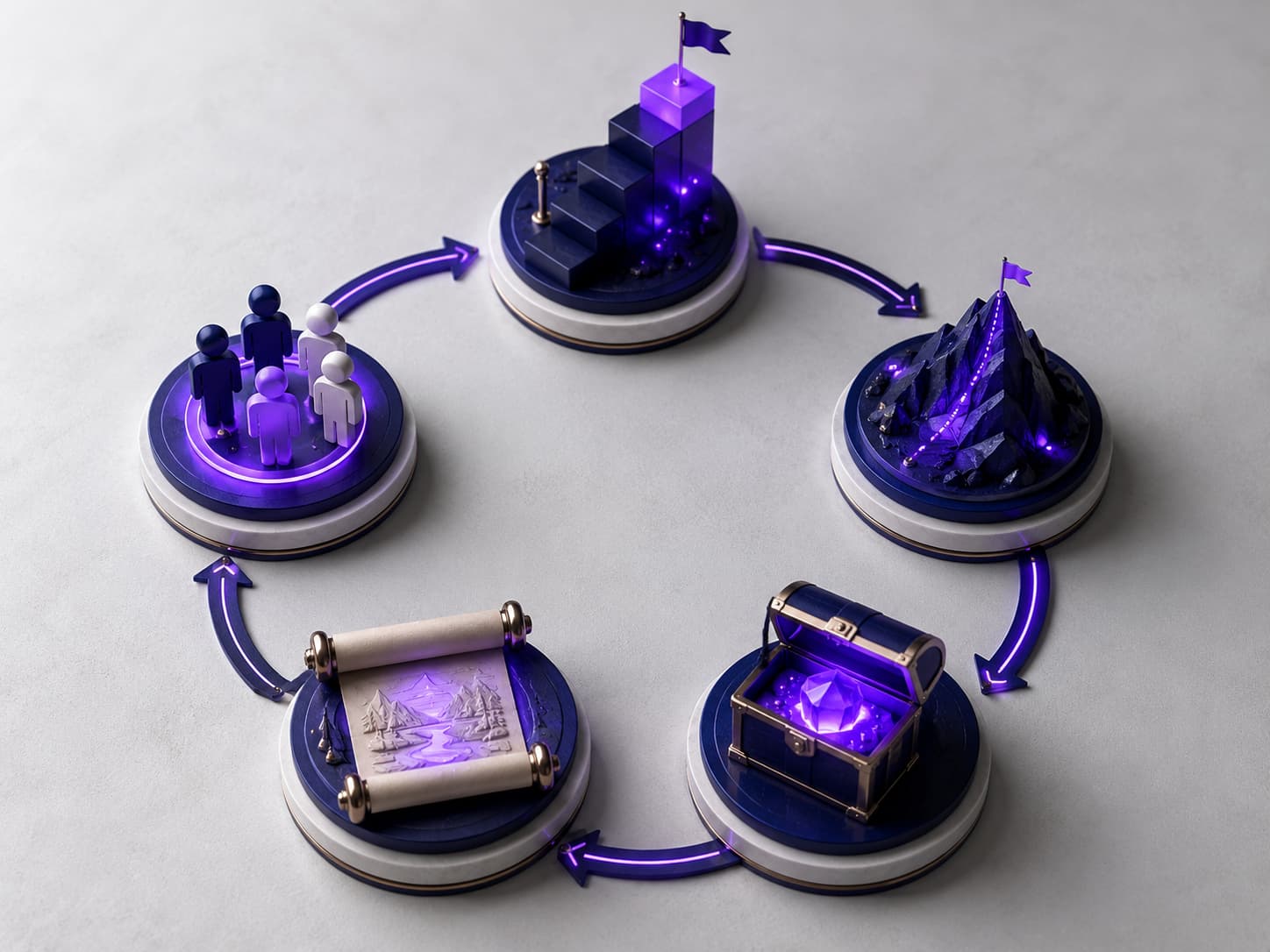
Lasting engagement comes from four mechanics working together: progression, challenge, meaningful reward and storytelling. On their own they entertain; assembled, they create a reason to come back. That is the difference between a prize game and an engagement setup.
| Mechanic | What it triggers | Marketing example |
|---|---|---|
| Progression (points, tiers, gauge) | The need to finish what you started | Status programme, progress bar |
| Challenge / mission | The satisfaction of rising to it, mastery | Weekly challenges, staged journeys |
| Reward | Anticipation and gratification | Prizes, exclusive access, real benefits |
| Storytelling | Emotional attachment to the brand | Universe, character, quest, lore |
| Social / status | Belonging and comparison | Leaderboards, shareable badges, community |
| Phygital | The bridge from online to store | AR kiosk in the dealership, drive-to-store QR |
The design rule: each mechanic must feed the next one. An instant win opens a session; progression makes people want to extend it; the reward validates the effort; storytelling ties it all back to the brand; the social layer spreads it. It is a loop, not a straight line.
How does gamification actually convert?
Gamification converts because it turns advertising that is endured into participation that is chosen — and participation produces behavioural data you can act on. A visitor who plays is no longer an impression: they act, reveal preferences and agree to share their details in exchange for an experience they consider worth it.
Three conversion levers stack up:
- Active engagement is worth more than passive reach. A participant who spends several minutes inside an experience is far better qualified than a view. Gamified setups raise engagement by 100 to 150% compared with non-playful environments (Adictiz). The channel matters too: that is the whole point of a conversational channel such as RCS, the engagement channel after SMS, where these mechanics run inside messaging.
- First-party data. The game is a legitimate reason to collect declared and behavioural data — a valuable asset now that third-party cookies are disappearing.
- Drive-to-store. Connecting digital to the point of sale turns engagement into a visit, then into a sale. That is what a well-designed phygital setup is for.
The Gocad case: from a game to measured participation
For Gocad, we designed a complete phygital setup: in-store kiosks, a Web AR game (NFC/AR) and a proprietary platform to run and measure it. It drew over 6,000 participants. The key was not the game alone: it was the integration of the game into a capture and tracking platform — the game as the entry point to an ongoing relationship, not as a standalone activation.
How does gamification work in e-commerce and retail?
In e-commerce and retail, gamification serves two goals: increasing purchase frequency (loyalty) and bringing customers into the store (drive-to-store). Digital alone plateaus; connected to the physical world, it becomes a measurable traffic engine.
Two levers illustrate this:
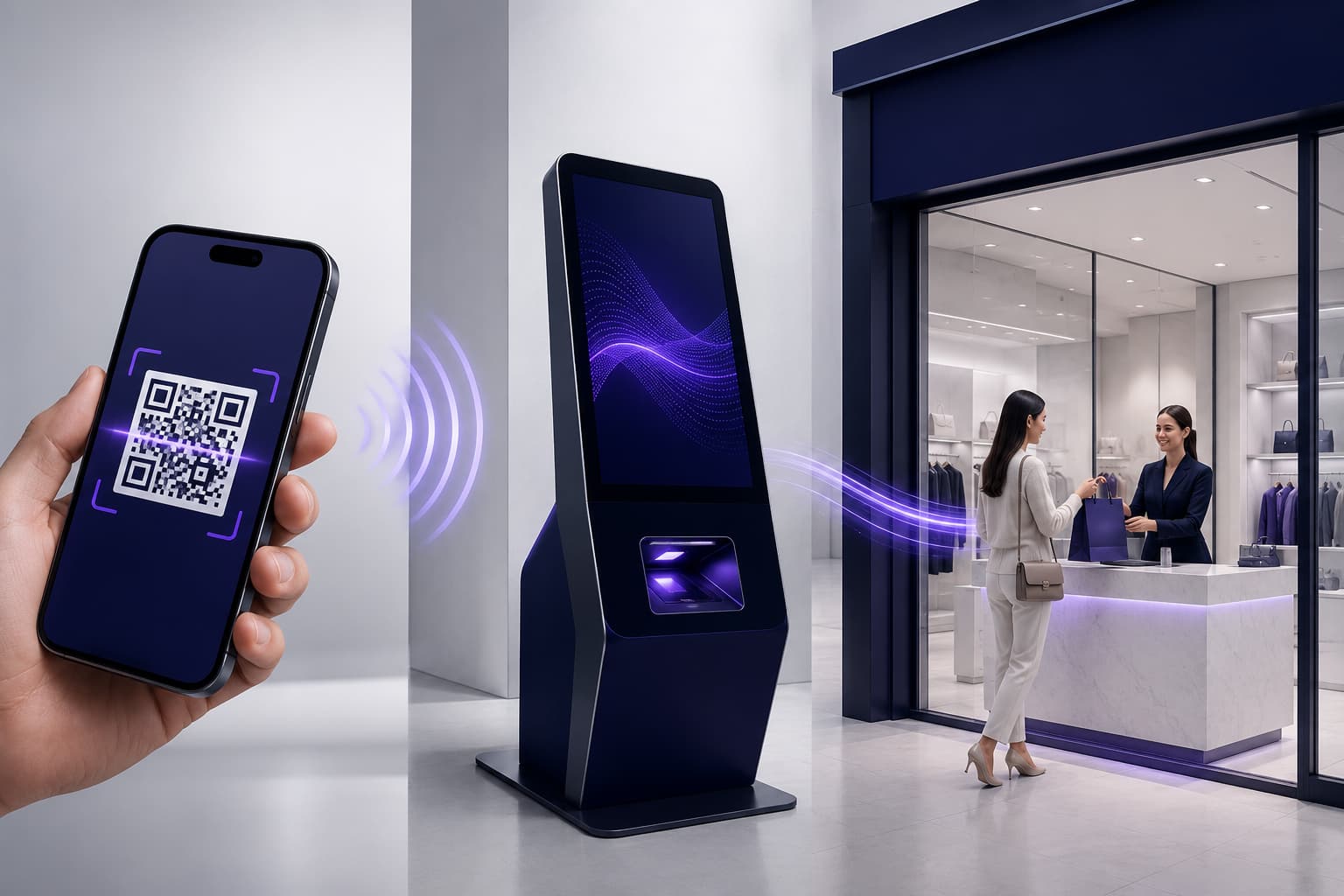
- The in-store game kiosk — personal code, AR game, full tracking: the kiosk turns a visit into a memorable, traceable experience, and attributes every activation to the store that generated it.
- Edenauto × Kia — for dealer group Edenauto (via RYM Agency), a WebGL 3D configurator and Web AR to view the vehicle at full scale, alongside a viral FOOH campaign in CGI. The goal is drive-to-store: get people in for a test drive.
In both cases the game mechanic is not a gimmick: it is a measurement system. Personal code, tracking, proprietary platform — every interaction is attributed, which makes it possible to prove ROI store by store. That is where the difference lies between an activation and an engagement setup.
How do you design an engagement setup, not just a game?
You design an engagement setup by starting from the business objective and the data to be collected, not from the game. The game is the last thing decided, not the first. Here is the method we apply, from ideation to rollout.
- Define the objective and the metric. Acquisition, qualification, loyalty, drive-to-store? Each objective calls for a different mechanic. We set the KPI before we draw the game.
- Identify the motivational driver. Achievement, social status, discovery, ownership? Without a clear driver, the setup dies after 90 days.
- Design the loop, not the one-off. Entry (instant win), progression (a reason to come back), reward (gratification), storytelling (the link to the brand), sharing (reach).
- Connect it to the information system. CRM, identity, data: the game must feed the existing ecosystem, otherwise the data is lost.
- Design the phygital layer where it makes sense. Kiosk, QR, AR, NFC: build the online-to-store bridge when the objective is footfall.
- Instrument the measurement. Tracking, management platform, attribution: without measurement there is no proof of ROI and no way to optimise.
- Test, roll out, iterate. Prototype, user testing, rollout, continuous adjustment based on real data.
This is exactly what our dual role is for: the creative side to imagine the experience, and in-house technical expertise to build it, integrate it with the client's information system and roll it out at scale. From ideation to rollout — and, where needed, working from inside the client's organisation.
Worth remembering. A good engagement setup is not a game bolted onto a campaign. It is a mechanic tied to a business objective, to data and to a measurement system. The game is the visible part; the value sits in the loop and in the platform that runs it.
What marketing can steal from video games
Video games are 40 years ahead of marketing on engagement: they know how to create the desire to come back without handing out a physical prize. Progression, a sense of mastery, immersive storytelling, community, reward economies — levers that marketing is only beginning to use seriously.
That is precisely the territory METASENSE explores: applying the grammar of video games and immersive work (3D, WebGL, AR, storytelling) to brand and media experiences. Our 3D augmented visitor journey in Nîmes — a treasure hunt through the Roman monuments — shows that the same engagement logic applies to culture as much as to retail: you no longer consume content, you play an experience. That is the deeper ambition of the engagement pillar: to do for marketing what video games did for entertainment.
Let's talk about your engagement setup
The instant win brings people in once. A real engagement mechanic brings them back, qualifies your database and can be measured store by store. If you want to turn a one-off activation into a lasting setup — phygital, drive-to-store, e-commerce — let's talk about your project. We design, build and roll out, from the idea to the ROI.
FAQ — Marketing gamification
What is marketing gamification?
Marketing gamification is the use of game mechanics — points, levels, challenges, rewards, storytelling — inside a customer journey to increase engagement, participation and loyalty. It turns a passive audience into active participants and produces behavioural data you can act on.
What is the difference between an instant win and gamification?
The instant win (wheel, scratch card) is a single acquisition mechanic: it delivers immediate gratification with no reason to come back. Gamification is a broader strategy that combines progression, reward and storytelling to create lasting engagement. The instant win can be the entry point to a gamified setup, not the whole setup.
Does gamification really work for generating leads?
Yes, when the game is connected to a capture platform. The phygital setup METASENSE designed for Gocad drew over 6,000 participants through in-store kiosks and a Web AR game. The key is to integrate the game into a collection and tracking system.
What are the main engagement mechanics?
The most effective mechanics are progression (points, tiers), challenge (missions, quests), meaningful reward, storytelling (the brand universe) and the social layer (leaderboards, badges). Phygital (kiosk, AR, QR) adds a bridge to the point of sale. They work better combined into a loop than used in isolation.
What is a customer engagement setup?
A customer engagement setup is a system that connects interactive dynamics (game, challenge, reward) to a brand's ecosystem — CRM, identity, data — to drive repeat participation and loyalty. What sets it apart from a standalone game is its connection to the information system and to a measure of ROI.
How do you measure the ROI of a gamified campaign?
You measure ROI by instrumenting the setup from the design stage: tracking participations, attributing leads, following drive-to-store through a personal code or QR. A personal code assigned to each player links an activation to its store, its date and its journey. Without built-in measurement there is no proof of return.
Is gamification suited to e-commerce and retail?
Yes. In e-commerce it increases purchase frequency and loyalty; in retail it generates drive-to-store. Phygital setups (dealership kiosks, 3D/AR configurators, QR codes) connect digital to the store and turn engagement into a visit, then into a sale.
How long does the effect of a gamified setup last?
A standalone instant win produces a one-off peak; most gains from unstructured gamification disappear after around 90 days (Yu-kai Chou). A setup built around a clear motivational driver and a progression loop sustains engagement over time and can justify an annual renewal.
What data do you collect with gamification?
You collect declared data (contact details, preferences) and behavioural data (journey, choices, frequency). The game is a legitimate reason for first-party collection — an advantage as third-party cookies disappear. This data qualifies the database and feeds the CRM for targeted follow-up.
Do you always need an instant win to gamify a brand?
No. The instant win is only one mechanic among others. Depending on the objective, you can favour progression (loyalty), challenge (repeat engagement), storytelling (brand attachment) or phygital (drive-to-store). The right starting point is the business objective, not the game format.
How does AI fit into an engagement setup?
AI can personalise the experience (rewards, journeys and storytelling adapted to the profile), generate visual and video content at scale, and power interactive features (assistants, configurators). At METASENSE, AI is a capability we are building for our clients' experiences.
How much does a marketing gamification setup cost?
Cost varies widely with scale: a simple prize game, a multi-store phygital setup and a proprietary platform do not carry the same budget. METASENSE prices each engagement individually, based on the objective, the mechanic and the integration with the information system. The gamification market is worth more than $30bn (2023), a sign of its maturity.
Sources
- Gamification — Wikipedia (definition, mechanics, principles)
- Yu-kai Chou — Gamification Stats & ROI Cases (ROI statistics, the 90-day effect, Octalysis)
- Adictiz — Instant Win Marketing Examples (engagement +100 to 150%, instant win mechanics)
- Blog du Modérateur — Gamification, outil marketing (overview of marketing use cases)