

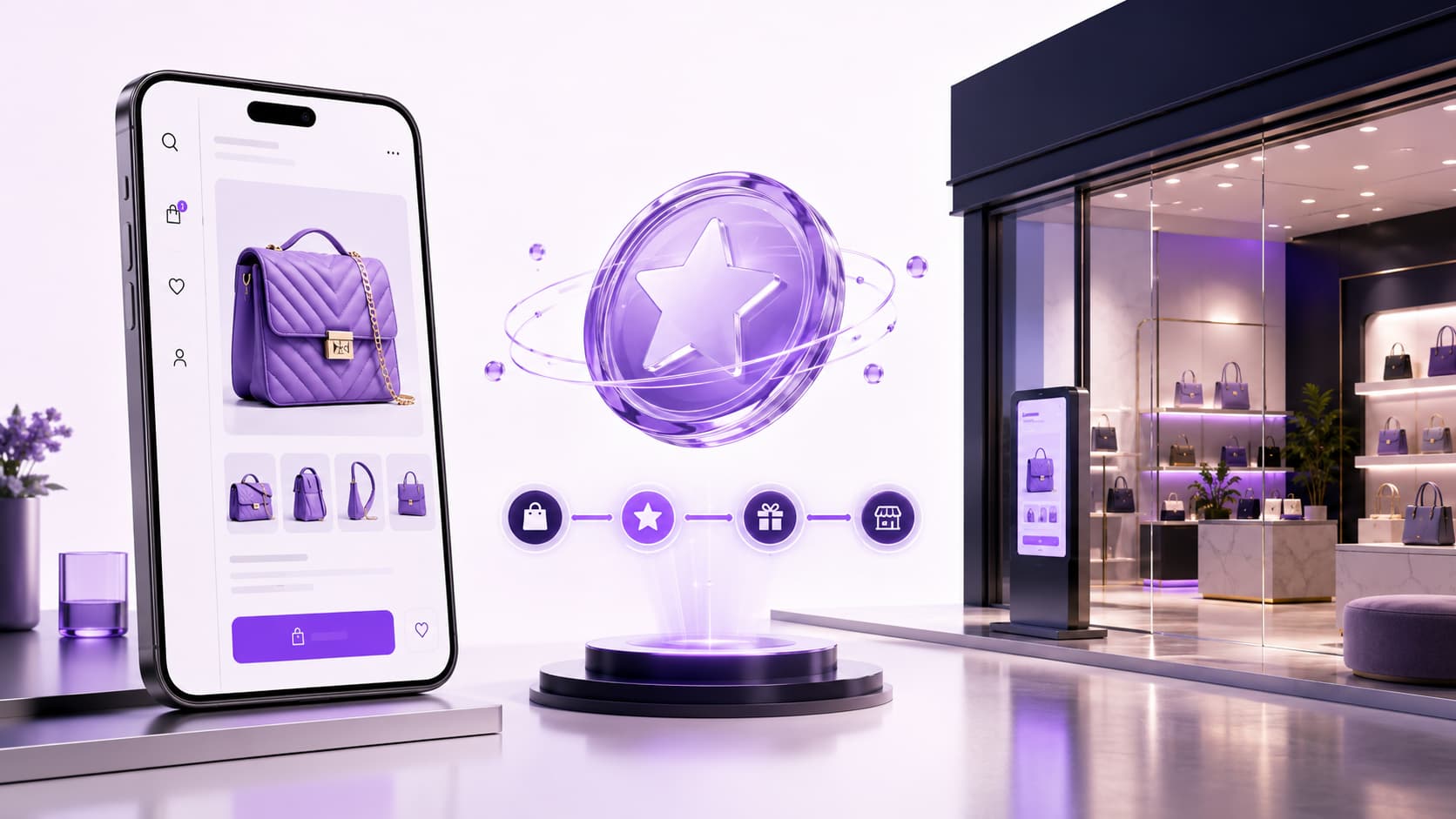
Ecommerce gamification, in short
Ecommerce gamification means building game mechanics — points, tiers, challenges, rewards, instant wins — into the buying journey, so a passive visit becomes an active interaction. The point is not to play for the sake of playing. It is to move three business metrics — engagement, conversion rate and loyalty — by giving the customer a reason to come back, to interact and to progress.
Done well, it works as well on an online store (basket, loyalty, configurator) as in physical retail (drive-to-store, in-dealership kiosks, cross-channel programmes). Done badly, it degrades the experience: an aggressive pop-up, a meaningless reward, a mechanic that slows the purchase down. Everything hangs on that distinction, and it is what separates a gadget from a growth lever.
Worth remembering: ecommerce gamification is not a layer of entertainment dropped onto a site. It is a mechanic wired into your data (CRM, identity, basket) that serves a measurable objective: engage, convert, retain.
This article sets out six concrete mechanics, the business benefit each one proves, and how to get started. For the fundamentals of the discipline (what gamification is, the instant win, the Gocad case), see our article Gamification marketing: build engagement, not just an instant win.
What exactly is ecommerce gamification?
Ecommerce gamification applies mechanics drawn from games (goals, progression, reward, competition, surprise) to a commercial environment that is not a game, in order to influence one precise behaviour: add to basket, complete a purchase, come back, refer a friend, visit the shop.
It rests on three universal psychological drivers: progress (watching a bar fill, reaching a tier), reward (immediate or deferred gratification) and status (badges, VIP levels, leaderboards). Retail has always used them — the stamped loyalty card is their ancestor — but digital now makes them real-time, personalised and measurable.
The market confirms the trend: it is worth $19.4 billion in 2025 and should reach $92.5 billion by 2030 (26% CAGR), with retail alone taking nearly 28% of that market (Mordor Intelligence). This is not a fashion: it is a structured investment category.
How does it differ from general marketing gamification?
Marketing gamification covers any branded game activity (prize game, short-lived campaign, event activation). Ecommerce gamification focuses on the buying journey: it lives in the store, the customer account, the basket, the loyalty programme and the online-to-store bridge. Its success is measured in conversion, average basket, repeat purchase rate and store traffic — not just in entries.
Why does gamification lift engagement and conversion?
Because it replaces a passive decision ("should I buy?") with an active dynamic ("I won, I am progressing, I want what comes next"). The customer stops watching a catalogue and starts driving a journey that rewards them.
The data points consistently to a real effect on the key metrics:
| Metric | Observed effect | Source |
|---|---|---|
| Customer engagement | up to +40% on gamified journeys | Gartner |
| Purchase frequency | up to 3× through gamified challenges (Limango case) | Open Loyalty |
| Customer retention | +30% with a gamified loyalty programme | Open Loyalty |
| Trial conversion | +15% conversion, +40% engagement (Autodesk case) | Open Loyalty |
These figures are market benchmarks, not a guarantee: the real effect depends on the mechanic, the audience and the quality of execution. A poorly calibrated spin-to-win can lower conversion by irritating users. Each mechanic therefore has to be designed in service of the business objective, never as a standalone animation.
Which 6 gamification mechanics work best in ecommerce and retail?
Here are the six mechanics with the strongest impact on the buying journey, each with its business benefit and an example. Choose according to your priority objective — convert, retain or drive footfall — rather than stacking them up.

1. The gamified loyalty programme
Benefit: turn dormant points into a driver of repeat purchase and status. Instead of simply accumulating points, you add tiers (Silver, Gold, Platinum), challenges ("3 purchases this month = bonus"), badges and exclusive benefits. The customer no longer collects: they progress.
This is now the number one priority among loyalty professionals: 45% of them name gamification as the most influential trend of the next two to three years, ahead of automation (40%) (Open Loyalty). Retail is its natural ground, because the relationship repeats and every visit is a chance to progress.
Figures from the field (Open Loyalty): fashion marketplace Limango tripled the purchase frequency of its members through gamified challenges built into its programme.
2. Challenges, tiers and progressive rewards
Benefit: increase purchase frequency and value by setting a target. A challenge ("unlock free delivery from your third order") creates a clear goal and a reason to return. The progress bar in the basket ("only €12 away from free delivery") is the simplest form — and one of the most effective — for raising average basket value.
It works because it plays on sunk-effort aversion: once committed to a progression, the customer wants to finish it. Advent calendars, daily login streaks and weekly missions run on the same logic.
3. Spin-to-win and the instant win — done properly
Benefit: capture an email and trigger a first purchase without degrading the experience. The prize wheel (spin-to-win) is the best-known mechanic, and the one most often mishandled. Done badly, it is intrusive and drives people away. Done well, it captures a qualified contact and offers immediate gratification that pushes towards purchase.

The rules of an instant win that helps rather than harms:
- Intelligent triggering — on exit intent or after genuine engagement, never on arrival.
- A real, usable reward — an offer with actual value, valid straight away.
- A clear trade — the email or the sign-up, in exchange for a genuine benefit.
- Data integration — the contact feeds the CRM and triggers a sequence, otherwise the gain is lost.
For a full breakdown of this mechanic and a complete client case, see our article on marketing gamification.
4. The playable product configurator
Benefit: bring the product to life before purchase, remove doubt and create desire. Configuring a product — colour, options, finishes — in 3D or augmented reality turns a static product page into an experience. The customer projects, handles, takes ownership: engagement rises and hesitation falls.

It is especially powerful for high-involvement products (automotive, furniture, equipment). At METASENSE, we built for dealer group Edenauto, with RYM Agency, a WebGL 3D configurator paired with Web AR that let customers view the Kia vehicle at full scale with no app download, backed by a drive-to-store logic and a viral CGI FOOH campaign. The configurator is not a gadget: it is the bridge between online desire and the dealership visit.
5. Gamified drive-to-store (online → shop)
Benefit: convert a digital audience into physical footfall and sales. Gamified drive-to-store connects the online experience to the point of sale: an online game unlocks an offer to collect in store, an interactive kiosk rewards the visit, a QR code turns the aisle into a playing field. Brands that activate gamification across the retail journey report significant increases in store footfall (Gartner).

METASENSE in the field — Gocad. Phygital kiosks, a Web AR game (NFC/AR) and a proprietary platform rolled out across points of sale: over 6,000 participants. Proof that an engagement setup properly integrated with the physical network turns a store visit into measurable interaction.
6. Social, UGC and community mechanics
Benefit: make your customers acquisition channels and feed social proof. Content competitions, shareable challenges, rewarded referrals, community leaderboards: gamification turns the purchase into a social act. The customer who shares gains something (points, status, early access); the brand gains organic reach and authentic content.
This mechanic works best when it is paired with a direct engagement channel. RCS (the successor to SMS) can send interactive cards, carousels and action buttons inside the native messaging app — an excellent way to restart a challenge or notify a reward. See our article: RCS, the engagement channel after SMS.
How does gamification strengthen customer loyalty?
By replacing the one-off transaction with a continuous relationship: every interaction moves the customer through a system that makes them want to come back. Loyalty is not declared, it is built by repeating rewarding experiences.
Three concrete levers:
- Visible progression — a status to reach, tiers to unlock, a bar that fills. The customer has something to lose by leaving.
- Recurring reward — weekly challenges, monthly draws, advent calendars: fixed appointments that build a habit.
- Status and belonging — a VIP level, exclusive access, recognition. Loyalty becomes part of identity.
Gamified loyalty programmes show retention around 30% higher than conventional programmes (Open Loyalty). The brand's job: keep every mechanic connected to customer data (CRM, identity, history) so the reward is personalised — otherwise the system turns generic and loses its hold.
Where do you start an ecommerce gamification project?
Start with the business objective, not the mechanic. The question is not "which prize wheel should we install?" but "which metric do I need to move: conversion, average basket, repeat purchase or store traffic?". The mechanic follows from the answer.
Our method, in five steps:
- Frame the objective and the audience. One priority metric, one precise audience. One mechanic that serves an objective beats five that dilute it.
- Map the journey. Identify the friction or drop-off point where a mechanic will have most effect (basket, first visit, post-purchase, store).
- Choose ONE aligned mechanic. Convert → instant win or basket progress bar. Retain → tiered gamified programme. Drive footfall → drive-to-store.
- Connect the data. Wire the mechanic into the CRM, customer identity and the basket. Gamification disconnected from data neither retains nor measures.
- Test, measure, iterate. Launch a pilot, measure the effect on the target metric, adjust. Gamification is steered by data, not by intuition.
Worth remembering: good ecommerce gamification is restrained, targeted and connected to your ecosystem (CRM, identity, data). Bad gamification is a stack of gadgets that slows the purchase down. The difference is decided in the framing, not in the technology.
Let's talk about your engagement project
METASENSE is a Creative Tech agency based in Vélizy-Villacoublay, specialising in engagement and gamification. What sets us apart: the combination of advisory, creative and in-house technical expertise — we design the mechanic, art-direct it, build it and integrate it into your ecosystem (CRM, identity, data), from idea to rollout. 3D/AR configurators, gamified loyalty programmes, drive-to-store setups: we turn the visit into engagement, and engagement into measurable business.
Let's talk about your ecommerce gamification project → /contactez-nous
FAQ — Ecommerce & retail gamification
What is ecommerce gamification?
It is the integration of game mechanics — points, tiers, challenges, rewards, instant wins — into the online buying journey, to turn a passive visit into an active interaction and raise engagement, conversion and loyalty.
Which game mechanics work best in ecommerce?
The most effective are the gamified loyalty programme, challenges and tiers, a well-calibrated instant win, the 3D/AR product configurator, gamified drive-to-store and social mechanics (referral, UGC). The choice depends on the objective: convert, retain or generate store traffic.
Does gamification really increase sales?
Yes, when it is well designed. Gamified journeys can raise engagement by up to 40% (Gartner) and retention by around 30% through gamified loyalty programmes (Open Loyalty). The real effect still depends on the mechanic, the audience and the quality of execution.
What is the difference between ecommerce gamification and marketing gamification?
Marketing gamification covers any branded game activity (competitions, short-lived campaigns, events). Ecommerce gamification focuses on the buying journey: store, basket, customer account, loyalty, drive-to-store. It is measured in conversion, average basket, repeat purchase and store traffic.
Is the prize wheel (instant win) effective?
It can be, if it is done properly: triggered intelligently (exit intent, not on arrival), with a real and usable reward, a clear trade (the email) and CRM integration. Badly executed, it is intrusive and drives visitors away.
What is gamified drive-to-store?
It is a game mechanic that links the online experience to the physical point of sale: a game unlocks an offer to collect in store, a kiosk rewards the visit, a QR code brings the aisle to life. The aim is to convert a digital audience into store traffic and sales.
How does gamification build customer loyalty?
Through three levers: visible progression (tiers, statuses), recurring reward (weekly challenges, draws) and a sense of belonging (VIP levels, exclusive access). Connected to customer data, these mechanisms create a continuous relationship rather than a one-off transaction.
Is a product configurator gamification?
Yes, as soon as it makes the experience interactive and playable. Configuring a product in 3D or augmented reality (colours, options, full scale) engages the customer, removes doubt before purchase and creates desire. It is also an excellent bridge to the store (drive-to-store).
Is gamification right for every brand?
Not always. It is relevant when the relationship repeats (retail, subscription, loyalty) or when the product is high-involvement (configurator). Poorly calibrated, or bolted onto a journey with no friction, it can damage the experience. The initial framing is decisive.
How long does it take to launch a gamification setup?
It depends on the complexity. A simple mechanic (basket progress bar, a wheel connected to the CRM) ships in a few weeks; a 3D/AR configurator or a cross-channel drive-to-store setup takes several weeks to a few months, framing and data integration included.
How do you measure the ROI of ecommerce gamification?
By defining a target metric before launch (conversion, average basket, repeat purchase rate, store traffic) and measuring how it moves on a pilot. Gamification has to be wired into the data (CRM, basket) to be steerable — otherwise it stays an unmeasurable gadget.
Where do you start an ecommerce gamification project?
Start with the business objective, not the mechanic: choose the metric to move, map the journey, select a single aligned mechanic, connect it to your data, then test and iterate on a pilot before scaling.