

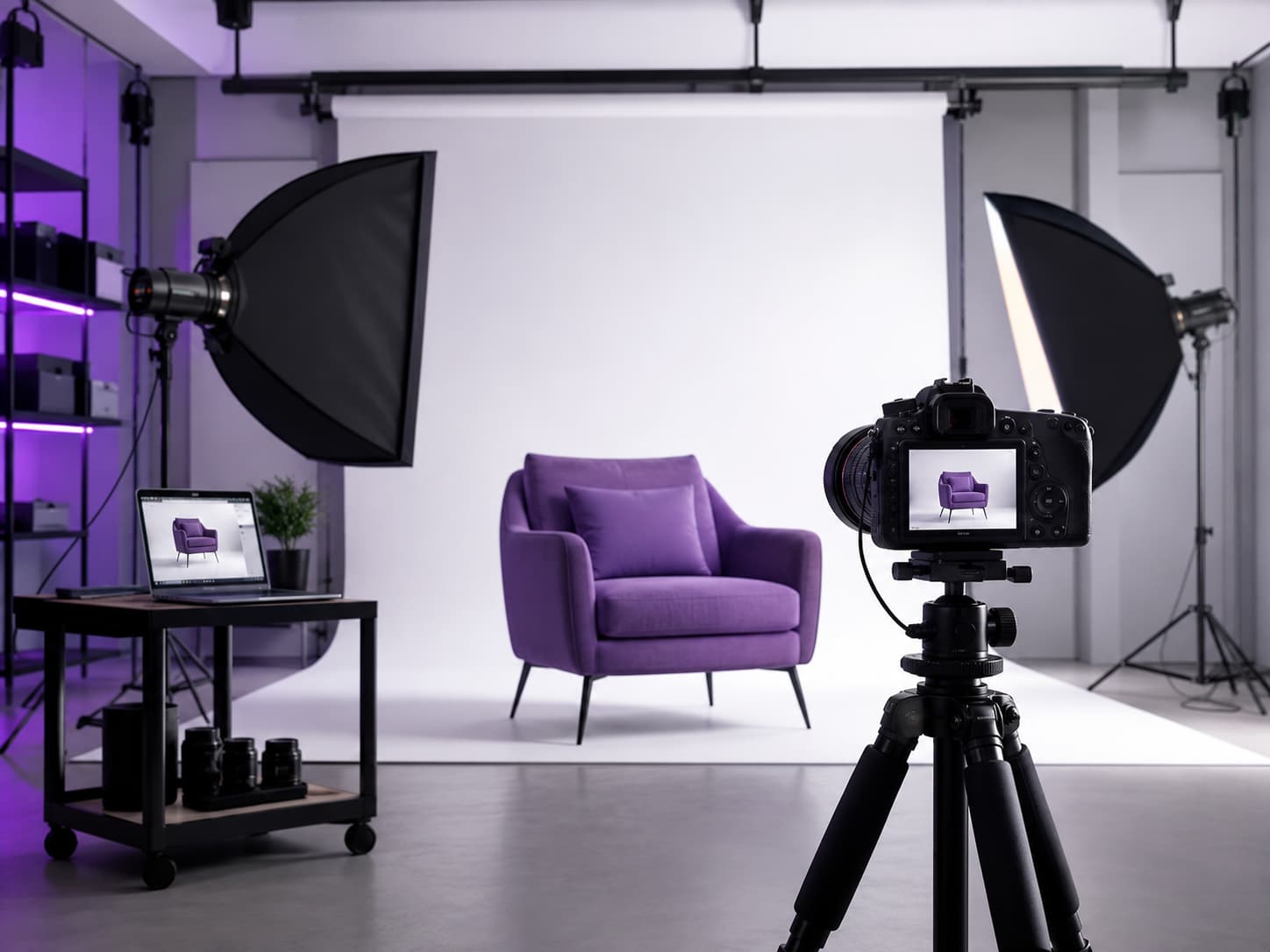
A 3D product page shows your item as a three-dimensional model the visitor can handle — rotating it a full 360°, zooming in on details, viewing it from every angle — where a photo-based page lines up a series of fixed images. The real question is not which one looks better, but which one sells your product, and at what cost. 3D is neither a gimmick nor an obligation: on some catalogues it removes doubt, lifts conversion and cuts returns; on others, a good photo packshot does the job and costs twenty times less.
As Managing Partner for Design, I meet brands convinced they "need 3D" before they know what they are trying to fix. This article settles the matter plainly: what 3D actually changes compared with photography on a product page, what it costs, and the cases where you do not need it. No overselling.
In short
- Photo packshot: fast, inexpensive, ideal for a simple product with few options and an impulse-buy price.
- 3D / 3D packshot / 360° view: covers every variant without a new shoot, removes the "what does it really look like" doubt, and paves the way for AR and configurators.
- Measured impact: average basket value rises by 10 to 30% and returns drop by 20 to 35% on pages enriched with 3D, according to retailer reports — read these as orders of magnitude, not guarantees.
- The right reflex: decide product by product. 3D earns its place when doubt is expensive (variants, high value, size that is hard to picture). Otherwise, photography wins.
- 3D on a product page is often the first step towards a full 3D product configurator.
3D product page or photo: what is the real difference?
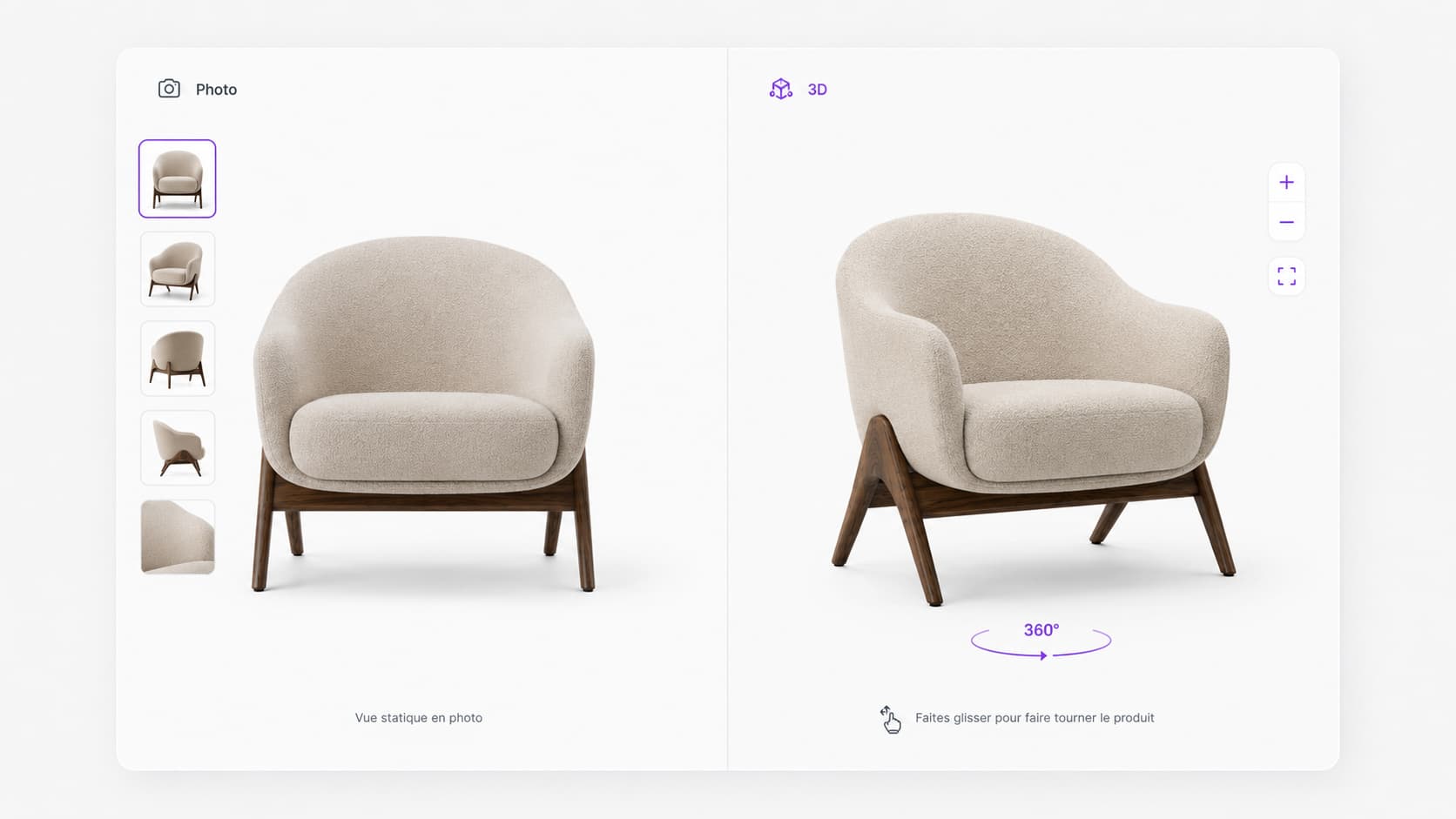
A photograph captures the product frozen at one moment; a 3D product page delivers an object the visitor can handle and view from every angle, built from a single model. That is a difference in kind, not just in image quality. However carefully composed, a photo shows what the photographer decided to show. A 3D model lets the visitor explore what they want to see — the underside, the stitching, the mechanism, the finish.
In practice, three uses of 3D coexist on a product page, from the simplest to the most engaging:
- The 3D packshot: a still image generated from a 3D model, rendered photorealistically. Visually, customers often cannot tell the difference — it is a "photo" with no studio and no physical product.
- The 360° product view: a series of images or a real-time render the visitor spins to inspect the object from every side.
- The interactive 3D model: a genuine real-time 3D object (WebGL) in the browser, which can be rotated, zoomed, and sometimes viewed in augmented reality at full scale.
| Criterion | Photo / photo packshot | 3D product page |
|---|---|---|
| What is shown | One fixed, chosen state | Every angle, at the visitor's choice |
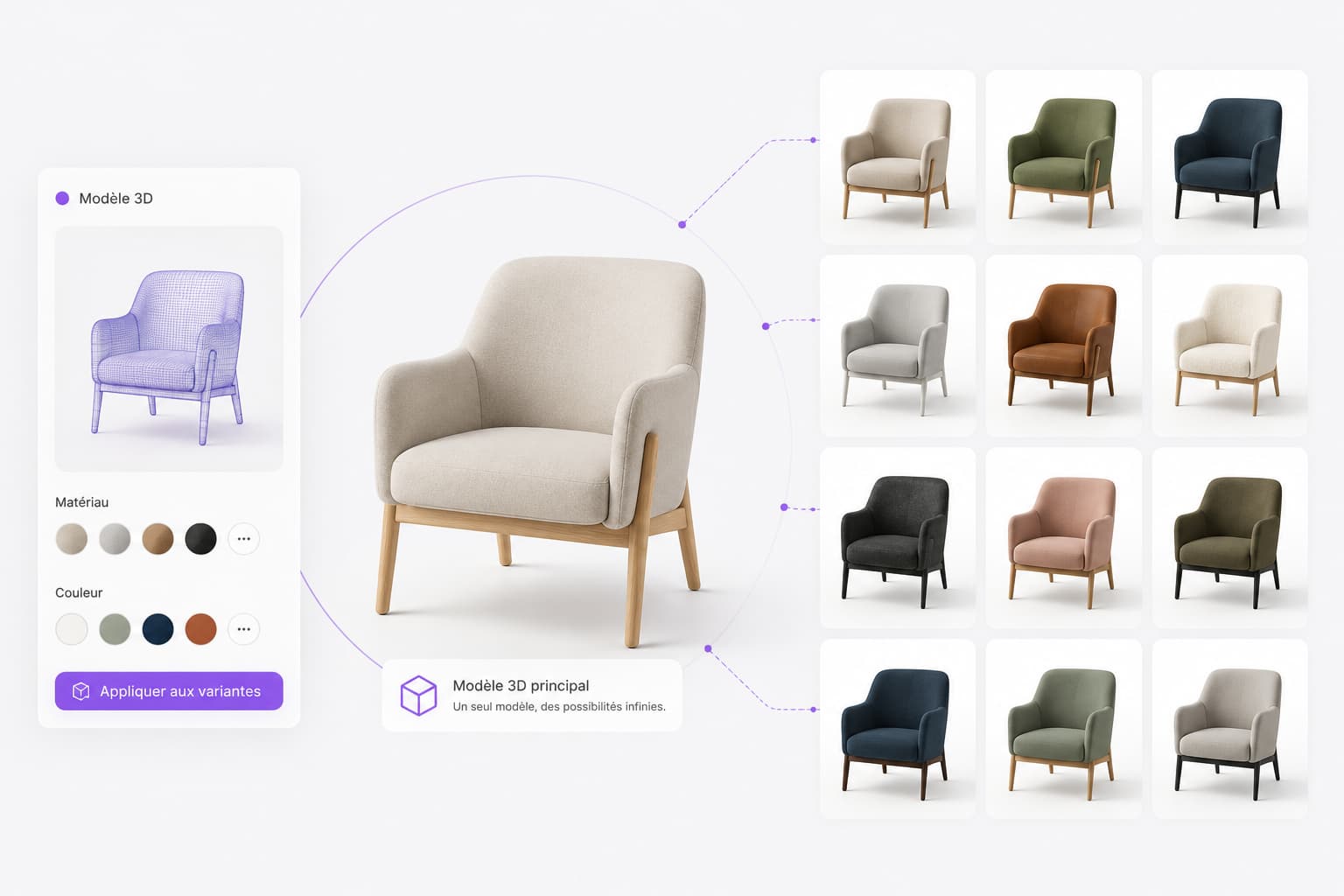
| Variants covered | Those actually photographed | All of them, from one model |
| Interaction | Static (zoom at best) | 360°, zoom, sometimes AR |
| Cost of a new variant | A new shoot | A few parameters |
| Initial cost / lead time | Low and fast | Higher (modelling) |
| Emotion / lifestyle | Excellent (real staging) | Good but more technical |
Worth remembering. Photography and 3D are not rivals but complements: lifestyle photography sells emotion and context, 3D sells precision and confidence. Most good product pages combine the two.
What exactly is a 3D packshot?
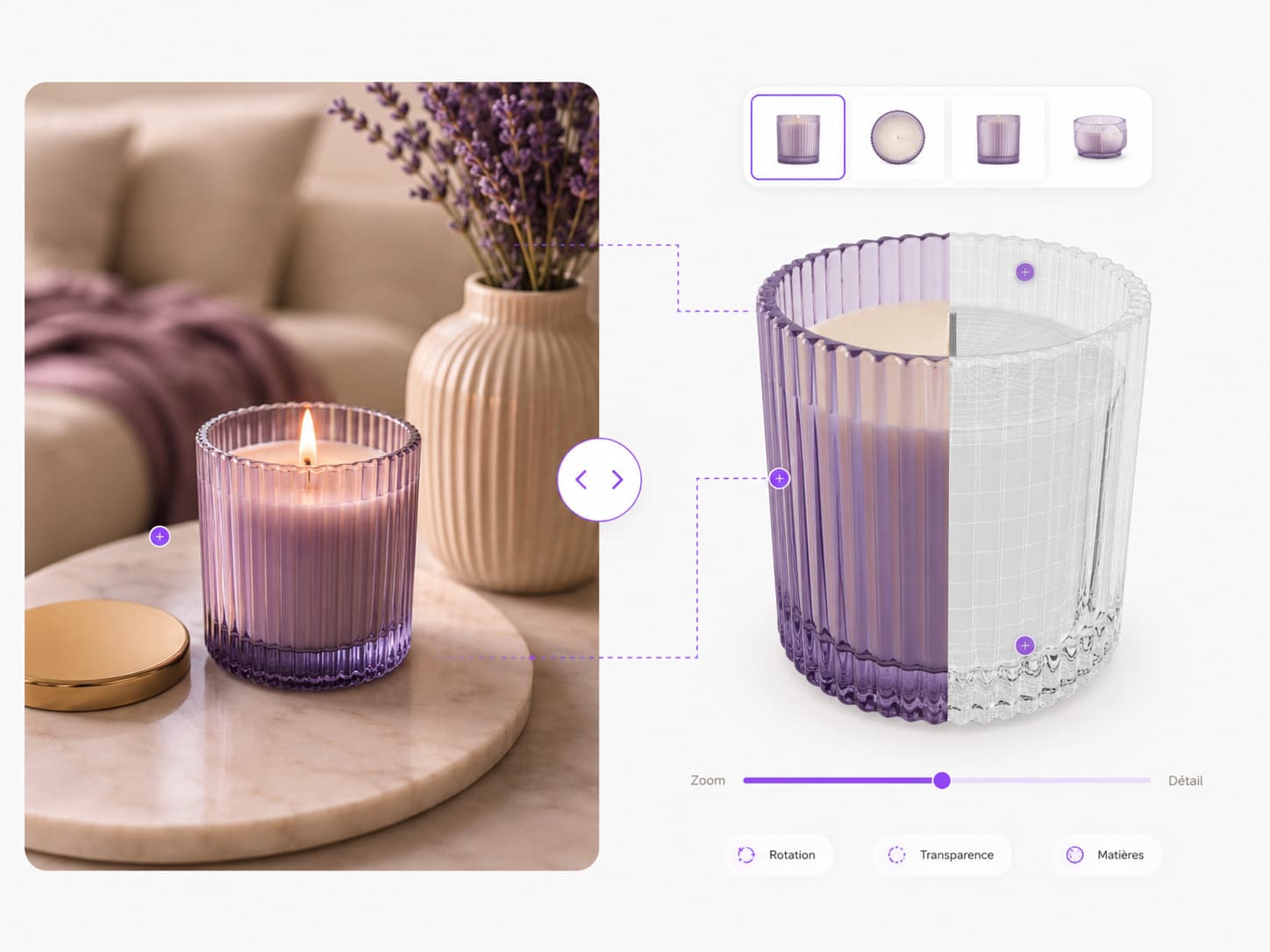
A 3D packshot is a still product image, photorealistically rendered, generated from a 3D model rather than a camera shoot. Instead of renting a studio, lighting and shooting a physical product, you model the object once, then compute as many images as you need — every colour, every angle, every background — without ever picking up the camera again.
The 3D model can come from two sources: the product's existing CAD data (STEP, OBJ or IGES files from the engineering team), or a remodelling from drawings or photographs. Once the model exists, each additional version (a new colour, a new material) costs only a render, where photography would demand a fresh shoot.
That is precisely the economic advantage of the 3D packshot: the upfront modelling investment pays back through the number of variants and the reusability of the model — on product pages, but also in catalogues, advertising, social media, and even AI-generated video.
Does 3D really improve sales compared with photography?
Yes, but not everywhere, and not by magic: 3D sells when it removes a doubt that photography leaves open. The data points to a genuine effect on suitable products. Retailers who have enriched their pages with 3D report an average basket up 10 to 30% and returns down 20 to 35%, particularly in furniture, home decor, jewellery and packaging. On the research side, a study published in the Journal of Marketing (Tan, Chandukala and Reddy, 2022) analysed data from the mobile app of an international cosmetics retailer, where augmented reality lets shoppers see how a product would look on their own face. Using that feature is associated with higher sales. The average effect is modest. It is stronger for less popular brands, niche products and more expensive products: according to the authors, augmented reality helps most where uncertainty about the product is high.
The mechanism is easy to understand: on a product page, the visitor cannot touch the product. Anything that reduces the uncertainty of "is this what I picture?" raises the odds of a purchase and lowers the odds of a return. 3D acts on three levers:
- It removes doubt. Spinning the object, zooming in on a material, judging a volume — the buyer sees what they are ordering.
- It raises engagement. Visitors spend on average two to three times longer on a page with an interactive 3D module, and attention time correlates with conversion.
- It narrows the gap between expectation and delivery — the leading avoidable cause of returns.
An honest caveat. These figures come largely from platforms and studios that sell 3D: they are orders of magnitude, not a contractual promise. The real gain depends on your catalogue, your traffic and the quality of execution. Our job, upstream, is to tell you whether the effort is worth it for your products — not to sell you 3D on principle.
Does 3D really cut product returns?
Yes, on the share of returns caused by a product that is "not like the photo" — a cause that is far from marginal. The average e-commerce return rate sits around 19 to 20% in 2026, rising to 24-26% in fashion. Among the stated reasons, the gap between the online image and the product received accounts for roughly 20 to 22% of cases in apparel: a colour that reads differently, a material that looks less appealing, a cut that does not hang like the visual.
That is exactly the share 3D attacks. By giving a faithful, manipulable, true-to-scale representation, it aligns customer expectations with reality before purchase. It will never solve returns caused by the wrong size (the leading reason in fashion, around 45-50% of returns) or by logistics failures — those need other levers (size guides, virtual try-on, quality control).
Worth remembering. 3D reduces "appearance" returns, not "size" returns or "delivery" returns. Before investing, look at why your customers send items back: if size dominates, 3D is not your priority.
What does a 3D product page cost compared with photography?
A photo page costs the price of a shoot; a 3D page costs modelling first, then almost nothing per variant. That is the whole economic argument: photography is cheap per unit but has to be paid for again with every new version; 3D demands an upfront investment that pays back through the number of versions and the reuse of the model.
As a market benchmark, a professional 3D packshot starts at around €400 when the product has to be modelled, after which each version (colour, material, angle) falls to a few tens of euros, the model already being built. What moves the invoice:
- Does the product need modelling, or does CAD data already exist? A STEP file from the engineering team saves the most expensive stage.
- Product complexity — a simple bottle is nothing like a watch or a machine.
- The number of views and variants to produce.
- The level of realism (PBR rendering, materials, animation).
- The degree of interactivity: still image < 360° view < real-time model < 3D product configurator (the most engaging, and the most expensive).
For detailed ranges by level of interactivity, see our article on how much a 3D configurator costs.
On pricing. The benchmarks above are market ranges meant to orient the reader, not our rates. METASENSE prices each engagement individually, after scoping, because the cost depends entirely on your catalogue and on the effect you are after. The right question is not "what does a 3D visual cost" but "how much margin are a higher average basket and 20% fewer returns worth on this product".
When is photography enough (and 3D unnecessary)?
Photography remains the right choice for a simple, low-priced product with a low return rate and few variants to show. On those pages, 3D adds nothing photography does not already deliver, at a far higher cost. Overselling 3D on that kind of catalogue burns budget.
| 3D is worth it | Photography is plenty |
|---|---|
| Customisable product, or many variants | Two or three variants, easy to photograph |
| High unit value (doubt is expensive) | Low price, impulse purchase |
| Bulky product whose size must be judged | Obvious size, or size does not matter |
| High appearance-related return rate | Few returns, or size-related returns |
| Need for consistency across channels (web, ads, social) | A single channel, few images |
Photography also keeps an advantage 3D struggles to match: the emotion of the real. A lifestyle setting — the product in a real kitchen, worn by a real model, under real light — creates a connection that a cleaner 3D render does not always reproduce. That is why the right setup is almost always hybrid: photography for emotion and context, 3D for precision, confidence and variants.
Worth remembering. 3D does not replace photography, it complements it where photography reaches its limits: variants, manipulation, scale. Keeping both is often the better decision.
Does 3D on a product page hurt speed and SEO?
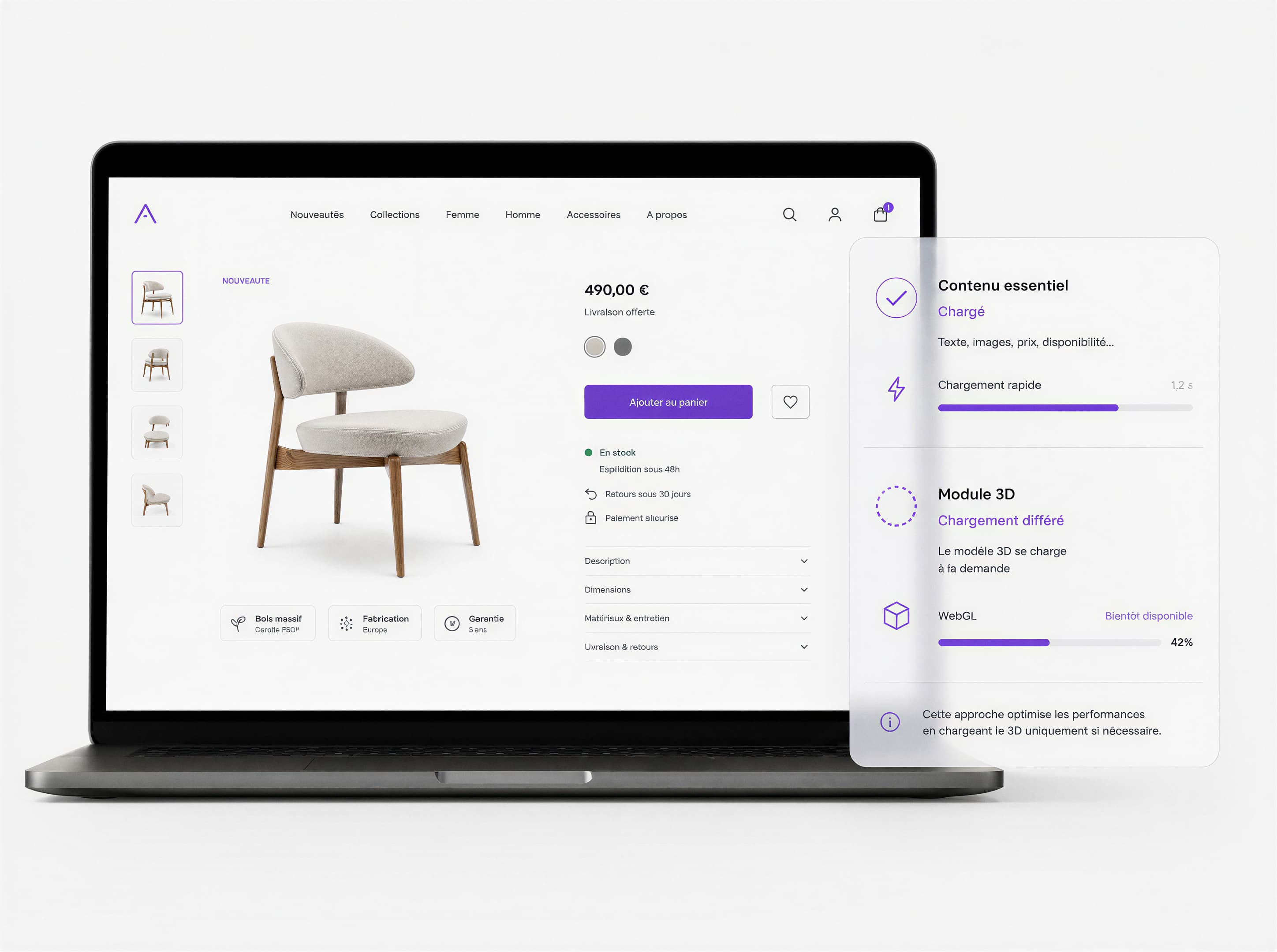
Yes if it is badly integrated, no if it is done properly — and this is a real issue, not a detail. A still 3D packshot behaves like any other image: no impact, provided you serve a light format (WebP/AVIF). A real-time 3D model (interactive 360° view, configurator), however, brings a WebGL engine that, badly placed, can weigh the page down and degrade your Core Web Vitals — and therefore your ranking.
The rule we apply: essential content (title, price, description, first visual) exists as light, crawlable HTML from first load, and real-time 3D is triggered later, after the page renders or on interaction. Done well, it costs nothing in perceived load time. We cover the subject in depth in our guide to immersive 3D on the web and WebGL.
We put that performance discipline to the test at scale on Nîmes-la-Romaine (with Aura, formerly EDEIS): a multilingual WebGL 3D web app, reachable from a simple QR code, which absorbed thousands of simultaneous connections with no install and no slowdown. The same engineering discipline applies to an e-commerce product page.
Should you replace all your photos with 3D?
No — an all-in switch to 3D is rarely the right calculation. Modelling an entire catalogue is expensive and only makes sense if every page genuinely benefits from 3D. The profitable approach is to start with the products where doubt costs the most: high value, many variants, high return rate. Measure the effect there, then extend.
For many brands, the sensible sequence is progressive:
- 3D packshots on key products, for clean visuals that can be declined at will.
- 360° views where handling reassures (material, mechanism, finish).
- Interactive model plus AR for products where size and customisation decide the purchase.
- 3D product configurator when the product is customisable and configuration drives the basket.
Each step is a separate investment, with its own return. The role of an agency like ours is not to convert everything to 3D, but to frame what deserves 3D, in what order, and in what format — from a simple packshot to a real-time configurator.
Let's talk about your catalogue before we talk about 3D
Torn between keeping your photos and moving to 3D on your product pages? The right answer does not come from a sales pitch: it comes from an honest review of your catalogue — which products, which return reasons, what value, what ambition. That is our craft: designing and building 3D web experiences that serve your sales, not the demo. And if photography is enough, we will tell you.
Let's talk about your project →
Frequently asked questions
Does 3D improve sales compared with photography?
Yes, on suitable products. Retailers who have enriched their pages with 3D report an average basket up 10 to 30% and time on page two to three times higher, orders of magnitude that depend on your catalogue and your execution. Research points the same way: a study published in the Journal of Marketing (2022) on virtual try-on with augmented reality finds that its effect on sales is stronger for less popular brands and more expensive products, where doubt is greatest.
What is a 3D packshot?
A 3D packshot is a still product image, photorealistically rendered, generated from a 3D model instead of a camera shoot. You model the object once, then compute as many images as you need — every colour, every angle, every background — with no new shoot and no physical product.
How much does 3D modelling of a product cost?
As a market benchmark, a professional 3D packshot starts at around €400 when the product has to be modelled, after which each version falls to a few tens of euros, the model being reusable. The price depends on complexity, the number of views and the level of realism. METASENSE prices each engagement individually after scoping.
Does 3D reduce product returns?
Yes, on the share of returns caused by a product that is "not like the photo", which accounts for roughly 20 to 22% of returns in fashion. By offering a faithful, manipulable representation, 3D aligns expectations with reality. It does not solve returns caused by size (around 45-50% in fashion) or by delivery failures.
Should you replace all your photos with 3D?
No. An all-in switch to 3D is rarely profitable. Better to start with the products where doubt costs the most (high value, variants, high returns), measure the effect, then extend. Lifestyle photography remains irreplaceable for emotion: the right setup is often hybrid, photo plus 3D.
What is the difference between a 3D packshot, a 360° view and an interactive model?
The 3D packshot is a still image generated in 3D. The 360° view is a series of images or a render you spin to inspect the product. The interactive model is a real-time 3D object (WebGL) you rotate, zoom and sometimes view in AR. It is a rising scale of interactivity — and of investment.
Does 3D on a product page slow the site down?
A still 3D packshot behaves like any ordinary image: no impact in a light format. A real-time 3D model brings a WebGL engine that, badly integrated, can weigh the page down. Done well — light HTML content, 3D loaded later — the impact on speed and SEO is neutral.
3D packshot or photography: which to choose for a new catalogue?
It depends on the product. For simple, low-priced items with a low return rate, photography is enough and costs less. For products with many variants, high value, or where size decides the purchase, the 3D packshot — reusable and easy to decline — quickly becomes more profitable than repeated shoots.
Sources
- Eightx — Average ecommerce return rate 2026 — average e-commerce and fashion return rates, 2026.
- Mon Comptoir Local — Packshot 3D vs photo produit — average basket +10 to 30%, returns -20 to 35%, photo/3D complementarity.
- Tan, Chandukala and Reddy — Augmented Reality in Retail and Its Impact on Sales (Journal of Marketing, 2022) — effect of augmented reality on a cosmetics retailer's sales, stronger when uncertainty about the product is high. Paywalled article, free summary on the American Marketing Association website.
- 3DGRAPHISTE.FR — Le packshot 3D — definition and principle of the 3D packshot.
- Le Pavé Parisien — Combien coûte un packshot produit en 3D ? — cost benchmarks (approx. €400 plus versions).
- BestColorfulSocks — Fashion product return rate statistics — fashion return reasons, including the photo/product gap (approx. 20-22%) and size (approx. 45-50%).