

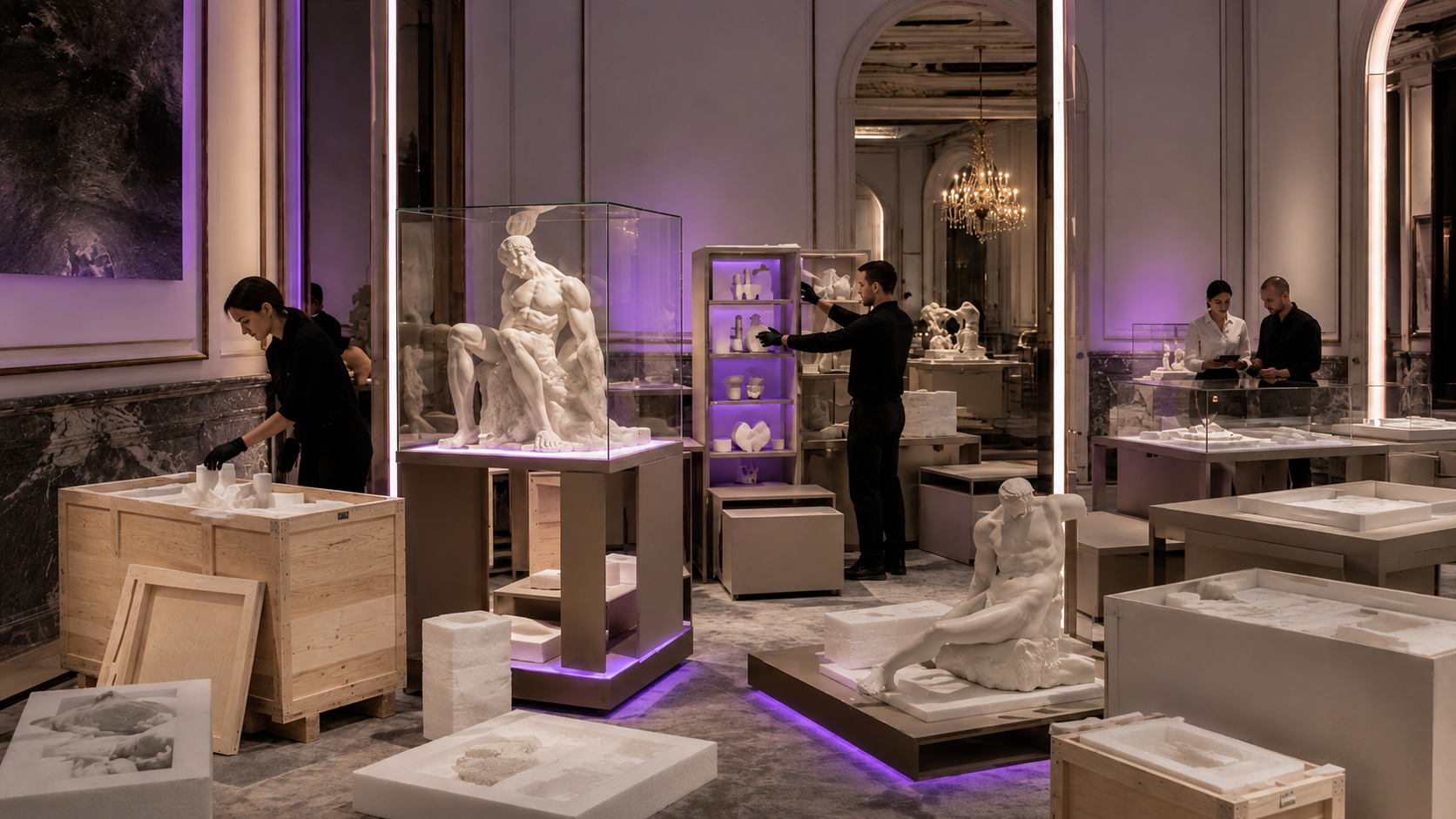
A touring exhibition drawn from a private collection is designed the other way round to a museum exhibition: the venue is not a given, it changes at every stop — so the scenography cannot rest on the building. When a collection travels without owning a museum, the one constant is neither the room, nor the control booth, nor the front-of-house team: it is the visitor's phone. That is why a web experience, with no download, absorbs the constraints of touring far better than a fleet of equipment to transport and reinstall at every stop.
This concerns a wide and oddly underserved segment: private collections, corporate foundations and off-site exhibitions run by independent curators, concession holders or local authorities hosting a temporary exhibition in a venue that is not a museum. This article covers what really sets them apart from an established museum: the constraints specific to touring, and how a digital experience answers them — including on confidentiality and on works that cannot travel.
In short
- The problem is not the collection, it is the venue: unequipped spaces, unreliable networks, repeated installations and strikes, no permanent interpretation team.
- Without a building, the digital experience is the venue: produced once, redeployed at every stop with no logistics.
- The web with no download (WebAR, real-time 3D, storytelling) removes both frictions: nothing to install on site, nothing to install on the phone.
- Confidentiality becomes a setting: private link, access code, time window — impossible with a physical display that is open permanently.
- Works that cannot travel can still be shown, through a 3D digital twin — when insurance, fragility or the lender rules out moving them.
- The economics flip: digital is a largely fixed cost, physical logistics a cost that repeats at every stop on the tour.
What is a touring exhibition of a private collection?
A touring exhibition of a private collection is an exhibition designed to travel through several host venues in succession, drawn from a holding that belongs to no museum institution and has no permanent exhibition site. One structural point sets it apart from a museum's temporary exhibition: the venue is never a given. It is negotiated stop by stop, and its technical characteristics change every time.
Three profiles find themselves in this situation:
- The private collector, or the family holding a collection (art, design, technical objects, corporate archives, industrial heritage) who wants to exhibit without building.
- The corporate foundation or endowment fund, holding a collection or a documentary heritage to bring to audiences, partners and local communities. France counted 5,833 active foundations and endowment funds in 2024, a figure that keeps rising, and arts and culture rank among the leading causes supported (Observatoire de la philanthropie, Fondation de France, baromètre 2025).
- The independent curator, the concession holder or the host authority, producing or receiving an exhibition in a venue that was never designed for it: a corporate lobby, a deconsecrated chapel, a public library, a market hall, a tourist office, a village hall.
Cultural patronage is no marginal phenomenon: it remains the second field of corporate giving in France, with 28% of corporate patrons active in it (Admical, Baromètre du mécénat d'entreprise 2024). What these organisations lack is neither the collection, nor the appetite, nor often the budget: it is a venue.
Do you have to become a museum to open a collection to the public?
No — and it is rarely even desirable. The French « Musée de France » designation can be granted to a private not-for-profit legal entity, but it requires, among other things, an inventory of holdings, evidence that no security interests encumber them, and above all a statutory clause irrevocably dedicating the collections to public display (Ministère de la Culture, appellation « Musée de France », Act no. 2002-5 of 4 January 2002).
In other words: museum status commits the collection irreversibly. For a collector, a family or a corporate foundation, that is a commitment of an entirely different order from « showing our collection ». Many discover late that the question was never « how do we become a museum? » but « how do we open to visitors without being one? ».
The sector's historical answer is the off-site programme (hors les murs): any outreach activity carried out away from the main site of conservation. It emerged in the 1970s as a reversal of perspective — going to audiences rather than making them come (Exposcope). Touring is the most demanding form of it, because it repeats that reversal at every stop.
Worth remembering. A private collection needs no building to be visitable. It needs a visit experience — and that experience can be digital, carried in a QR code rather than in a lorry.
Which constraints make touring so different from an established museum?
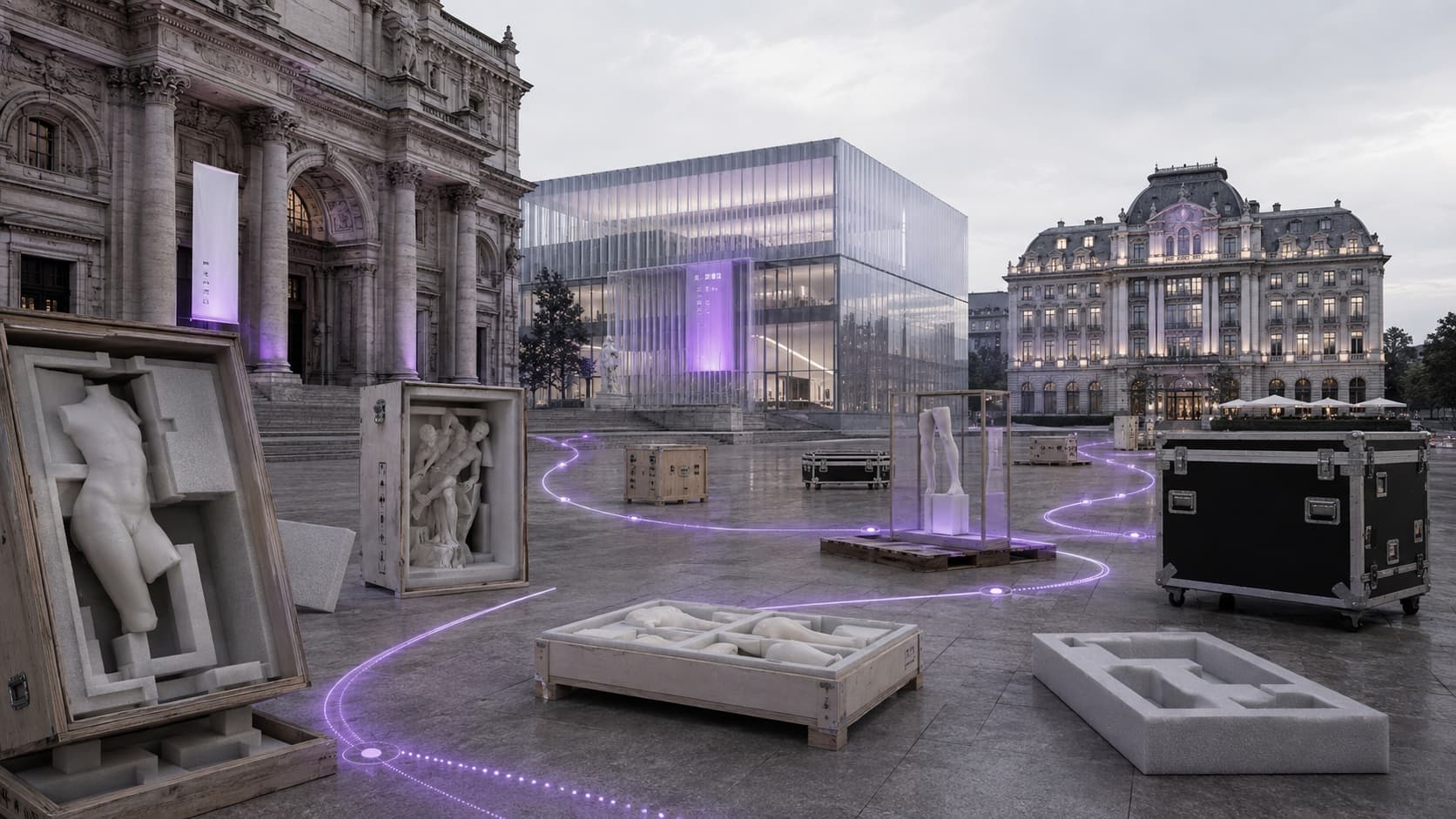
An established museum designs an exhibition for a venue it knows; a touring exhibition must be designed for a venue it has not seen yet. That is the founding difference, and it generates six very concrete constraints that never bite with the same intensity in a permanent gallery.
| Touring constraint | What it breaks in a conventional setup | What the web with no download absorbs |
|---|---|---|
| Unequipped venues — no control booth, no hanging rails, variable heights, volumes and doorways | Screens, kiosks, projection, partitions: to transport, cable, level and redo | The screen belongs to the visitor; nothing to install beyond a QR code holder |
| Unreliable network — no Wi-Fi, weak 4G inside older buildings | A heavy app to download on site, video streaming, connected hardware | Lightweight web app, caching (PWA), local access point as a fallback |
| Fast, repeated installation and strike | Every install costs technical staff time and carries a risk of damage | No install at all: the experience is already online, identical at every stop |
| A small but demanding audience | A spectacular setup badly calibrated for 40 visitors a day | Depth of content on demand, with no marginal cost per visitor |
| Confidentiality — lenders, values, provenance, works that cannot be published | A physical display shows everything, to everyone, permanently | Private link, access code, time window, tiered content |
| No permanent interpretation team | With no guide on site, only wall labels remain | Built-in storytelling, self-guided journey, a voice given to the collection |
These constraints are not theoretical. The reference guide from the Société des musées du Québec on touring exhibitions makes three points that sum up the exercise: host rooms vary widely (ceiling height, columns, number of walls, floor type, doorway configuration), so the design must be modular, light and flexible, and a technical presence is generally required for the install — which weighs directly on the tour budget. The same guide notes that a touring exhibition is announced to its network one to two years before it goes into circulation, and that in Quebec half the exhibitions in circulation were 150 m² or smaller. Touring is not a smaller exhibition: it is an exhibition designed for an unknown venue.
On top of that sits a specific layer of risk: transport and handling. Vibration, climate variation, repeated handling and logistical incidents are the main causes of damage to fragile pieces, and the installation and strike phases are identified as points of vulnerability in their own right (SEREX, assurance d'exposition itinérante). Adding stops to a tour multiplies that exposure — and the insurance cost that comes with it.
We have handled these constraints on a setup genuinely built to tour. For Orano, METASENSE produced a national roadshow: a touring installation combining physical structures, augmented reality and a serious game, designed from the outset to be rebuilt across 5 successive sites, and which reached around 870 visitors. The subject belonged to the client; the exercise is universal — delivering the same experience at the fifth stop as at the first, in venues whose volumes and equipment you do not control, with a different host team every time. Two lessons transfer directly to a private collection on tour, whatever the holding:
- Anything physical must be justified item by item. Every transported element is paid for five times: transport, install, strike, storage and risk. Only what needs to exist physically should travel.
- A tour does not operate at museum scale. Five sites, around 870 visitors: an audience counted per stop, not as an annual flow. A setup oversized for that volume is a setup badly calibrated — exactly the « small but demanding audience » constraint in the table above.
Why does the digital experience become the venue?
Because in a touring exhibition, the digital layer is the only element that does not change from one stop to the next. The corporate lobby of the first stop has nothing in common with the public library of the third; the QR code is rigorously identical. It is a reversal of logic: you stop trying to reproduce a venue, you carry the experience and let the venue be what it is.
That reversal has three operational consequences:
- Part of the scenography becomes immaterial. What has to be seen and understood — context, scale, the making of a piece, what lies beneath the surface — no longer needs a panel, a built-in screen or a dedicated case. It lives in the digital journey, in 3D or augmented reality, and triggers in front of the work.
- The experience is produced once and redeployed n times. That is the exact opposite of physical logistics, which is paid for at every stop (transport, insurance, install, technical staff, storage between dates).
- The host venue no longer has heavy technical prerequisites. A bare wall, decent lighting and a printed holder are enough to open the experience. That is what makes venues eligible which would otherwise have been ruled out on sight.
This is not agency theory: it is the mechanic we deployed for Nîmes la Romaine, with Aura (ex-EDEIS) and the Musée de la Romanité — a 3D augmented visitor journey, opened from a simple QR code, multilingual, which sustained thousands of simultaneous connections while asking nothing of the visitor. The subject was classical antiquity; the mechanic is not: it holds in exactly the same way for a design holding, a corporate collection, an industrial heritage or a photographic archive. The setup is described in detail in our case study of the 3D augmented visitor journey in Nîmes.
Worth remembering. When there is no building, the question « where do we exhibit? » shifts. The venue becomes the point of contact: a QR code on a plinth, a card, an invitation. Everything else — narrative, scale, context, depth — lives in the digital experience.
Why the web with no download rather than an app or hardware?
Because a touring exhibition stacks two frictions, and the web with no install is the only option that removes both: nothing to install on site, nothing to install on the visitor's phone. A native app adds an installation step for an audience that will come once; a fleet of tablets or headsets adds hardware to transport, charge, clean, repair and replace.
| Option | What it requires at every stop | What it requires of the visitor | Verdict on tour |
|---|---|---|---|
| WebAR / web app (no download) | A QR code holder | Scan, allow the camera | The most robust: zero logistics, zero install |
| Native app | No hardware | Store, download, permissions, storage | Heavy audience loss for a one-off visit |
| Supplied tablets / headsets | Transport, charging, hygiene, security, servicing | Waiting for a free device | Cost and fragility repeated at every stop |
| Kiosks and on-site screens | Transport, cabling, levelling, control booth | Nothing | Heavy, expensive, dependent on the venue |
The reasoning comes down to one metric: the number of visitors who actually experience the content. Every step added between intent and content removes a share of them, and the app download is by far the most expensive — we set this out, with figures, in our article on the museum visit app with no download. On a touring exhibition with a small audience, that drop-off is not a statistic: it is twenty people out of forty.
One point of technical honesty, though: the web does not cancel the network constraint, it moves it. A WebAR experience has to load. In an older building with poor coverage, that is handled by design, not by luck: optimised and compressed 3D assets, progressive loading, caching through a Progressive Web App, and — where the venue allows — a local Wi-Fi access point at the entrance, dedicated to loading the experience. This is exactly the kind of trade-off that separates a demo that works at the office from a setup that holds across five different venues.
What can you actually do with a collection on tour?
Five uses cover most of what a touring private collection needs, and they combine according to the holding, not according to a technology catalogue.
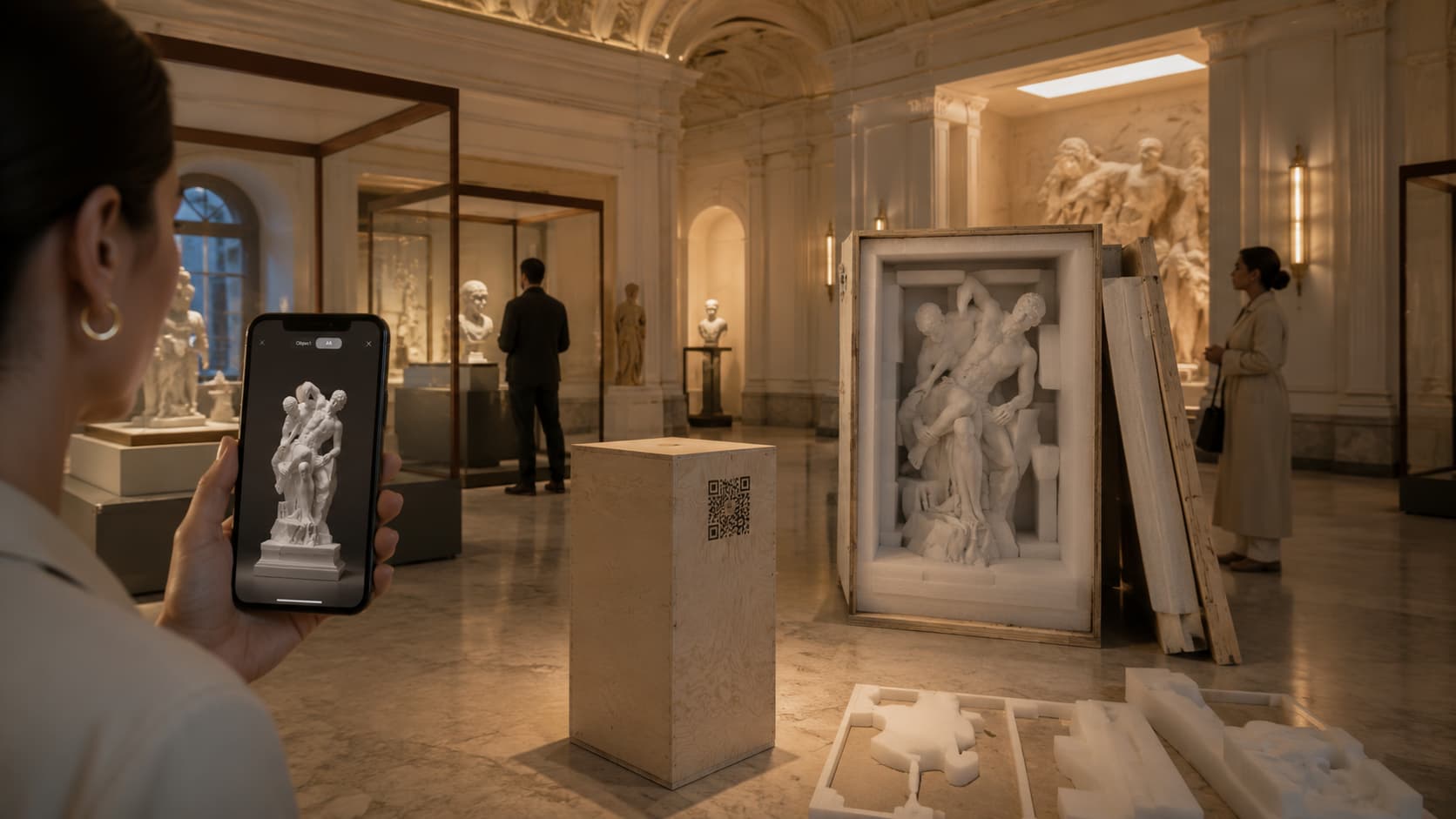
- Show the work that does not travel. This is the use most specific to the segment. A piece too fragile, too heavily insured, or that the lender refuses to move, can still appear in the journey as a 3D model that visitors can view and rotate. The gap in the hang becomes a strong point of the narrative.
- Restore the lost scale and context. An object removed from its original setting loses half its meaning. Augmented reality puts it back: at real size, in its setting, in use. We reviewed the main uses of augmented reality in museums in a dedicated article.
- Give the collection a voice. With no permanent guide on site, the narrative has to be built in: audio storytelling, a guided journey, or a conversational layer letting visitors put their questions to the collection itself — a use we detail in our article on the museum chatbot that gives the curator a voice.
- Extend the stop, before and after. The physical exhibition lasts three weeks; the digital experience stays. It becomes the lasting record of the tour: a living catalogue, available between stops, reusable for the next one.
- Engage without patronising. A puzzle trail, a treasure hunt or a collect-them-all mechanic works very well with a family audience — and switches off just as easily for a collectors' private view. The same setup can serve two audiences at two reading levels.
One point of method, and it comes from the sector itself. In its white paper « Le jumeau numérique dans le patrimoine : fantasme ou réalité ? » (March 2025), the Centre des monuments nationaux draws a lesson from more than twelve digitisation projects: the idea that a single, highly precise 3D model can serve every use does not hold — the use determines the type of model, and a point cloud « risks falling short if your goal is an immersive experience » (CMN, livre blanc 3D, 2025). Translated for a private collection: you do not digitise « the collection », you digitise for a defined use — otherwise you pay for a heavy 3D capture you will do nothing with.
How do you handle confidentiality and sensitive works?
On this precise point, digital is more discreet than a physical display: a hang shows everything to everyone, permanently, whereas a web experience is configurable. It is an argument rarely put forward, yet decisive for a private collection, where questions of provenance, value, lender identity and security are real.
Four concrete levers:
- Access control. Private link, an access code handed out on site, a time-limited session: in-depth content can exist only during the stop, for the people present.
- Tiered content. A single journey can serve a public tier (narrative, context) and a restricted tier (provenance, technical documentation, object file) without duplicating the setup.
- Keeping sensitive data unpublished. Insurance values, lender contact details and conservation conditions have no place in the visitor experience: they stay in the back office, on the operations side.
- Control of the image. A 3D model released publicly is an asset that circulates. Resolution, level of detail and reuse terms are decided before digitisation, not after.
Worth remembering. Confidentiality is not an obstacle to digital in a private collection: it is a design parameter. It belongs in the brief, alongside the narrative and the budget.
How do you build a touring setup, step by step?
Six steps, in this order — and the technology only comes fourth.
- Frame the narrative before the technology. What should a visitor who will not come back understand, feel and remember? That answer drives everything else; the reverse produces setups that impress and say nothing.
- Survey the host venues — and their worst case. Floor area, height, available walls, lighting, network, security, staff on site. The setup must work in the least equipped venue on the tour, not the best appointed.
- Decide what gets digitised, and for what use. A piece digitised for 3D viewing in a browser has nothing like the requirements of a conservation survey. Choose the use first, the technique second.
- Build a web experience with no install. WebAR or real-time 3D depending on the use, tested on a real spread of iPhone and Android devices, optimised for fast loading and weak networks, with a fallback mode.
- Set access, rights and confidentiality. Content tiers, access control, how long it stays online, reuse terms for the 3D models.
- Deploy, measure, re-edit between stops. The great advantage of digital touring: whatever did not work at stop one can be fixed before stop two, without rebuilding anything.
What does a digital setup for a touring exhibition cost?
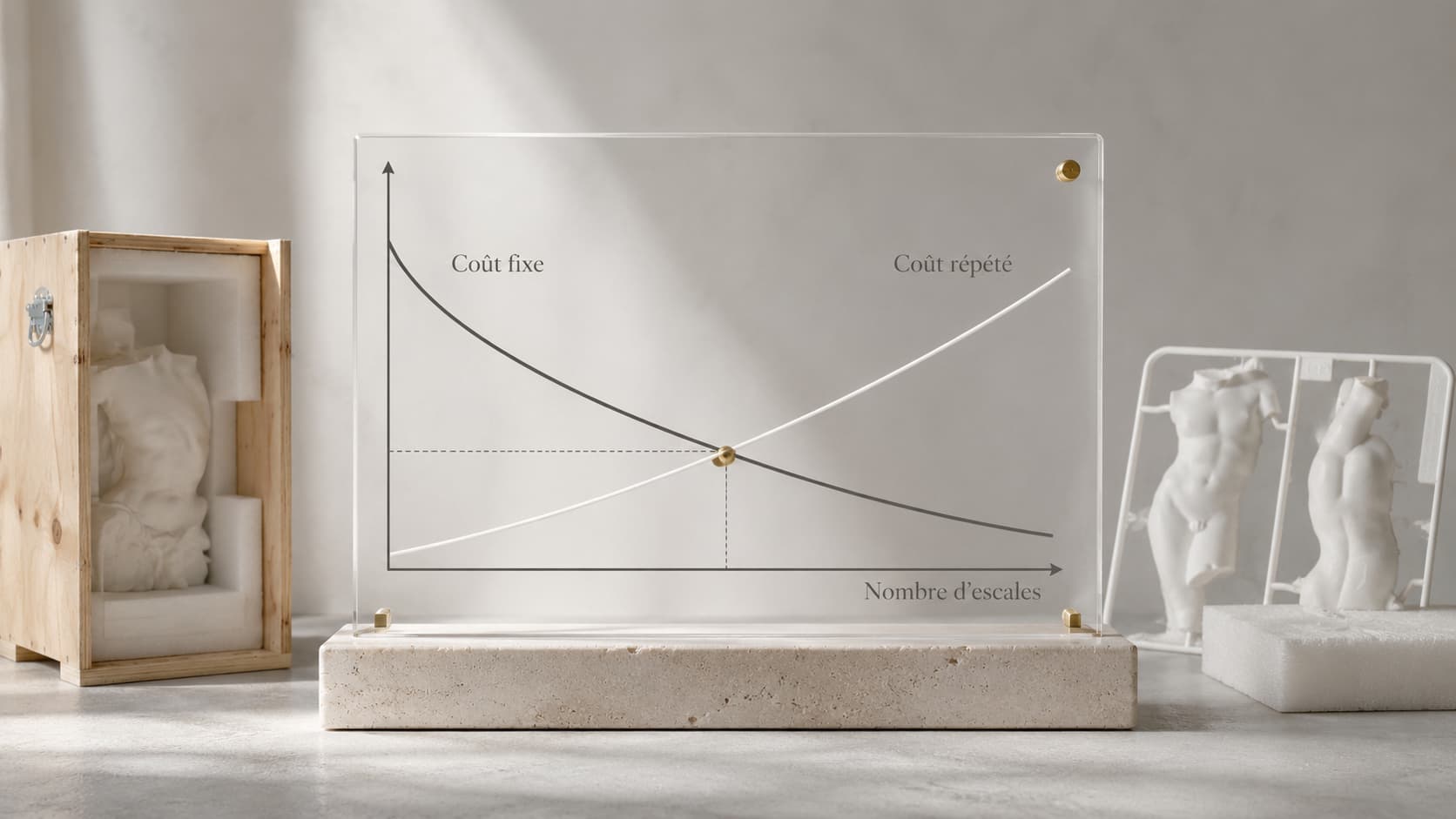
There is no off-the-shelf price, but there is a sound way to reason: compare a largely fixed cost with costs that repeat at every stop. That is the only calculation that matters when deciding to invest in a digital experience rather than in transported scenography.
| Item | Physical touring setup | Digital web experience |
|---|---|---|
| Initial production | Building the scenography, furniture and supports | Design, 3D and media content, development |
| At every stop | Transport, insurance, install and strike, technical staff, storage | Printing the QR code holders |
| Adapting to a new venue | Re-levelling, sometimes rebuilding | None |
| Risk of damage | Real, cumulative across the tour | None on the setup |
| Life after the tour | Storage or disposal | The experience stays online |
Three variables really size the budget: the volume of 3D content to produce (the most structural item), the scope of the journey (number of points of interest, languages, reading levels) and the management functions (editing back office, access control, audience measurement). At METASENSE we price each engagement individually after a scoping phase — publishing a rate card for this kind of setup would give everyone a wrong number. The useful early marker is the number of stops: the longer the tour, the more the trade-off leans towards digital.
Why entrust this kind of setup to METASENSE?
Because a touring setup rarely fails on the idea, almost always on the execution: a network too weak, an untested iPhone, a 3D model too heavy, a venue that was not in the plan. METASENSE is a Creative Tech agency based in Vélizy-Villacoublay, and its particularity is to hold both halves of the problem: consulting and creative work (narrative, digital scenography, art direction) and the in-house technical expertise that actually designs, builds and deploys the setup.
Our evidence on this mechanic is public:
- Nîmes la Romaine, with Aura (ex-EDEIS) and the Musée de la Romanité: a 3D augmented visitor journey opened from a QR code, multilingual, which held thousands of simultaneous connections — proof that a web experience can carry a complete visit with nothing to install.
- Gocad: a setup of phygital kiosks paired with a Web AR game, deployed off-site, which drew over 6,000 participants. The logic is that of a nomadic setup, deployed in venues never designed for it.
- Akram × CDLA: an online engagement experience that absorbed 30,000 visitors in under three months, without incident — proof that the robustness of a web experience is not traded against its creative ambition.
These projects do not define a sector: they demonstrate a mechanic — running a rich visit experience on a device the audience already has in its pocket, in venues whose characteristics you do not control. That mechanic applies directly to a private holding, a corporate collection or an off-site exhibition. The wider frame of our approach is set out in our article on cultural mediation in 3D, AI and immersive formats; the events variant of going off-site is covered in the one on the immersive experience at events.
These interactive installations can also be designed without a museum, for a private collection or a venue in the making.
Let's talk about your collection and its tour
You hold a collection, a corporate foundation or an exhibition that has to travel, and you are looking for a way to open it to visitors with no museum, no control booth and no app imposed on your audience? This is precisely the kind of constraint we work on: we start from your host venues, your holding and your confidentiality requirements to design a setup that holds everywhere — including at the least equipped stop on your tour.
Let's talk about your touring exhibition →
FAQ — Touring exhibition of a private collection
What is a touring exhibition of a private collection?
It is an exhibition designed to travel through several host venues in succession, drawn from a holding that belongs to no museum and has no permanent site. Its particularity: the venue changes at every stop, which rules out any scenography that depends on the building.
Do you have to be a museum to open a private collection to the public?
No. The « Musée de France » designation is open to a private not-for-profit entity, but it requires an inventory, the absence of security interests over the holdings, and a statutory clause irrevocably dedicating the collections to public display. Opening to visitors requires neither that status nor a building.
What are the main constraints of a touring exhibition?
Six: host venues that are unequipped and all different, a network that is often absent or weak, fast and repeated installation and strike, a small but demanding audience, confidentiality and insurance issues around the works, and no permanent interpretation team on site.
Why a digital setup rather than transported scenography?
Because digital is produced once and redeployed at every stop with no logistics, whereas physical scenography is paid for at every stop: transport, insurance, install, technical staff, storage. Across a tour of several venues, the economics lean clearly towards digital.
Does augmented reality work without an app to download?
Yes. WebAR is augmented reality that opens in the visitor's browser from a QR code or a link, with no app store involved. It is the best fit for a touring exhibition, where the audience comes once and will not install an app for a single visit.
What do you do when a work cannot travel?
It can be presented as a 3D model within the digital journey, alongside the pieces actually on display. This is one of the most useful applications of digital on tour: showing what insurance, fragility or the lender prevents you from moving.
How do you handle a venue with no Wi-Fi or mobile coverage?
By design: optimised and compressed 3D content, progressive loading, caching through a Progressive Web App, and where possible a local Wi-Fi access point at the entrance dedicated to loading the experience. The network is a constraint to address in the brief, not to discover on site.
How do you protect the confidentiality of a private collection?
By configuring access: private link, a code handed out on site, a time-limited session, and content tiered between a public and a restricted level. Sensitive data — insurance values, lenders, conservation conditions — stays in the back office and never enters the visitor experience.
Do you need to digitise the whole collection in 3D?
No, and it is a common and costly mistake. The Centre des monuments nationaux documents this in its 2025 white paper: the use determines the type of 3D model required. You digitise for a defined use — web viewing, augmented reality, conservation — not on principle.
How do you deliver interpretation with no team on site?
Through storytelling built into the setup: a guided journey, audio content, reading levels, and possibly a conversational layer letting visitors question the collection. The narrative travels with the exhibition instead of depending on the host venue's staff.
What does a digital setup for a touring exhibition cost?
There is no off-the-shelf price. Three variables size the budget: the volume of 3D content to produce, the scope of the journey (points of interest, languages, levels) and the management functions (back office, access control, measurement). Pricing follows the scoping phase, individually.
How long does it take to prepare a touring exhibition?
The Société des musées du Québec guide recommends announcing a touring exhibition to its network one to two years before it goes into circulation. The digital experience is designed in parallel with the assembly of the tour, once the host venues and their constraints are known.
Does the digital setup survive the end of the tour?
Yes, and that is one of its main benefits. Unlike scenography that is stored or scrapped, the digital journey stays online: it becomes the lasting record of the exhibition, a living catalogue reusable for later stops or for a remote audience.
Sources
- Fondation de France — Baromètre de la philanthropie 2025 (Observatoire de la philanthropie) — 5,833 active foundations and endowment funds in 2024 (+4%), arts and culture among the leading causes supported.
- Admical — Baromètre du mécénat d'entreprise 2024 — culture, the second field of corporate giving, 28% of corporate patrons.
- Ministère de la Culture — Appellation « Musée de France » — conditions applying to private not-for-profit legal entities (Act no. 2002-5 of 4 January 2002).
- Société des musées du Québec — Guide des expositions itinérantes — variability of host venues, modular design, technical presence at install, one to two years' notice, 50% of exhibitions ≤ 150 m².
- Centre des monuments nationaux — « Le jumeau numérique dans le patrimoine : fantasme ou réalité ? » (livre blanc, mars 2025) — the use determines the type of 3D model; findings from more than 12 digitisation projects.
- SEREX — Assurance d'exposition itinérante et œuvres d'art — transport, handling, and installation and strike risks.
- Exposcope — La médiation hors les murs : aller vers les publics — definition and genealogy of off-site practice since the 1970s.