

In short
— Drive-to-store covers every marketing action that turns an online journey into a physical visit to a shop.
— 3D and augmented reality (AR) are the most effective ways to build that bridge: they let people try, configure and picture a product before coming to touch it in store.
— Why it works: 74% of buyers research online before buying in store (the ROPO effect), and 72% of online shoppers are more likely to buy after seeing a product in AR.
— METASENSE proof: for dealer group Edenauto, the Kia launch campaign combines a WebGL 3D configurator, life-size AR and a viral FOOH campaign to drive traffic to dealerships.
Drive-to-store is where digital now proves its worth: not selling online, but bringing people into the shop. 3D and augmented reality excel here because they let customers see what they will come to collect in person. This article explains why drive-to-store matters, which 3D and AR mechanics actually generate footfall, how to measure from the click to the till, and how to launch your first campaign — with, at its centre, the campaign we delivered for dealer group Edenauto around the Kia launch.
For the wider view of game mechanics in retail, read our article on gamification in e-commerce & retail, where drive-to-store is one mechanic among many. Here it is the subject, examined through 3D and AR.
What is drive-to-store, and why does it matter?
Drive-to-store is the set of marketing techniques that turn an online interaction into a physical visit to a shop. The goal is not to sell on the internet: it is to trigger the journey, then the purchase in store. It is the practical form of phygital retail — the digital journey and the physical experience merged into one continuous flow.
Drive-to-store matters because most purchases still happen in store, but are decided online. This is the ROPO effect (Research Online, Purchase Offline): according to a survey of 2,000 shoppers in the United Kingdom and the United States, 74% of consumers research online before buying offline, and online behaviour influences 56% of in-store sales. In other words: the battle for the shop is largely fought on screen, before the visit.
For retail brands, store networks and distributors, the stakes are threefold:
- Capture intent as it forms — online, on mobile;
- Give a strong reason to travel: to try, to configure, to experience something;
- Connect click data to the store visit, so ROI can be managed.
Why do 3D and augmented reality bridge the gap to the shop?
3D and AR close the one real gap between digital and the shop floor: the inability to see, handle and picture a product in your own context. By rebuilding that sensory experience online, they create the desire to go further — that is, into the shop.
Three mechanisms explain why this works:
- Projection. Seeing a car at full size on your driveway, a sofa in your living room or a product on yourself removes the doubt. 72% of online shoppers say they are more likely to buy after seeing a product in augmented reality (source: BrandXR, 2025 AR in Retail Report).
- Engagement. Configuring, rotating a 3D model through 360°, playing: interaction creates an emotional investment that prepares the visit. Retailers using AR also record 31% fewer product returns, a sign that customers arrive more decided.
- Desirability. 3D and AR position the brand as premium and modern — and produce highly shareable, therefore viral, content.
Close to half the French population was expected to use AR frequently in 2025 (source: LSA / Snap-Deloitte study): the technology is now mainstream, available without any download through Web AR.
Worth remembering: 3D and AR do not replace the shop — they prepare it. The more immersive the online experience, the more the physical visit becomes the natural, wanted end of the journey.
Which 3D and AR mechanics actually generate footfall?
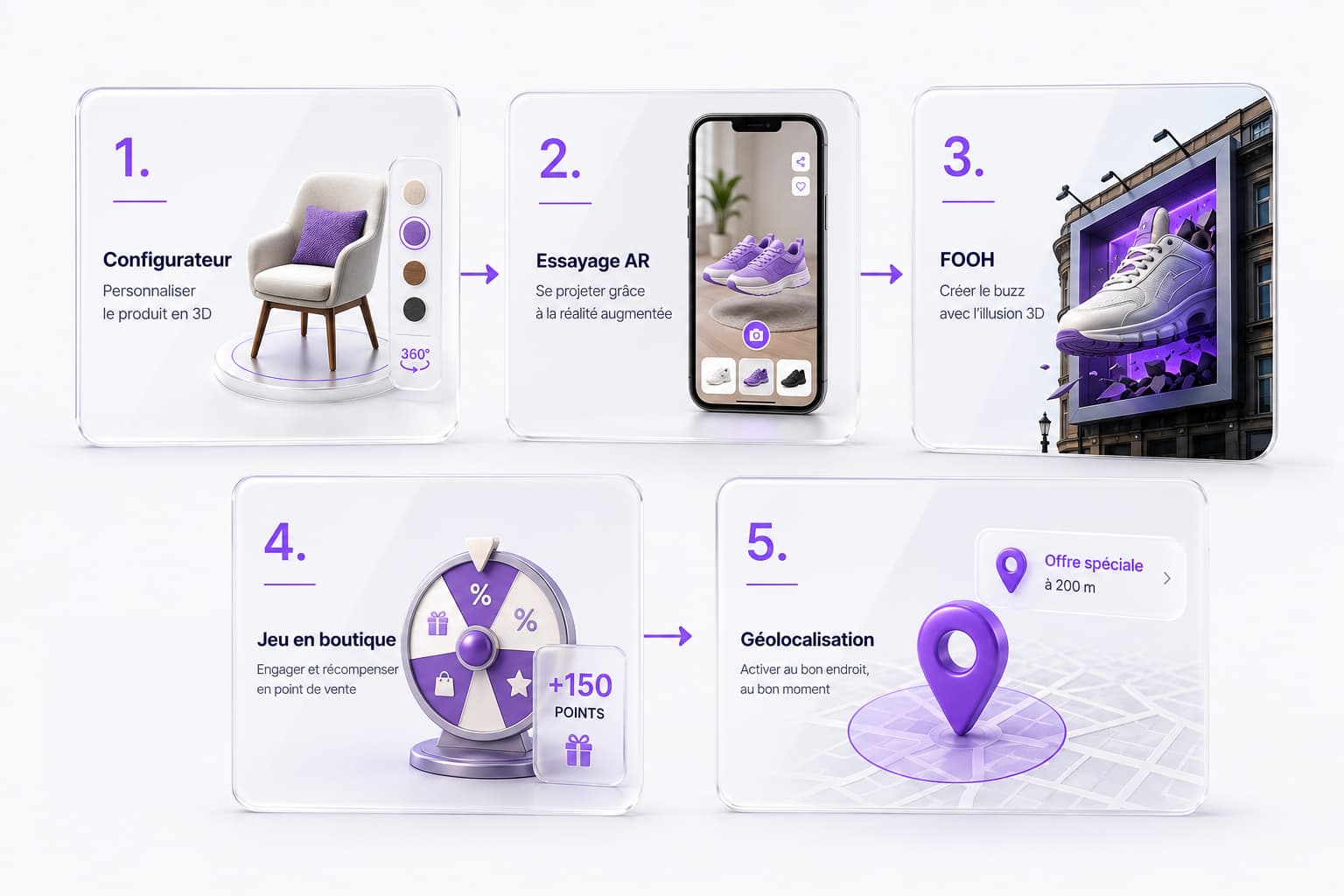
Five families of 3D and AR mechanics have proven they convert online attention into physical visits. Here are the most effective, with their role in the drive-to-store journey.
| Mechanic | What it does | Drive-to-store effect |
|---|---|---|
| 3D configurator | Personalise a product (colour, finish, options) in real-time WebGL | The customer designs "their" product, then comes to see or order it in store |
| AR try-on / preview | Project the product at full size into your own space (Web AR, no app) | Removes doubt, creates the urge to confirm in store |
| 3D advertising / FOOH | Hyper-realistic CGI video (fake outdoor advertising) shared on social | Viral awareness pointing to the store network |
| In-store reward game | Online mini-game or instant win, prize collected in store (QR, coupon, code) | Gives a concrete, time-bound reason to travel |
| Geolocation & store locator | Direct people to the nearest shop (map, push, AR wayfinding) | Turns intent into a route to the store |
The most powerful combination does not use a single mechanic but chains them: capture attention with a viral FOOH, engage with a 3D configurator, convert with a coupon to collect in store, and measure throughout. That is exactly the logic of the campaign detailed below.
On the fundamentals of engagement — loops, rewards, motivation — read our article on gamification & marketing: building engagement.
How does Edenauto turn 3D and AR into dealership traffic?
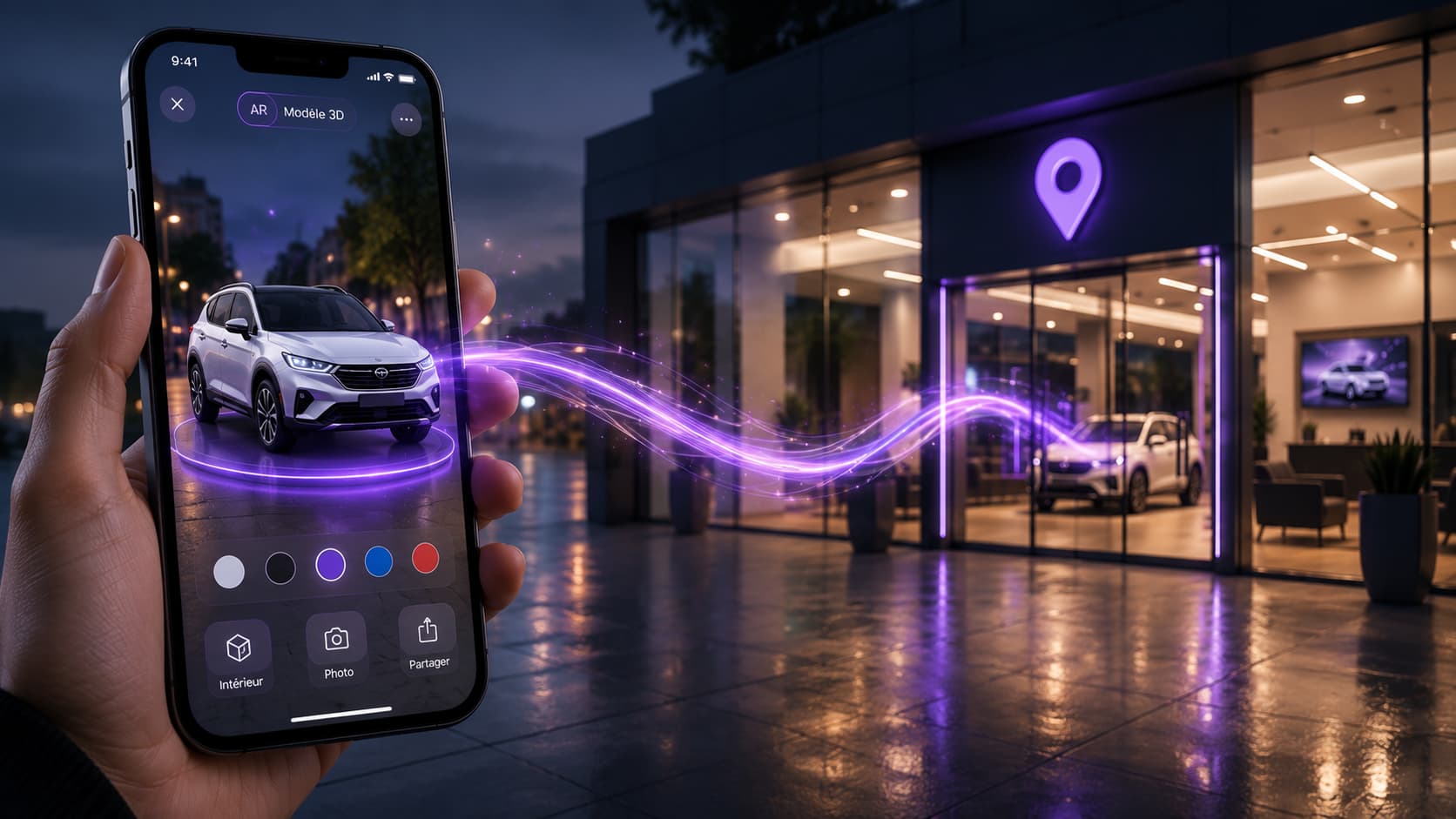
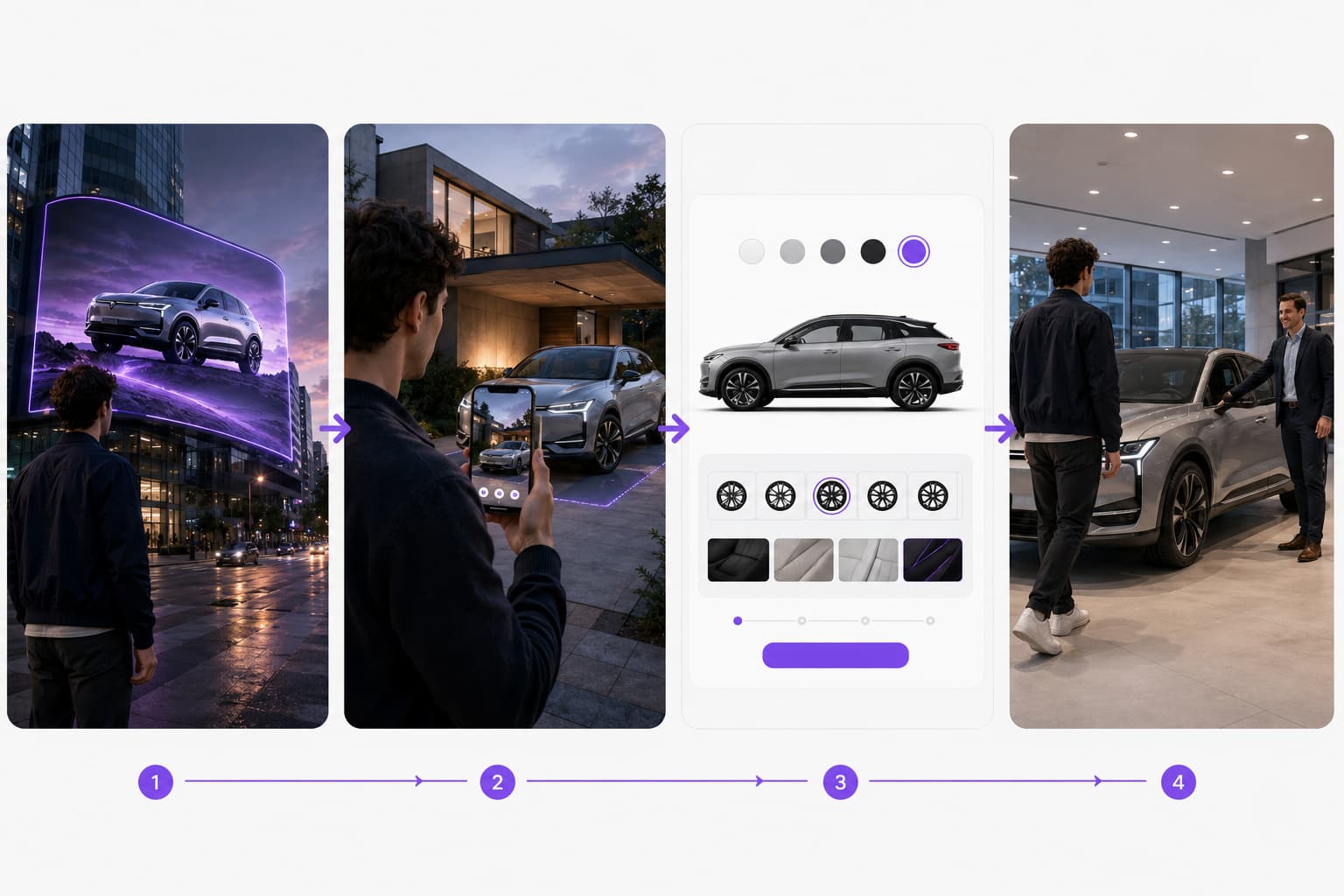
For dealer group Edenauto (via RYM Agency), METASENSE combined a WebGL 3D configurator, a life-size Web AR experience and a viral FOOH campaign around the Kia launch, all serving drive-to-store. The aim: turn online curiosity into a dealership visit.
The setup works in three stages:
- The WebGL 3D configurator lets customers build their vehicle — colours, trims — with premium real-time rendering, straight in the browser.
- Web AR projects the vehicle at full size into the customer's own space, with no app to download: they park the car outside their home before ever going for a test drive.
- The FOOH campaign (Fake Out Of Home, viral CGI advertising) builds the awareness and social conversation that point back to the network.
FOOH is a format in full expansion: 1,872 FOOH videos were produced in 2025, averaging roughly 184,000 views per video (source: fooh.com). Its viral trigger — "is this real?" — makes it a powerful awareness magnet, which is then channelled towards the shops.
The lesson from this campaign: drive-to-store is not a channel, it is a sequence — awareness (FOOH) to desire (life-size AR) to a personalised project (3D configurator) to a test drive and a purchase at the dealership.
How does an in-store installation close the drive-to-store loop?
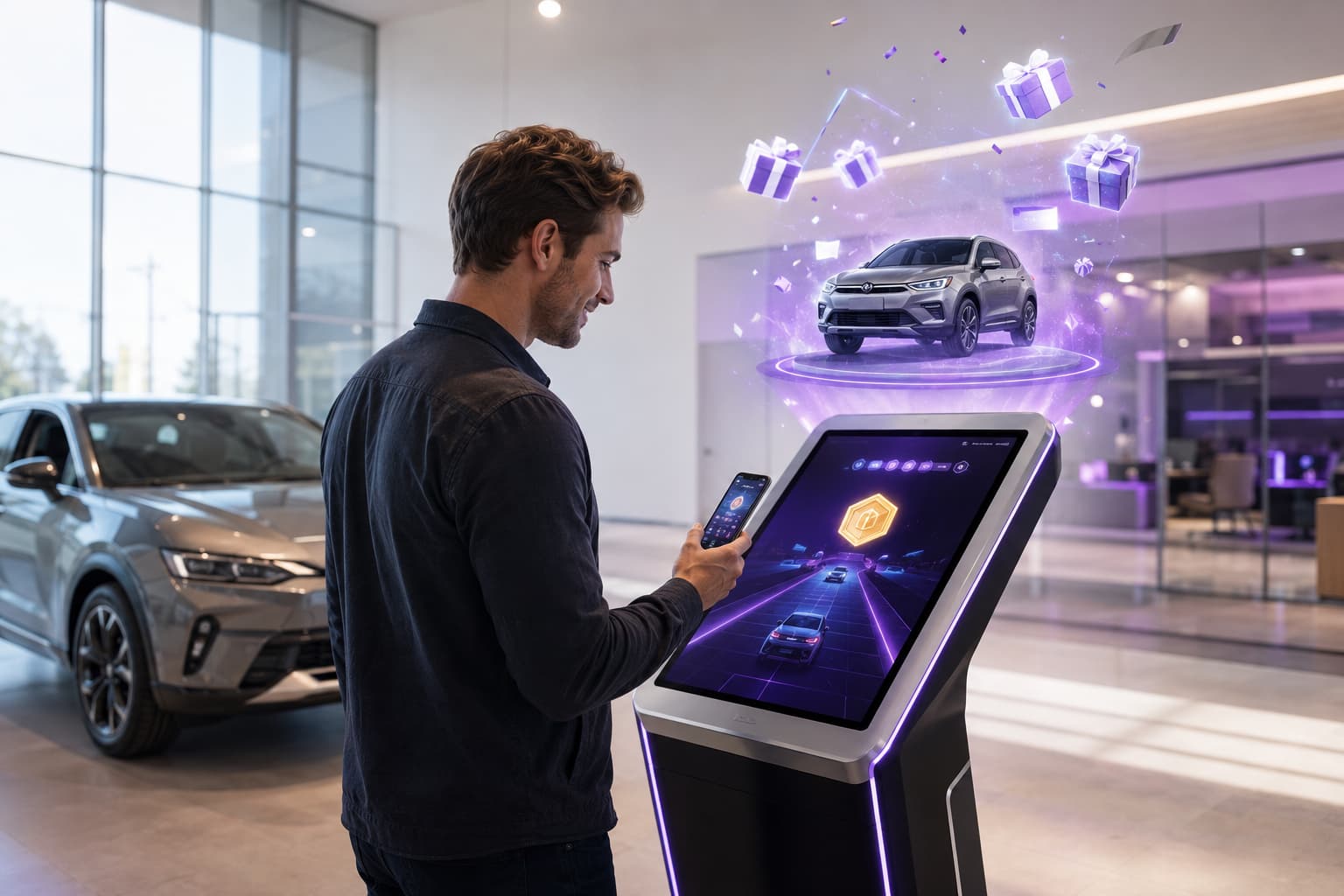
A game installation placed in the shop closes the drive-to-store loop by making the store not the end of the journey but the place where the experience happens: digital brings the visitor in, and the shop offers the moment they cannot get anywhere else. This is drive-to-store in reverse: a concrete reason to walk in, and a usable trace once inside.
The typical mechanism:
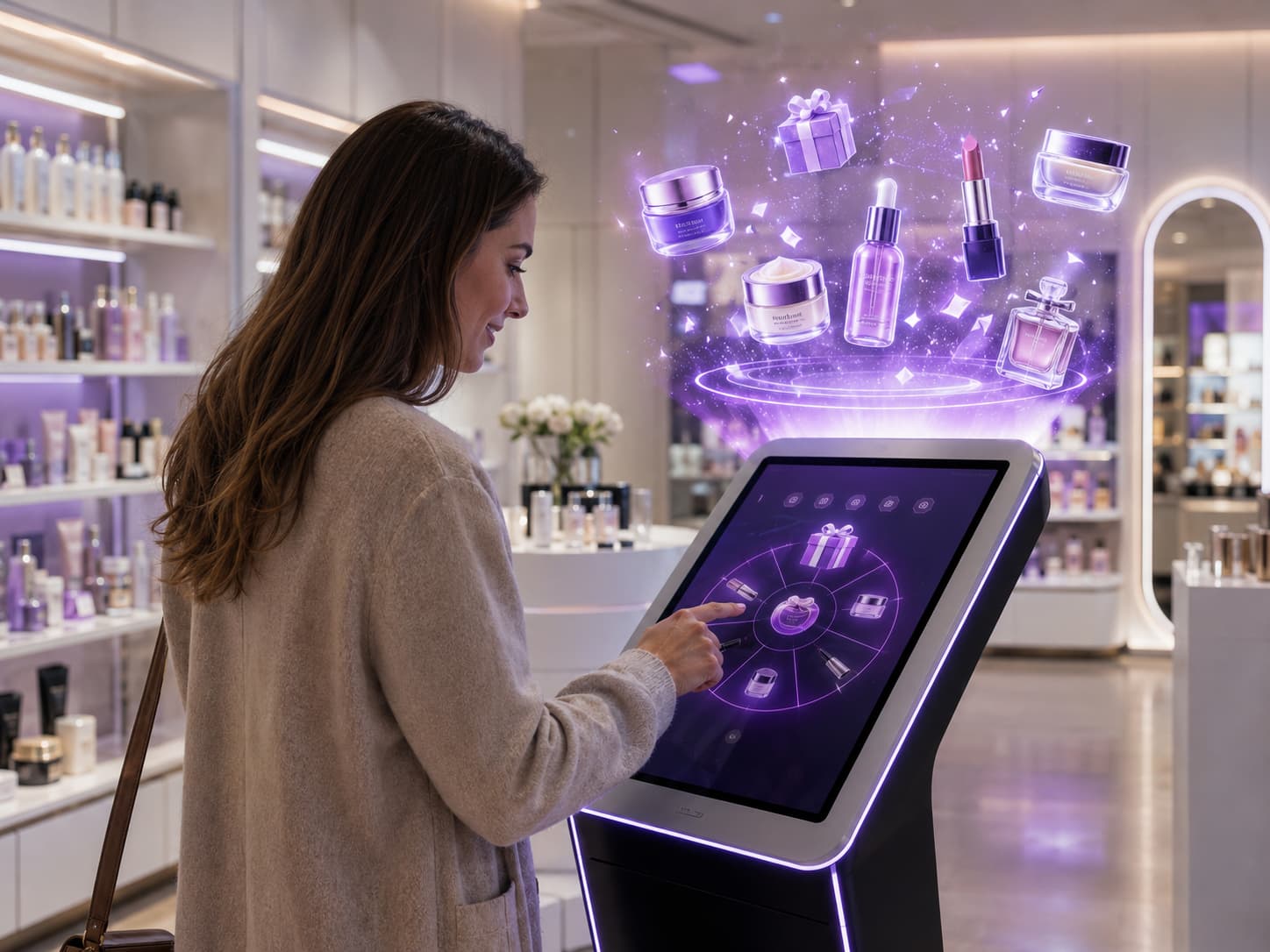
- Each visitor receives a personal code that unlocks an augmented reality game experience on a kiosk installed in the shop;
- Tracking ties each activation to a specific shop, which makes the setup measurable store by store;
- UX/UI continuity between the website, the mobile and the kiosk removes the break that makes people abandon the experience on the doorstep.
This loop pays twice. First, exclusivity: the experience exists only in store, which gives the journey a value no discount can match. Second, attribution: the personal code identifies the shop, the date and the path — where a conventional campaign broadcasts a message without ever knowing what it triggers.
Worth remembering: there are two sides to the same principle. Pull people towards the shop through the online experience — 3D configurator, life-size AR, FOOH; or make the shop the stage for the experience — kiosk, game, reward on site. In both cases 3D and AR are the fuel, and measurement is built in from the start.
How do you measure a drive-to-store campaign, from click to till?
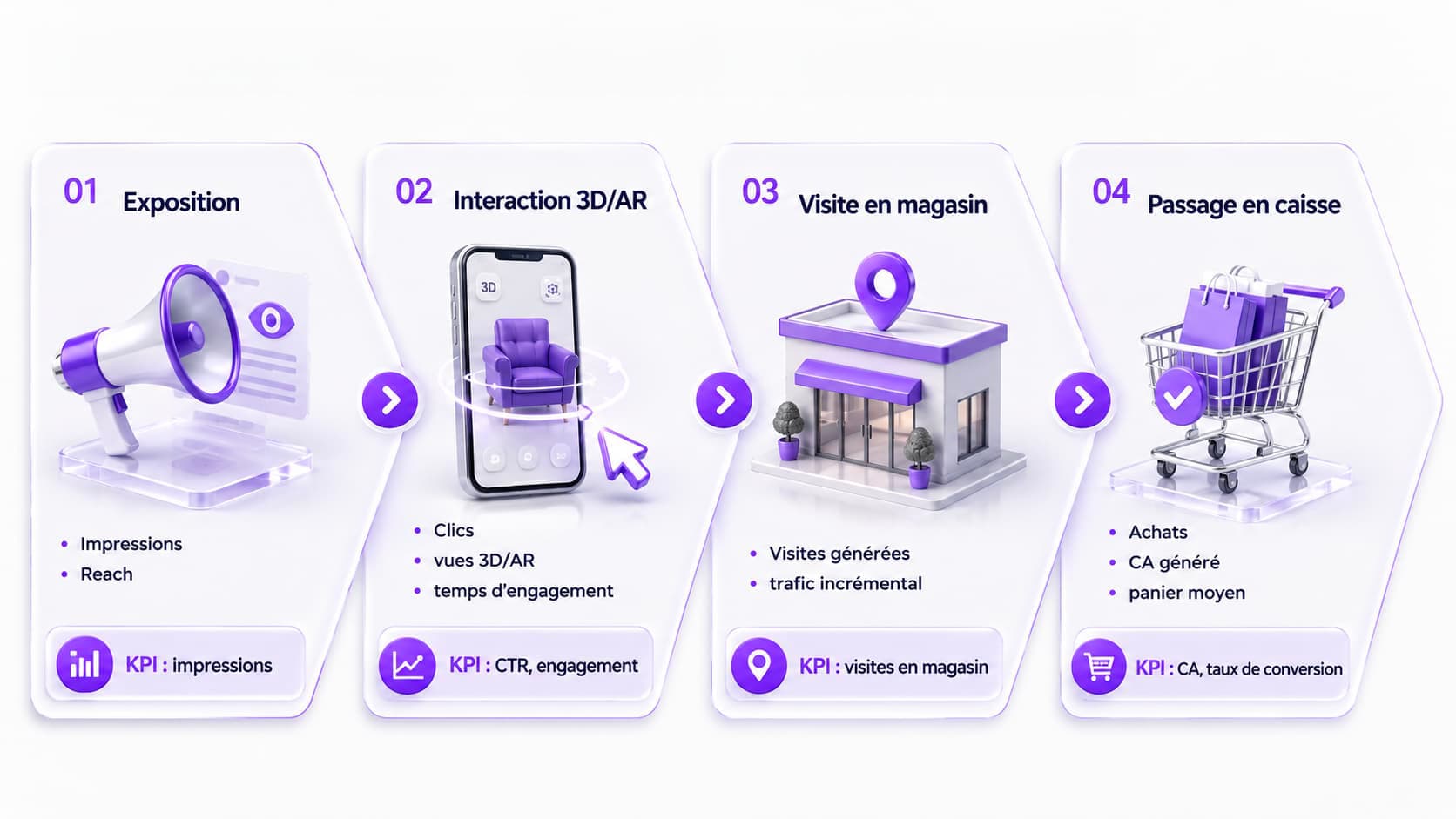
You measure a drive-to-store campaign by connecting every step — exposure, online interaction, visit, purchase — through a traceable identifier, then comparing against unexposed periods or audiences. Without that attribution chain, ROI stays a hunch.
The measurement tools most often used:
- Coupons, e-couponing & QR codes: a unique code issued online and redeemed in store links the click directly to the purchase.
- Store visits: Google Ads and Meta estimate the incremental visits a campaign generates.
- Geolocation, Wi-Fi & Bluetooth: track exposed audiences arriving at the shop.
- CRM & identity: tie the activation (personal code, account) to behaviour across the network — the model behind in-store kiosk installations.
- Before / during / after comparison and test vs. control group: isolate the real effect, the incremental visits.
The key KPIs to follow:
| KPI | What it measures |
|---|---|
| Interaction rate (3D/AR) | Engagement with the online experience |
| Incremental visit rate | Visits attributable to the campaign |
| Cost per store visit | Media efficiency |
| In-store conversion rate | From the journey to the purchase |
| Average basket & ROI | Value generated vs. investment |
The key: instrument from the design stage — codes, events, identity — not afterwards. That is our dual role: we design the experience and its data architecture.
How do you launch a 3D and AR drive-to-store campaign?
Launching a 3D and AR drive-to-store campaign takes six steps, from the business objective to measurement. This is the framework we apply.
- Set the objective and the master KPI. Network footfall, test drives, incremental sales? The KPI shapes everything else.
- Choose the mechanic or mechanics. 3D configurator, AR try-on, FOOH, in-store reward game, geolocation — depending on the product and the journey.
- Design the phygital experience. Script the move from click to shop: where the experience starts, where it ends, what triggers the visit.
- Build measurement in from the design stage. Unique codes, QR, events, CRM and store-visit integration — to connect the click to the till.
- Produce & develop. 3D modelling, Web AR with no download, CGI for the FOOH, CRM and store locator integration.
- Roll out, measure, optimise. Launch across the network, follow the KPIs in real time, and push the levers that perform.
This is precisely METASENSE's scope: we design the mechanic (advisory and creative), we build it (WebGL 3D, Web AR, integrations), and we instrument it so it can be managed. All of it from Vélizy-Villacoublay.
Let's talk about your drive-to-store campaign
You run a store network, a retail brand or a distributed chain, and you want to turn your online audience into measurable footfall? We design and deploy 3D and AR drive-to-store experiences from the idea to the ROI — as we did for dealer group Edenauto around the Kia launch.
Let's talk about your project →
FAQ — Drive-to-store, 3D and augmented reality
What is drive-to-store?
Drive-to-store is the set of marketing actions designed to turn an online interaction into a physical visit to a shop. The goal is not to sell on the internet, but to trigger the journey and then the purchase in store, within an omnichannel approach.
Why use 3D and AR for drive-to-store?
Because they close the gap in digital: seeing, handling and picturing the product. That experience creates the urge to confirm in store. 72% of online shoppers are more likely to buy after seeing a product in augmented reality, and AR cuts product returns by 31%.
What is the ROPO effect?
ROPO stands for Research Online, Purchase Offline: the customer researches online before buying in store. Around 74% of consumers behave this way, and online activity influences 56% of physical sales. Drive-to-store works directly on that effect.
What is a FOOH campaign?
FOOH (Fake Out Of Home) is a fictional advertising display created in hyper-realistic CGI and shared as video on social media. Its "is this real?" effect generates virality and awareness, which is then channelled towards the store network. 1,872 FOOH videos were produced in 2025.
Does Web AR require an app?
No. Web AR runs directly in the smartphone browser, with no download and no installation. The customer scans a QR code or opens a link and immediately sees the product at full size in their own space — a major advantage for mainstream use.
How do you measure the ROI of a drive-to-store campaign?
By connecting every step through a traceable identifier: unique coupons and QR codes, store visits (Google Ads, Meta), geolocation, CRM integration, and comparison against a control group. The key KPIs: incremental visit rate, cost per visit, in-store conversion and average basket.
What is a 3D configurator?
A 3D configurator is a WebGL interface that lets customers personalise a product in real time — colours, finishes, options — with realistic rendering, straight in the browser. It engages the customer, who designs their product, then comes to see or order it in store.
Does drive-to-store apply to every sector?
It is particularly effective for products where physical contact counts: automotive, furniture, home appliances, electronics, fashion, beauty. The ROPO effect is strongest for home appliances (58%), electronics (54%) and clothing (49%).
What is the difference between drive-to-store and e-commerce?
E-commerce aims at the online sale; drive-to-store aims at the sale in a physical shop, triggered by digital. The two are complementary: digital prepares and directs, the shop closes and builds loyalty. That is the logic of phygital retail.
How long does it take to deploy a 3D and AR drive-to-store campaign?
It depends on the mechanic and the size of the network, from a few weeks for a targeted AR experience to a few months for a multi-mechanic setup across a national network. METASENSE prices each engagement individually, once objectives and scope are framed.
Do 3D and AR replace the shop?
No. They prepare it and add to its value. The online experience creates desire and removes doubt; the physical visit remains the destination — to touch, to try and to buy. The best campaigns make the shop the culmination of the digital experience, not its competitor.
Sources
- Research online, purchase offline — Wikipédia (ROPO effect)
- 2025 Augmented Reality in Retail & E-Commerce Research Report — BrandXR
- Réalité augmentée : les clients la réclament — LSA conso
- How to Get Started with FOOH in 2025 — fooh.com
- Mesurer l'impact réel des campagnes drive-to-store — Click2Buy
- Drive-to-Store : définition et enjeux — Solocal