

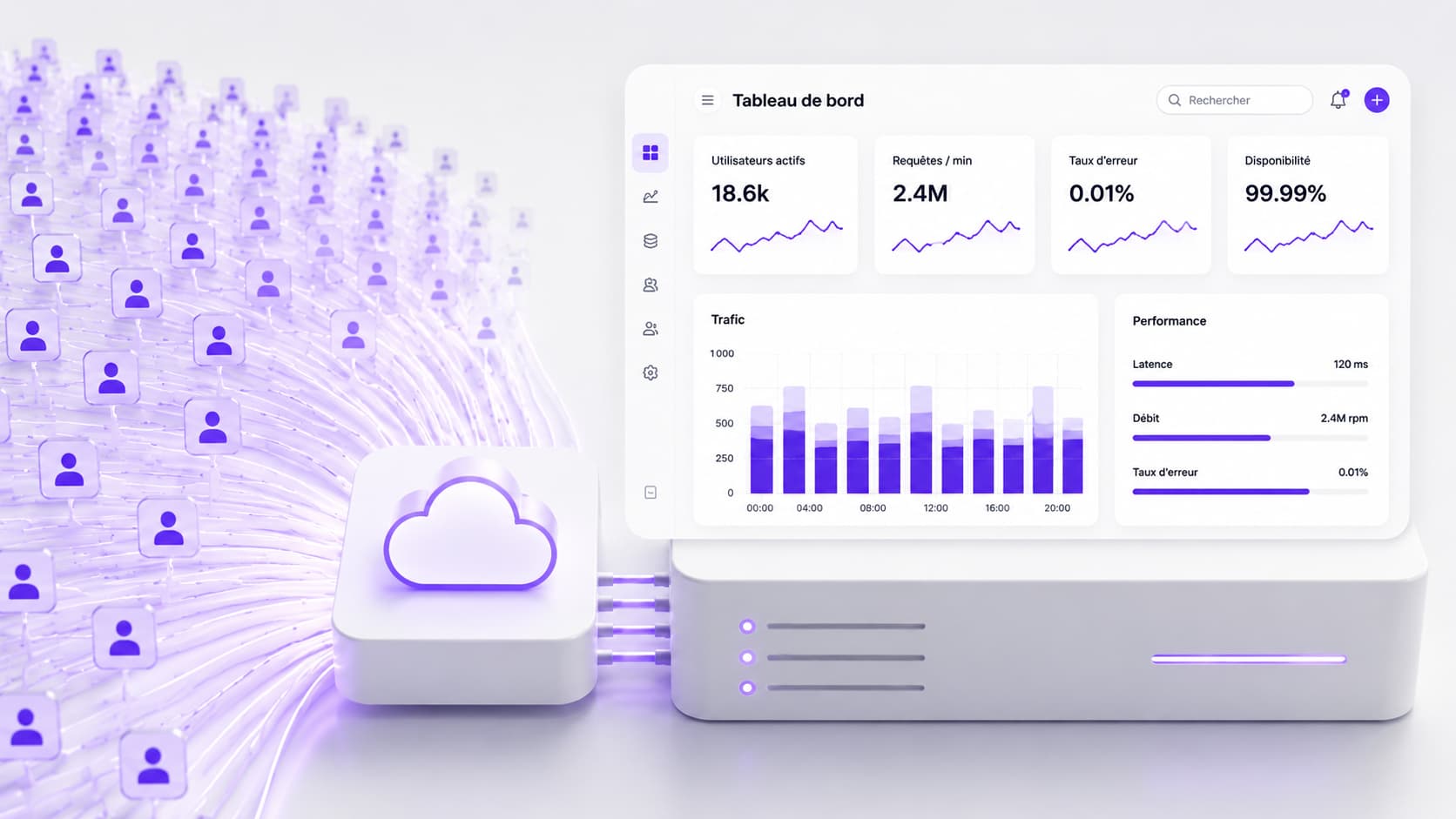
In short. Custom platform development means designing and coding a web application (often a SaaS) that matches your business processes exactly, instead of bending your company to fit standard software. It makes sense when the tool is a competitive advantage, when your workflows are too specific for an off-the-shelf SaaS, or when subscriptions and manual workarounds keep piling up. A successful project rests on four decisions: an honest scoping phase (custom or not), an architecture built to last (multi-tenant, security, API), an MVP that ships fast, and a controlled roadmap. Budget €40,000 to €80,000 for a solid V1, more for a multi-role SaaS (HEXAIT, 2026).
On paper, off-the-shelf software costs less and goes live in days. In practice, many leaders discover the opposite three years later: subscriptions climbing 5 to 15% a year, teams spending their days working around the tool's limits, and a business advantage they cannot industrialise because the SaaS will not allow it. That is when custom platform development becomes a serious question.
This article sets out the decision framework we apply at METASENSE when a leader calls us with that question. No sales pitch: custom is not always the right answer, and we will also tell you when it is not. You will find the criteria to decide, the technical stakes to anticipate, the steps of a successful project, the traps that derail budgets, and sourced price benchmarks.
What is a custom platform (and how does it differ from an off-the-shelf SaaS)?
A custom platform is a web application developed specifically for one organisation's processes, as opposed to standard software that you configure. Where an off-the-shelf SaaS (a CRM, an ERP, a general-purpose management tool) imposes its logic and its fields, a custom platform codes your business logic — including your exceptions, your calculation rules and your branching workflows.
Three objects are often confused:
- The marketing or e-commerce site: it presents your offer or sells products. That is web design and build, covered in our article on building a high-performing website in 2026.
- The business platform or web application: an internal tool (management, steering, production) that structures your activity. Usually single-tenant: one client, one use case.
- The SaaS: a platform designed to be sold to or used by several clients (multi-tenant), with subscription management, roles and data isolation. Technically the most demanding case.
This article covers the last two. If your need is limited to a site that generates leads, heavy custom development is probably not justified — and knowing when no-code (Webflow) is enough and when you need to build is a question in its own right.
When does custom development genuinely make sense?
Custom development makes sense when the tool is part of your value proposition, when your workflows are too specific for market software, or when the hidden cost of SaaS exceeds that of a dedicated build. Conversely, if your needs are close to what the market offers, SaaS remains the right call.
Here are the five signals that, taken together, tip the decision:
- The tool is your secret sauce. If the feature creates a competitive advantage your clients can see, you cannot outsource it to a third-party vendor (BETSOL, build vs buy).
- Your workflows look like a decision tree with an exception on every branch. Standard software slows you down; a custom build codes those exceptions (Lonestone, 2026).
- You twist your processes to make them fit a CRM's fields. Time spent working around the tool is value lost every day.
- You need to connect more than 5 mission-critical systems. Beyond that, SaaS integration limits become blocking (Lonestone, 2026).
- Spreadsheets are getting out of hand. When strategic data lives in files circulating by email, you are ready for a platform.
Worth remembering. A simple framework used by technical leaders: measure the gap between your needs and the best SaaS on the market. Gap < 15%: buy and adapt. Gap > 30%: build. In between, consider a hybrid (a SaaS extended by custom modules). Source: Effect Web Agency.
That is exactly the logic behind ADCO2, the second platform we built for RYM: a SaaS carbon footprint calculator with dashboards and reporting, because no tool on the market measured the footprint of marketing campaigns the way the business required.
Off-the-shelf SaaS or custom platform: the honest comparison
SaaS is cheap to enter and often expensive to use; custom is expensive to start but rarely the costliest over five years. The table below sums up the real trade-offs — beyond the entry price.

| Criterion | Off-the-shelf SaaS | Custom platform / SaaS |
|---|---|---|
| Upfront cost | Low (subscription) | High (development) |
| Five-year cost | Rising (+5 to 15%/year, per seat) | Falling after V1 |
| Time to launch | A few days | Several weeks to a few months |
| Business fit | 70–90% (the rest = workarounds) | 100% (coded for you) |
| Integrations | Limited to the vendor's catalogue | Unlimited (your APIs, your systems) |
| Ownership & lock-in | Dependent on the vendor | You own the code and the data |
| Competitive advantage | Shared (your competitors have it too) | Differentiating, hard to copy |
The point most often ignored: the hidden TCO of SaaS. According to several 2026 analyses, the real total cost of a SaaS reaches 2.5 to 4 times its list price once you add per-seat costs, integrations, manual workarounds and the daily productivity tax. Over five years, subscriptions frequently exceed the cost of a custom build — and that spend never stops (DesignRevision, 2026).
What are the key technical stakes of a custom platform?
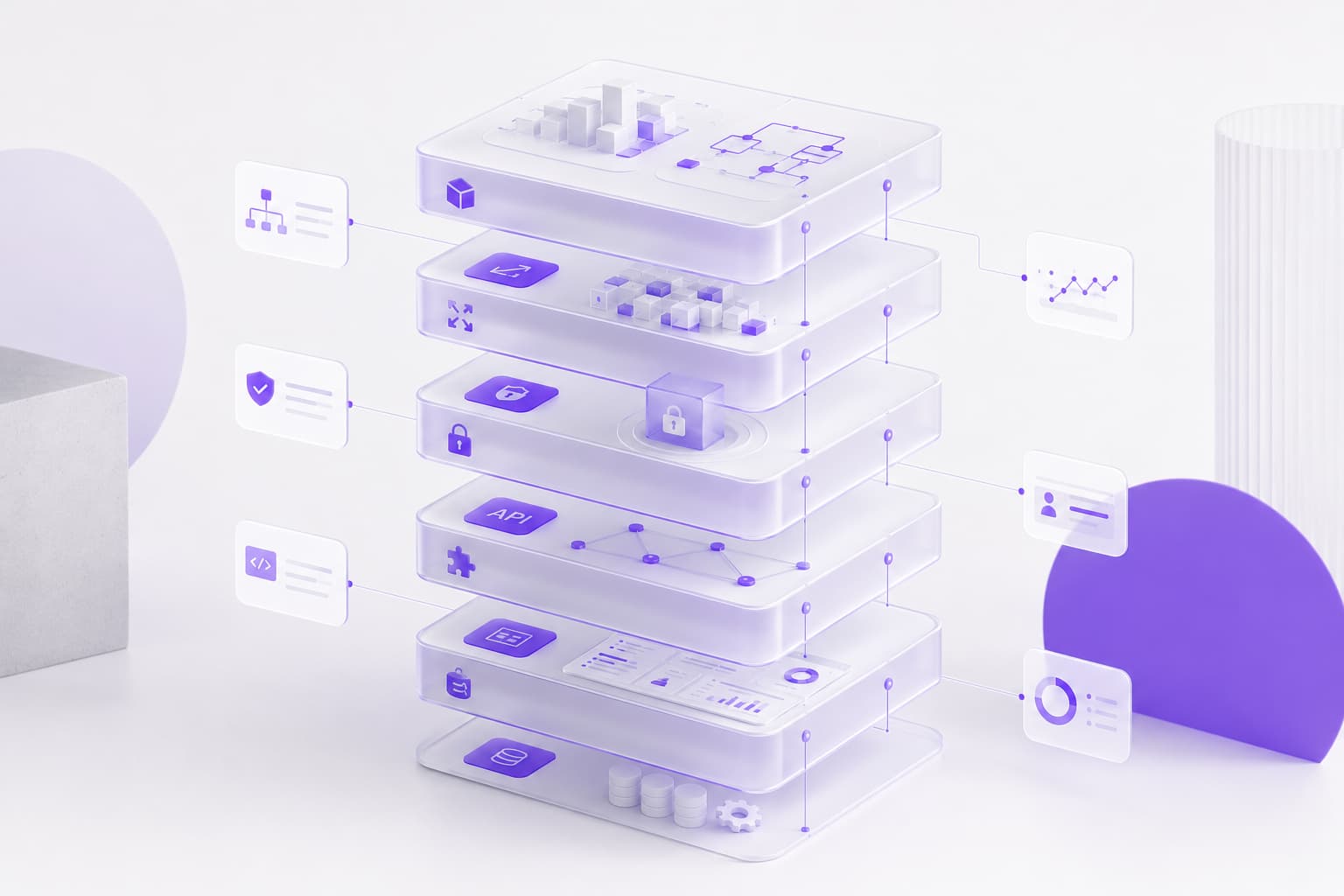
A successful custom platform rests on six technical foundations: architecture, scalability, security, integrations and APIs, UX, and control of technical debt. Underestimate one of them and you are booking an expensive rewrite in 18 months.
Architecture: design multi-tenant from day one
If your platform is meant to serve several clients or entities, you need to design a multi-tenant architecture from the start. The most common — and most expensive — mistake is to start single-tenant, planning to switch later. Refactoring a single-tenant codebase into a multi-tenant one usually amounts to a partial rewrite, because data separation runs through everything: models, queries, authentication middleware, cache (HEXAIT, 2026).
Scalability: absorbing load without blowing up costs
A well-designed architecture must absorb growth without multiplying the infrastructure bill. A poorly designed multi-instance approach can multiply costs by 3 to 5, whereas a well-managed multi-tenant setup keeps operational maintenance to around 10% of development time (HEXAIT, 2026). We know this stake first-hand: the 3D web app we built for Nîmes-la-Romaine (in partnership with Aura, formerly EDEIS) held thousands of simultaneous connections at peak visiting times.
Security and GDPR compliance
For any platform handling sensitive data, security is not added afterwards: it is designed into the architecture (privacy by design). That is the approach we applied to MyLoot, a legaltech SaaS platform for estate transmission: strict data isolation and GDPR compliance built into the model, not bolted on.
Integrations and the API
A business platform rarely lives alone: it talks to your CRM, your ERP, your billing tools, your data. A well-designed API is what turns an isolated tool into the backbone of your systems. It is also what spares you the integration ceiling of off-the-shelf SaaS.
UX: adoption decides the ROI
A business platform that teams do not adopt returns nothing. Usability, speed of learning and fluidity are not comfort: they are the adoption levers that determine the project's ROI.
Technical debt: the cost of rushing
Technical debt is the set of shortcuts taken to ship fast that you pay back later in slower development. Deferring architecture decisions until after the MVP is the classic cause: schema migrations that took minutes end up blocking deployments for hours (HEXAIT, 2026).
What are the steps to build a custom platform?
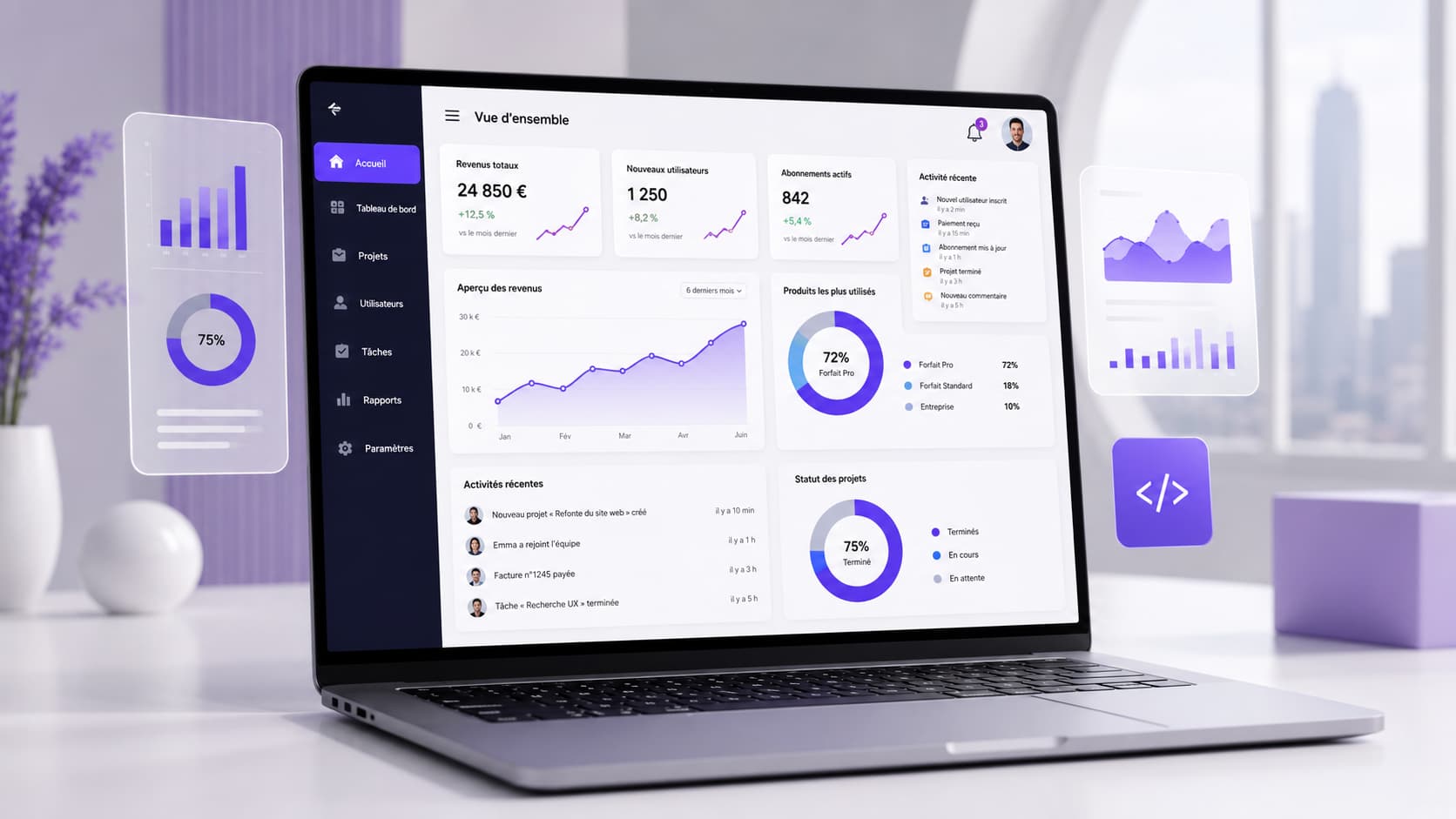
A custom platform project runs in five steps: scoping, architecture, MVP, iterations and evolution. The method is agile — short cycles, frequent user feedback — but the foundations (architecture, security) are laid at the start.
- Scoping and needs validation. We clarify the business problem, test the needs against the market (build vs buy), define the V1 scope and the success metrics. This is where we decide whether custom is justified.
- Architecture and specifications. Stack choice, data model, multi-tenant strategy, security, API integration plan, roadmap. The structural decisions are taken now — not later.
- MVP (minimum viable product). We ship a reduced but real version quickly, in production, to validate the value with real users before investing in the full scope.
- Iterations. Short cycles, frequent feedback, CI/CD. We grow the platform in measurable increments rather than through a risky big bang.
- Rollout and evolution. QA, performance tuning, go-live, team training, then continuous maintenance and scalability.
Worth remembering. An MVP is not a cut-price version. It is a risk-reduction tool: it puts your value hypothesis in the hands of real users as early as possible, before you commit the bulk of the budget. But be careful — an MVP is no licence to defer structural architecture decisions (multi-tenant, security).
That discipline — solid foundations plus fast delivery — is the heart of the METASENSE dual role: we design the strategy and the product, and we build it in-house. To understand how the collaboration works on the client side, see our article on how to run a successful web project with a development agency.
How much does custom platform development cost in 2026?
In 2026, a solid V1 of a custom SaaS sits between €40,000 and €80,000, and a complex SaaS (multi-role, advanced billing, many integrations) goes beyond €80,000. These ranges are market benchmarks; the real price depends on scope.
| Project type | 2026 market range | Source |
|---|---|---|
| Simple web application (scoped MVP) | €5,000 – €15,000 | HEXAIT |
| Complex web application | €30,000 – €50,000 + | HEXAIT |
| Custom SaaS — production V1 | €40,000 – €80,000 | HEXAIT |
| Complex SaaS (multi-role, billing, integrations) | €80,000 and up | HEXAIT |
Costs vary with day rates: a senior developer bills €500 to €900 excl. VAT per day in France, and Paris agencies between €600 and €1,200 excl. VAT per day depending on their positioning (HEXAIT, 2026).
At METASENSE, we do not publish a rate card: every platform has its own scope, security constraints and integrations, so we price each engagement individually. The right reflex is not to compare entry prices, but to think in total cost over five years — where custom, as we have seen, is rarely the most expensive.
What traps should you avoid in a custom platform project?
Projects derail for almost always the same reasons: deferred architecture, creeping scope, a supplier chosen on price, and confusion between an MVP and a rushed product. Anticipating them is most of the scoping work.
- Deferring architecture decisions (multi-tenant, security, data model) to move faster. This is the leading cause of expensive rewrites.
- Scope creep. A scope that widens mid-project blows up budget and timeline. A scoped MVP protects against it.
- Choosing the cheapest supplier. A badly architected platform costs more to repair than to build. Technical skill has a price — and it can be checked against real work in production.
- Confusing an MVP with a cut-price product. An MVP reduces scope, not the quality of the foundations.
- Neglecting adoption. A platform delivered without support or careful UX will not be used — and will return nothing.
- Forgetting scalability. Year one needs are not year three needs: plan for evolution from the architecture stage.
Why entrust your custom platform to METASENSE?
METASENSE is a Creative Tech agency based in Vélizy-Villacoublay that brings together what the market separates: advisory and creative work and the technical expertise to design, build and grow your platform — from idea to rollout. Our platform stack is built on Nuxt.js, Vue.js, Vercel, headless CMSs and Supabase, with an agile, milestone-based method.

Our proof on this ground is concrete:
- The RYM platform (Story) — a custom-built SaaS for steering marketing operations, generating recurring revenue.
- ADCO2 — a second SaaS platform for RYM: a carbon footprint calculator for campaigns, with dashboards and reporting.
- MyLoot — a legaltech SaaS platform for estate transmission, designed privacy by design and GDPR compliant.
- Nîmes-la-Romaine (Aura, formerly EDEIS) — a web app that held thousands of simultaneous connections.
Let's talk about your platform project
Are you weighing an off-the-shelf SaaS against a custom build, or do you already know your business deserves its own platform? The first step is honest scoping. Let's talk about your project: we will tell you frankly whether custom is the right answer — and how to build it so that it lasts.
FAQ — Custom platform development
What is a custom platform?
A custom platform is a web application developed specifically for one company's processes, rather than standard software that you configure. It codes your exact business logic — your workflows, your rules, your exceptions — and you own the code and the data.
What is the difference between a custom SaaS and an off-the-shelf SaaS?
An off-the-shelf SaaS is shared software that you rent and configure: it imposes its logic. A custom SaaS is built for your own needs; it fits your business 100%, integrates with your systems without a ceiling, and creates a competitive advantage that is hard to copy.
When should you build custom software rather than buy a SaaS?
When the tool is part of your value proposition, when your workflows are too specific for the market, when you need to connect more than five critical systems, or when the hidden costs of subscriptions and workarounds exceed those of a dedicated build. Simple rule: a gap above 30% with the market means you build.
How much does a custom web platform cost in 2026?
In 2026, a solid V1 of a custom SaaS sits between €40,000 and €80,000, a complex SaaS goes beyond €80,000, and a simple scoped web application starts at around €5,000 to €15,000 (HEXAIT). The real price depends on scope and is quoted case by case.
What is a multi-tenant architecture and why does it matter?
Multi-tenant is an architecture where a single software instance serves several clients while keeping their data isolated. It is critical for a SaaS: designing it from the start avoids an expensive rewrite, because refactoring a single-tenant base into a multi-tenant one often means rebuilding part of the code.
What is an MVP and why start there?
An MVP (minimum viable product) is a first version, reduced but real, put into production to validate the value with real users before investing in the full scope. It is a risk-reduction tool — but it is no licence to defer structural architecture decisions.
How long does it take to build a business platform?
A simple application can ship in a few weeks; a custom SaaS V1 is usually counted in months. The duration depends on scope, the number of integrations and security requirements. An agile method lets you ship an MVP quickly, then grow it through iterations.
What is technical debt and how do you avoid it?
Technical debt refers to the shortcuts taken to ship fast that slow down future development. You limit it by taking the right architecture decisions from the start (data model, multi-tenant, security) rather than after the MVP, and through regular code reviews and testing.
Can no-code (Webflow, Bubble) replace custom development?
For a marketing site or a very simple MVP, no-code can be enough and costs less. But as soon as the business logic gets complex, or scalability, security or deep integrations come into play, custom takes back the advantage. See our comparison, Webflow or WordPress in 2026.
Is custom really cheaper than SaaS in the long run?
Often, yes. SaaS is cheap to enter but its real total cost reaches 2.5 to 4 times the list price and grows every year. Custom costs more upfront, but its cost curve falls after V1 — over five years it rarely exceeds the cumulative subscriptions (DesignRevision, 2026).
Do we own the code of a custom-built platform?
Yes. It is one of the main advantages of building custom: you own the source code and your data, with no dependency on a third-party vendor that could raise its prices, change its terms or disappear. The exact terms are set contractually before the project starts.
How do you choose the agency or supplier for your platform?
Check for real platforms in production (not just marketing sites), command of architecture and security, the ability to advise objectively (including advising against a custom build), and the way they work with you. See running a successful web project with a development agency.
Sources
- HEXAIT — Combien coûte un développement web sur mesure en 2026
- HEXAIT — Architecture multi-tenant pour SaaS, le guide technique 2026
- Lonestone — Développement sur mesure : le guide complet 2026
- BETSOL — The Enterprise Build vs. Buy Decision Framework for Software
- Effect Web Agency — Build vs Buy: A Decision Framework for Custom Web Applications
- DesignRevision — Custom SaaS Development: Build vs Buy Analysis 2026