


To get cited by ChatGPT and other AI engines in 2026, your content has to be understandable, extractable and trustworthy for answer engines — that is the job of AEO (Answer Engine Optimization) and GEO (Generative Engine Optimization). In practice: answer the question straight away at the top of every page, structure the content into question headings, lists, tables and self-contained definitions, add structured data (schema.org), cite verifiable sources, build your authority (E-E-A-T) and keep your entity consistent across the whole web. Classic SEO is not going away, but it is no longer enough: a growing share of searches now ends without a click, inside a generated answer. The goal is no longer only to rank well — it is to be the answer the AI cites. Here is what AEO and GEO cover, which KPIs change, and the concrete method to make a site quotable.
In short — what matters in AEO/GEO in 2026
- AEO = optimising to be the direct answer of an answer engine (ChatGPT, Perplexity, Google AI Overviews).
- GEO = optimising to be understood, cited and recommended by generative AI.
- Neither replaces SEO: they sit on top of it. Clean HTML and indexation remain the foundation.
- The KPI shifts: from traffic and rankings to Share of Answers (the share of AI answers where the brand is cited), mention frequency and actual conversions.
- What works: answer-first writing, extractable structure, structured data, consistent entities, E-E-A-T, freshness, multi-format.
- In 2026, 68% of Google searches end without a click (SparkToro) — the answer is increasingly consumed inside the engine.
Why is ranking on Google no longer enough in 2026?
Ranking on Google is no longer enough because a growing share of searches produces no click at all: the answer is read inside the engine. According to SparkToro, over the first months of 2026, around 68% of Google searches end without a click to a website — the answer is consumed on the spot, in a snippet, an AI Overview or an AI conversation. Google AI Overviews now appears on more than 20% of searches, and when it does, it cuts the click-through rate by roughly 60% (Search Engine Land).
At the same time, people are asking their questions elsewhere. ChatGPT has several hundred million weekly users, and Gartner expects a drop of around 25% in traditional search volume by 2026 in favour of chatbots and AI agents (cited by Frase). The query itself is changing shape: a question asked to ChatGPT runs to about twenty words on average, against a handful on Google (HubSpot). People no longer type keywords — they state a complete need, and expect a synthesised answer rather than a list of links.
The consequence is simple: if your content is not understood, extracted and cited by these engines, you can rank first on Google and still be invisible in the answer your prospect actually reads. SEO remains necessary — you have to be indexable and credible — but it is now insufficient. That is exactly what AEO and GEO address.

What is AEO (Answer Engine Optimization)?
AEO (Answer Engine Optimization) is the practice of optimising content so it becomes the direct answer displayed by an answer engine — ChatGPT, Perplexity, Google AI Overviews, Gemini or a voice assistant. Where SEO targets a position in a list of links, AEO targets the answer itself: the definition that gets quoted, the table that gets cited, the step that gets extracted, the sourced statistic.
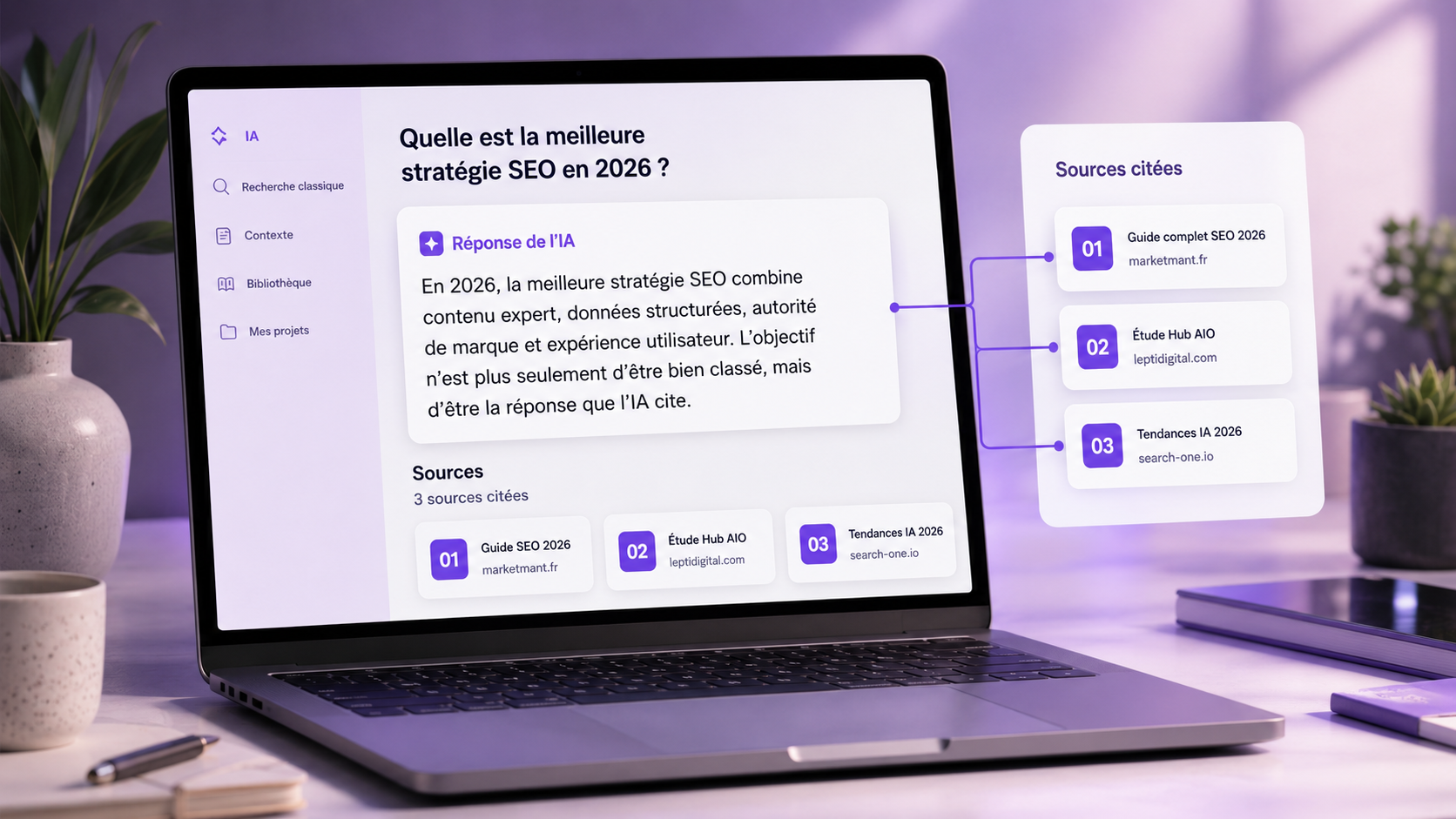
Concretely, AEO works on the answer layer: it makes sure your page contains self-contained blocks — a complete definition, a numbered list, a 40 to 60-word answer — that an engine can lift without having to rebuild the meaning. It is the craft of writing for the machine that answers as much as for the human who reads.
What is GEO (Generative Engine Optimization)?
GEO (Generative Engine Optimization) is the practice of optimising content and a brand to be understood, cited and recommended by generative AI that writes an answer from several sources. Where AEO focuses on the extracted answer, GEO widens the scope: it covers how the AI represents your entity based on every trace you leave on the web — your site, but also press coverage, directories, LinkedIn, forums and third-party citations.
A landmark study — the GEO research from Princeton and the Allen Institute for AI (Aggarwal et al., presented at ACM KDD 2024) — tested nine optimisation methods across 10,000 queries. The result: adding statistics, quotations and verifiable sources can lift a piece of content's visibility in generative answers by roughly 30 to 40%. In other words, evidence density is not an editorial nicety: it is a measured driver of AI citation.
In practice, AEO and GEO overlap heavily and are often used together. Keep the distinction in mind: AEO optimises the answer, GEO optimises how the AI perceives your brand. Both aim at the same outcome — being cited.
What is the difference between SEO, AEO and GEO?
The difference lies in the target and the outcome: SEO aims at a ranking in a list of links, AEO at an extracted answer, GEO at a citation inside generated text. They are not in competition: AEO and GEO do not replace SEO, they stack on top of it. An indexable, fast, credible page (SEO) remains the foundation; AEO and GEO make it quotable.
The right reflex in 2026 is not to choose but to stack: a technically sound site (SEO), structured for the answer (AEO), and consistent as an entity across the whole web (GEO).
How do you get cited by ChatGPT and other AI engines? (the method)
To get cited by ChatGPT and other AI engines, make every page easy to understand, to extract and to verify. Here are the seven concrete drivers, in order of impact, to become quotable.

- Answer first. Give the direct answer in the opening paragraph of the page and at the top of every section. AI lifts the blocks that answer without detour; content that circles the question before answering never gets extracted.
- Structure for extraction. Headings phrased as questions (aligned with People Also Ask), lists, comparison tables, numbered steps and self-contained definitions ("X is…") that stand on their own. A clean, sequential heading structure sharply increases the odds of being cited.
- Add structured data. Schema.org markup (
Article,FAQPage,HowTo,Organization,Person) and clean semantic HTML help the machine understand what each block is. That is what turns a paragraph into an identifiable answer. - Cover the entity field and stay consistent. Treat a subject in full — all its sub-questions, all its related concepts — and keep your entity consistent: same name, same location, same expertise, on your site and everywhere else (directories, LinkedIn, press). AI builds its picture of your brand from the sum of your mentions.
- Prove your authority (E-E-A-T). Experience, expertise, authoritativeness, trustworthiness: a named author, verifiable figures, cited sources, real cases. The Princeton GEO research shows that evidence density — statistics, quotations, sources — markedly raises the probability of being cited.
- Stay fresh. A page updated regularly, with a visible date and recent data, is judged more reliable and more quotable than static content. Freshness is a direct signal for answer engines.
- Think multi-format. AI also cites video and audio: clean transcripts, chapter markers and structured data on media widen your chances of being the source that gets picked up.
None of these is a hack. They are principles of clear, structured, evidenced content — precisely what answer engines reward. The good news: what makes content quotable by AI also makes it more useful to the human reader.
Which KPIs should you track: what is Share of Answers?
Share of Answers is the proportion of AI answers, across a given set of queries, in which your brand is cited or mentioned. It is the new central KPI: you no longer measure only a position or a traffic volume, but how often the AI names you as a source. Alongside Share of Answers, three indicators are gaining ground:
- Citations and mentions: how often, and in what context, your brand appears in answers from ChatGPT, Perplexity or Gemini.
- AI share of voice: your presence in answers relative to your competitors, across a consistent set of prompts.
- Actual conversions: AI traffic is often smaller but better qualified — the decision forms before the click. So you look at leads and sales, not impressions.
To measure all of this, a new generation of AEO/GEO tracking tools queries the main engines at regular intervals and compiles your citations, mentions and share of voice over time. HubSpot, for instance, offers a free AEO Grader that tests how ChatGPT, Perplexity and Gemini describe your brand, plus a week-by-week tracking dashboard. The principle is always the same: define a set of prompts representative of your topics, then track how your citations evolve.
Is SEO dead because of AI?
No, SEO is not dead: it becomes the foundation of AEO and GEO. A page invisible to Google is usually invisible to AI too, since these engines lean in part on the existing index and search signals. Clean HTML, speed, indexability, content quality and domain authority all remain decisive.
What changes is the end goal. Yesterday: rank in order to earn a click. Today: rank and be structured well enough to become the cited answer. The three disciplines form a continuum — and that is exactly what HubSpot and most specialists recommend in 2026: unify SEO and AEO into a single visibility strategy rather than setting them against each other.
Key takeaways
- AEO and GEO do not replace SEO: they add to it. Keep a sound technical foundation.
- The KPI shifts from traffic and rankings to Share of Answers and actual conversions.
- The winning drivers: answer-first writing, extractable structure, structured data, consistent entities, E-E-A-T, freshness, multi-format.
- What makes content quotable by AI also makes it better for the human reader.
How METASENSE builds sites and content that AI engines cite
At METASENSE, AEO and GEO are not theory: we apply them to our own content production. The article you are reading is answer-first, structured into question headings, with self-contained definitions, an FAQ, verifiable sources and structured data (schema.org) — exactly the method described above. We apply to ourselves what we design for our clients.
This skill is a natural extension of our dual role: strategy and creative on one side, in-house technical expertise on the other — from idea to deployment. Building a site that AI engines cite means combining the two: an editorial architecture designed for the answer (answer-first, entities, FAQ) and a clean technical implementation (semantic HTML, schema.org, performance, freshness). It is the same know-how that lets us ship fast, well-structured sites — such as Gourand's first website, built on Webflow and delivered in under two weeks, or the CPX Group corporate site, delivered in 72 hours on a modern stack (Nuxt + Vercel + headless CMS).
To go further on the method behind a site that performs in 2026, read Building a website in 2026: a high-performing site that generates leads. And to place the budget of a custom-built project, see How much does a custom website cost in 2026?.
Where to start: the roadmap to make a site quotable
Here is a seven-step roadmap to make a site quotable by AI engines — to be run in this order.
- Audit your current AI visibility. Ask ChatGPT, Perplexity and Gemini the key questions of your market: are you cited? How do they describe you?
- Check the SEO foundation. Indexability, speed, semantic HTML, authority: without a sound base, no citation.
- Rewrite answer-first. A direct answer at the top of the page and of each section; headings phrased as questions, aligned with People Also Ask.
- Structure for extraction. Self-contained definitions, lists, tables, steps, and an FAQ for each key topic.
- Add structured data.
Article,FAQPage,OrganizationandPersonschema; entity consistency everywhere (name, location, expertise). - Strengthen authority. A named author, sourced figures, verifiable quotations, external mentions (press, LinkedIn, directories).
- Measure and maintain. Track your Share of Answers and your citations, and refresh key pages regularly.
Let's make your site quotable by AI
Being cited by AI is not a box to tick: it is a way of designing the site and the content, from the technical foundation to the editorial architecture. METASENSE is a Creative Tech agency based in Vélizy-Villacoublay that designs AND builds — from advisory through to deployment — sites made to rank well and be cited in AI answers. Rather than a generic recipe, we frame your case in a single meeting: AI visibility audit, AEO/GEO priorities, action plan.
Explore our web development & design expertise · Request an AI visibility audit
FAQ — AEO, GEO and getting cited by AI
What is AEO (Answer Engine Optimization)?
AEO is the practice of optimising content so it becomes the direct answer displayed by an answer engine such as ChatGPT, Perplexity or Google AI Overviews. Instead of targeting a position in a list of links, AEO targets the answer itself: the definition, table or step the AI extracts and quotes.
What is GEO (Generative Engine Optimization)?
GEO is the practice of optimising content and a brand to be understood, cited and recommended by generative AI. It covers how the AI represents your entity based on every trace you leave on the web: your site, but also press coverage, directories, LinkedIn and third-party citations.
What is the difference between AEO, GEO and SEO?
SEO aims at a strong ranking in a list of links, AEO at a direct extracted answer, GEO at a citation inside AI-generated text. They are not in competition: AEO and GEO do not replace SEO, they stack on top of a sound technical foundation.
How do you get cited by ChatGPT?
To get cited by ChatGPT, answer the question straight away at the top of every page, structure the content into question headings, lists, tables and self-contained definitions, add structured data (schema.org), cite verifiable sources, and build your authority and entity consistency across the whole web.
Is SEO dead because of AI?
No, SEO is not dead: it becomes the foundation of AEO and GEO. A page invisible to Google is usually invisible to AI too. Clean HTML, speed, indexability and authority remain decisive. What changes is the goal: you also have to be structured well enough to become the cited answer.
How do you measure your visibility in AI engines?
You track Share of Answers: the proportion of AI answers where your brand is cited, plus mentions, share of voice against competitors, and actual conversions. AEO/GEO tracking tools, such as HubSpot's free AEO Grader, query ChatGPT, Perplexity and Gemini at regular intervals to measure those citations over time.
What is Share of Answers?
Share of Answers is the proportion of AI answers, across a given set of queries, in which your brand is cited or mentioned. It is the central AEO/GEO KPI: you no longer measure only a position or traffic, but how often the AI names you as a reliable source.
Is structured data essential for AEO?
It is not strictly mandatory, but it is strongly recommended. Schema.org markup (Article, FAQPage, HowTo, Organization, Person) and clean semantic HTML help engines understand what each block is and identify it as a quotable answer. It is one of the easiest drivers to activate.
How long does it take to see results in AEO/GEO?
Expect several weeks to a few months: answer engines reindex and reassess content gradually, and entity consistency across the web takes time to settle. Well-structured, fresh, answer-first pages get cited faster than long, vague content.
Which answer engines should you prioritise?
Target the ones your audience actually uses: ChatGPT and Google AI Overviews for the widest reach, Perplexity for source-backed research, Gemini and Claude depending on your audiences. The good news: one answer-first, structured and sourced method serves all of them at once.
Does content freshness matter for getting cited?
Yes. A page updated regularly, with a visible date and recent data, is judged more reliable and more quotable than static content. Refreshing your key pages periodically — figures, examples, sources — is one of the most cost-effective ways to keep and win AI citations.
Can METASENSE make my site quotable by AI?
Yes. METASENSE is a Creative Tech agency based in Vélizy-Villacoublay that designs and builds sites and content with AEO/GEO in mind: answer-first architecture, extractable structure, structured data, entity consistency and a high-performing technical foundation. We apply this method to our own content before deploying it for our clients.
Sources
- SparkToro — In 2026, Less than One Third of Google Searches Still Send a Click
- Search Engine Land — Google zero-click searches reach 68% in early 2026
- HubSpot — Answer engine optimization trends in 2026
- HubSpot — Answer engine visibility: The playbook for marketers
- Princeton / Allen Institute for AI (Aggarwal et al., KDD 2024) — GEO: Generative Engine Optimization
- Frase — Answer Engine Optimization: Complete AEO Guide 2026
- CXL — Answer Engine Optimization (AEO): The comprehensive guide
- Google Search Central — AI features and your website